How CalmStack connects learning and practice
Understanding an emotional regulation idea and remembering to use it during a difficult moment are two different problems. CalmStack is designed to connect short learning with noticing, brief practice and reflection in everyday life.
Published 4 September 2026 · Last evidence review 4 September 2026 · OASYS Editorial
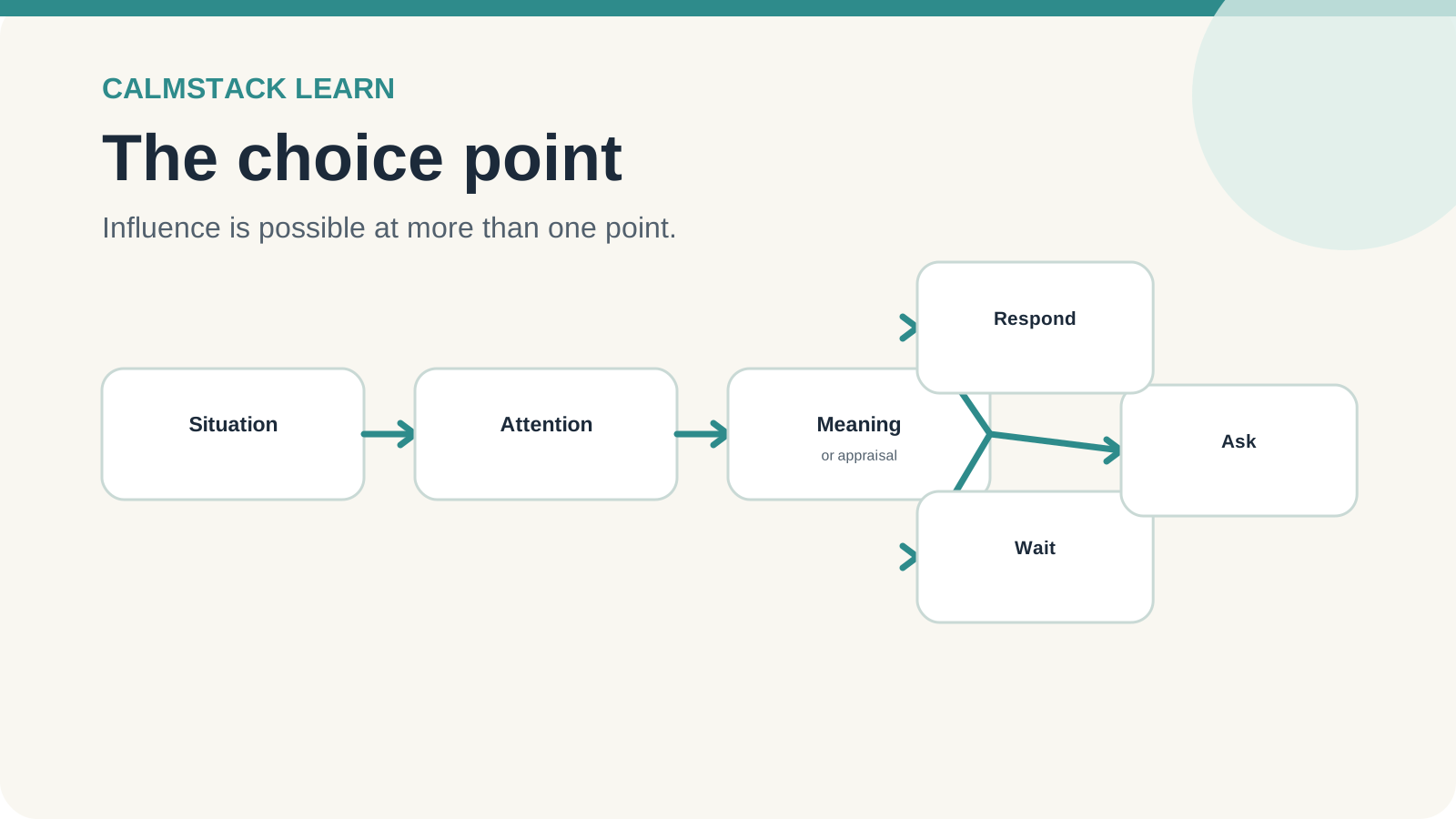
You can understand emotional regulation perfectly at eight o’clock in the evening.
You read something useful.
It makes sense.
You even think:
“I should remember that.”
Then 10:17 the following morning arrives.
Somebody says something irritating.
Your attention narrows.
You make an assumption about what they meant.
You feel the urge to respond.
And the excellent psychological insight from last night is nowhere to be found.
It has not vanished from your memory.
You still know it.
You just did not use it.
That gap is one of the problems CalmStack is designed around.
Knowing what a useful response is and remembering that you can use it are different problems.
Learning something is not the same as using it
Education often happens under unusually favourable conditions.
You are sitting down.
You have chosen to read.
Nobody is demanding an immediate answer.
You can stop and reread a paragraph.
Real emotional situations are less considerate.
They happen during meetings.
On trains.
At home.
Halfway through another task.
When you are tired.
When somebody wants an answer now.
Articles 1 to 9 have already shown why that matters.
Emotion regulation depends partly on context.
Strong emotion can make some forms of flexible thinking harder.
Previous demands can affect the state in which the next event arrives.
And reactions can begin developing before we have deliberately thought through what is happening.
So there is a practical problem.
Learning can give you useful ideas.
But the moment in which you need those ideas may look nothing like the moment in which you learned them.
Psychology has studied this gap for a long time
This problem is not unique to emotional regulation.
People regularly intend to do things and then fail to do them.
Exercise.
Take medication.
Have a difficult conversation.
Use a coping strategy.
Complete an important task.
Remembering what you intended to do at the right moment is part of the challenge.
One body of research looks at implementation intentions.
An implementation intention links a situation with a planned response.
In its familiar form:
If this happens, then I will do this.
A large 2024 meta analysis by Paschal Sheeran, Olivia Listrom and Peter Gollwitzer examined 642 independent tests of implementation intentions.
Across cognitive, emotional and behavioural outcomes, forming these plans was associated with improved outcomes.
The effects were stronger when plans genuinely linked a specific cue with a response, when people were already motivated to pursue the goal and when the plans were rehearsed.
That last part matters.
An if then plan cannot manufacture motivation from nothing.
And it does not guarantee that somebody will perform the planned response under every possible condition.
But it illustrates an important principle:
it can help to connect an intention to the situation in which it needs to become action.
Context can become part of the learning
Imagine learning:
“When I notice myself getting defensive, I can pause before answering.”
That is knowledge.
Now compare it with:
“If I notice myself starting to explain harder when somebody challenges me, I will pause before answering.”
The second version has attached the idea to a recognisable cue.
The cue matters because real life rarely announces:
Emotion regulation opportunity approaching. Please prepare your preferred strategy.
You have to notice something.
A change in your body.
A familiar thought.
A particular situation.
An urge to act.
A pattern you have seen before.
That is why CalmStack puts so much emphasis on noticing rather than simply teaching more techniques.
Real life is different from the classroom
Another relevant research tradition is Ecological Momentary Intervention, often shortened to EMI.
These approaches use mobile technology to provide psychological support closer to people’s everyday environments rather than only discussing experiences later in a clinic, classroom or research session.
Related work on Just in Time Adaptive Interventions, or JITAIs, asks an even more specific question:
How might support be delivered at a time when somebody is likely to need it and able to use it?
Researchers Inbal Nahum Shani and colleagues describe JITAIs as interventions designed to adjust the type or amount of support according to changing information about a person’s state and context.
That is a sophisticated research framework.
It should not be turned into the claim that sending somebody a notification at the right time automatically changes behaviour.
A major 2026 review of JITAI research makes one difficulty especially clear.
The moment when somebody most needs help may also be the moment when they have the least capacity or willingness to engage with it.
That is an important design problem.
A brilliant intervention that requires twelve minutes of concentration may be almost useless if it appears during the exact moment when somebody has very little concentration available.
This is why CalmStack keeps things small
The CalmStack Foundations material uses a simple idea:
keep the next action small enough to use on difficult days.
That principle is deliberate.
A difficult moment is probably not the ideal time to read a fifteen minute lesson on appraisal theory.
You might have learned that theory earlier.
The job of the moment is different.
Notice what is happening.
Create a little space.
Choose something proportionate.
Then return to your life.
CalmStack therefore separates learning from in the moment support rather than asking one screen to do both jobs.
Learn is where an idea can be explored properly.
A Check in is where you might notice what is happening now.
A brief Reset Card can provide a small prompt or practice.
My Pattern can help you look back across repeated observations later.
They serve different purposes.
The CalmStack loop is deliberately simple
The architecture can be thought of like this:
Learn
Understand an idea before you urgently need it.
Then:
Notice
Recognise that something is happening in real life.
Then:
Check in
Put a small amount of information around the moment.
Then:
Choose something useful
Perhaps a pause.
A label.
A different interpretation.
A delayed response.
A small action.
Or deciding that nothing needs changing.
Then:
Return to life
The purpose is not to remain inside CalmStack.
Then, over time:
Reflect
Look back at what you noticed and what might be worth paying attention to again.
That is not a linear course that somebody has to complete perfectly.
You might enter the loop in different places.
You might read an article and do nothing else.
Use a Reset Card without completing a Check in.
Notice a pattern and return to Learn.
Or use CalmStack frequently for a while and hardly at all later.
The system is meant to support the moment.
The moment does not exist to generate app engagement.
Pause. Process. Respond.
This is also where the wider CalmStack idea becomes clearer.
Pause. Process. Respond.
Pause does not mean becoming calm.
It means creating enough interruption to notice what is happening.
Process does not mean analysing your entire life.
It can mean something as small as:
What am I feeling?
What am I assuming?
What does this situation need?
Respond means choosing the next move.
Sometimes the response will be quiet.
Sometimes direct.
Sometimes emotional.
Sometimes practical.
The goal is not one particular kind of response.
It is a little more flexibility between the event and what happens next.
CalmStack is not trying to teach one perfect technique
That would contradict much of the research discussed throughout this Learn series.
Emotion regulation is context dependent.
A strategy that helps in one situation may not be useful in another.
So CalmStack is not built around the idea that everyone should perform the same breathing exercise whenever they feel something difficult.
Breathing may be useful for some people in some moments.
So might stepping away.
Labelling an emotion.
Asking a question.
Reframing an interpretation.
Reducing a demand.
Waiting.
Speaking.
Doing nothing for the moment.
The useful skill is not memorising one universal response.
It is becoming better at noticing what is happening and having more than one possible next move available.
What CalmStack’s own research can tell us
There is an important evidence boundary here.
The design of CalmStack draws on established research traditions including emotion regulation, ecological assessment, brief intervention design and real world delivery.
There has also been an initial CalmStack related feasibility study.
The study followed 11 UK adults over 14 days.
Participants completed repeated ecological assessments, producing 941 observations, and during the intervention period they could use a brief combined micro intervention involving emotion labelling, paced breathing and a short cognitive reframe.
Paired distress ratings were often lower immediately after use, participants continued engaging with the study and reported positive perceived helpfulness.
That is encouraging.
It is not proof that CalmStack causes emotional improvement.
The study was small.
There was no randomised control group.
The intervention combined several components, so it cannot tell us which part produced any observed change.
Self monitoring itself may have influenced responses.
Natural emotional fluctuation and regression towards the mean are also plausible explanations for some of the reductions.
So the appropriate conclusion is modest:
the study supports the feasibility of delivering a very brief regulation intervention during everyday life and gives us preliminary signals worth studying further.
Controlled research would be needed before making causal or clinical effectiveness claims.
Design logic is not the same as outcome evidence
This distinction matters beyond CalmStack.
Suppose research shows that implementation intentions can help connect cues with responses.
Suppose JITAI research shows that timing and context matter.
Suppose emotion regulation research shows that strategies work differently in different circumstances.
Those findings can help us design a system.
They do not prove the finished system works simply because it contains ideas informed by that research.
There are two different questions:
Is the design informed by reasonable evidence?
and
Has this exact product been shown to produce this exact outcome?
CalmStack can currently answer the first much more confidently than the second.
We think that distinction should remain visible.
The app should eventually get out of the way
There is another consequence of the design.
Success is not somebody spending as much time as possible inside CalmStack.
If you read something useful, notice the moment, choose a response and get on with your day, the system has done its job.
That may take a minute.
Sometimes less.
Sometimes you may not need it at all.
This is why CalmStack’s learning and practice model is different from a conventional course where progress is measured mainly by completing more material.
The purpose of learning here is transfer.
Can something you understood earlier become useful when ordinary life becomes less tidy?
That is the harder problem.
Knowing and remembering are different problems
That is the click.
You can know a technique exists.
Understand why it works.
Explain it perfectly.
And still fail to think of it when you actually need it.
That is not evidence that the learning was pointless.
It tells us that knowledge and retrieval in context are different parts of the problem.
CalmStack is designed around the space between them.
Learn when you have enough room to think.
Notice what is happening when real life arrives.
Use something small enough to be realistic.
Then return.
And later, if it is useful, look back and learn from what happened.
One small thing to notice
Think of one idea you already understand.
Something you have previously thought:
“I know I should do that.”
Now ask:
“What usually happens just before I forget to use it?”
That question may give you something useful.
A particular situation.
A body cue.
A time of day.
A familiar thought.
A type of conversation.
You do not necessarily need another technique.
Sometimes the missing piece is recognising the moment when the technique you already know becomes relevant.
References
- Myin-Germeys, I., Klippel, A., Steinhart, H., & Reininghaus, U. (2016). Ecological momentary interventions in psychiatry. Current Opinion in Psychiatry, 29(4), 258-263. https://doi.org/10.1097/YCO.0000000000000255
- Nahum-Shani, I., Smith, S. N., Spring, B. J., Collins, L. M., Witkiewitz, K., Tewari, A., & Murphy, S. A. (2018). Just-in-Time Adaptive Interventions in mobile health: Key components and design principles for ongoing health behavior support. Annals of Behavioral Medicine, 52(6), 446-462. https://doi.org/10.1007/s12160-016-9830-8
- Nahum-Shani, I., & Murphy, S. A. (2026). Just-in-Time Adaptive Interventions: Where are we now and what is next? Annual Review of Psychology, 77, 679-703. https://doi.org/10.1146/annurev-psych-121024-044244
- Sheeran, P., Listrom, O., & Gollwitzer, P. M. (2025). The when and how of planning: Meta-analysis of the scope and components of implementation intentions in 642 tests. European Review of Social Psychology, 36(1), 162-194. https://doi.org/10.1080/10463283.2024.2334563
- Thompson, C. (2026). Evaluating a digital micro-intervention for real-time emotion regulation: A within-person EMA study [Unpublished undergraduate dissertation]. Nottingham Trent University.