Noticing your emotional patterns at work
Certain situations at work can seem to produce similar reactions again and again. Looking across repeated moments may help you notice relationships between situations, timing and responses without turning those observations into labels about who you are.
Published 4 September 2026 · Last evidence review 4 September 2026 · OASYS Editorial
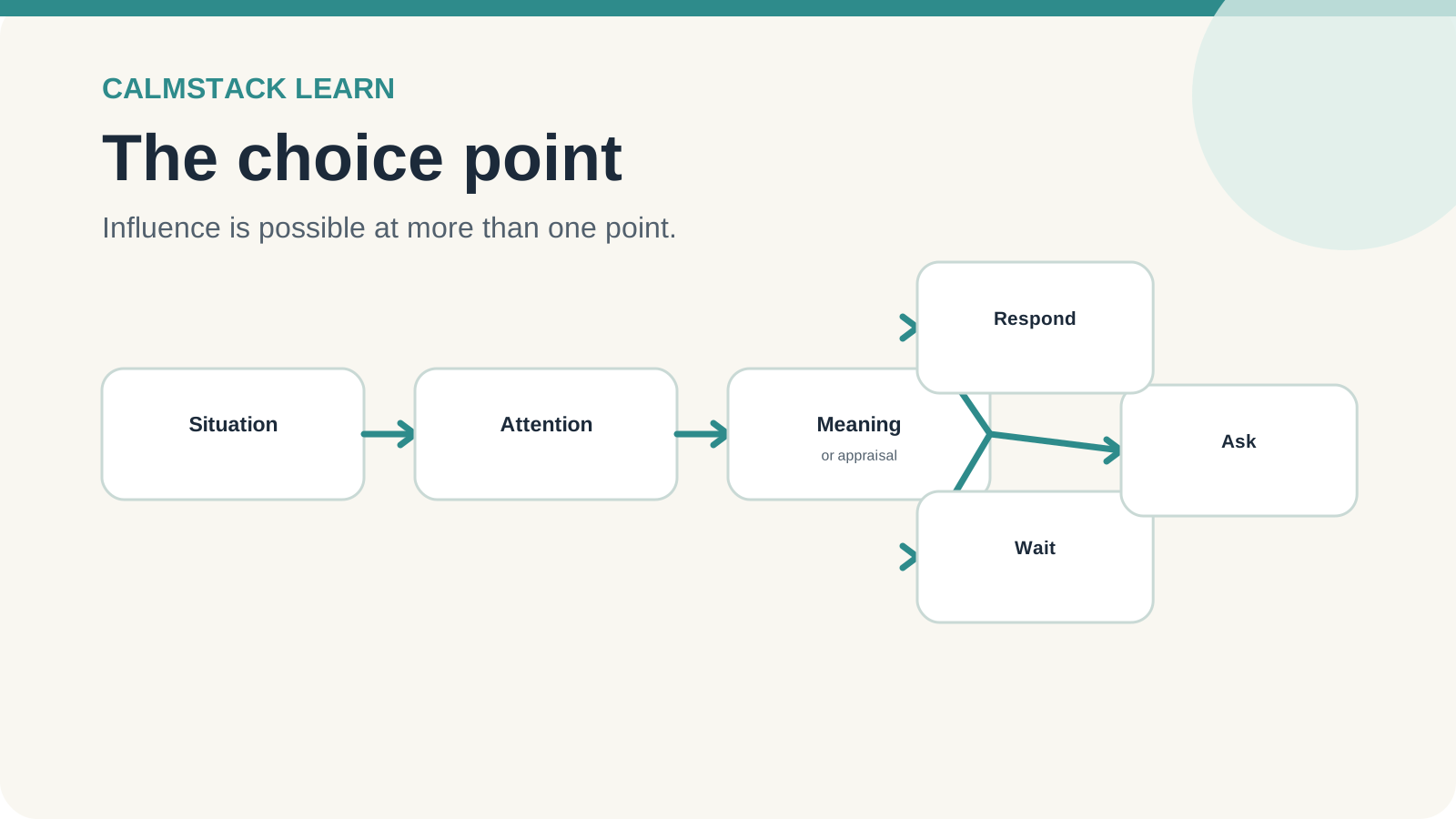
Monday morning meeting.
You leave annoyed.
Wednesday afternoon meeting.
Different topic.
Different people.
Same strange feeling afterwards.
Then it happens again the following week.
At some point you start wondering:
Is there actually a pattern here?
Maybe there is.
But finding a pattern is not the same as deciding:
“Meetings make me angry.”
And it is definitely not the same as deciding:
“I am an angry person.”
The useful part is usually somewhere in between.
We are not emotionally identical every day
It is easy to talk about ourselves as though we carry one emotional setting into work.
“I’m impatient.”
“I’m good under pressure.”
“I don’t handle criticism well.”
“Meetings stress me out.”
Those descriptions may capture something real.
They can also hide how much the same person’s experience changes from one day or situation to another.
Workplace researchers increasingly study this variation directly.
Rather than only asking:
“What is this person generally like?”
they can ask:
“What was different for this person today?”
A 2026 meta analysis led by John Aitken brought together 123 independent samples, 14,717 people and 127,410 observations examining changes in affect and work performance within individuals.
The study was mainly concerned with performance, but its starting point matters here.
Workplace emotion is not only something that differs between people.
It also changes within the same person over time.
That gives us a much better starting point for thinking about patterns.
Work is full of emotional events
One influential idea in organisational psychology is Affective Events Theory.
Howard Weiss and Russell Cropanzano proposed that events happening during work can produce emotional reactions which may then influence attitudes and behaviour.
The useful word is events.
A difficult conversation.
A piece of good news.
A customer complaint.
Someone thanking you.
A deadline moving.
A meeting being cancelled.
A colleague interrupting you for the sixth time.
These events do not have identical emotional effects for everyone.
They do not even necessarily have identical effects on the same person every time.
What happens around the event matters too.
The same person can have very different workdays
Daily diary research makes this easier to see.
Malissa Clark and colleagues followed 114 working adults across two working weeks.
They examined changes in people’s emotional states from day to day and the work events occurring around them.
Emotional variability was greater on days containing a mixture of positive and negative work events than on days containing only positive events or no reported events.
Another diary study by Sonja Rispens and Evangelia Demerouti followed workers across five working days.
On days when people experienced more relationship or process conflict at work, they also reported more negative emotions.
These studies do not give us a formula where one work event automatically produces one emotion.
They show something more useful.
What happens during the working day is related to how people feel during that day.
That sounds obvious when written down.
But it matters because we often turn a response to a situation into a statement about the person.
A repeated reaction may be connected to a repeated situation
Suppose you notice that you often become irritated when priorities change.
You could conclude:
“I don’t cope well with change.”
Maybe.
But that is quite a large conclusion from quite a small observation.
Look more closely.
Are all changes difficult?
Or mainly changes that happen late in the day?
Changes that create extra work?
Changes after you have already organised everything?
Changes communicated without explanation?
Changes from one particular person?
Perhaps the emerging pattern is not:
change makes me angry.
It might be:
I often become irritated when priorities change after I have already planned the day’s work.
That is much more specific.
And it gives you more useful information.
Context can hide inside what looks like the same event
Imagine you notice that three meetings have left you unusually frustrated.
At first, the obvious pattern seems to be:
meetings.
But then you look again.
One was on Monday.
One was on Wednesday.
One was on Friday.
Different people attended.
Different topics were discussed.
So perhaps meetings are not the useful part of the pattern.
Then you notice something else.
All three involved someone changing a piece of work you thought had already been agreed.
Now the possible pattern looks different.
Or perhaps all three happened immediately after another demanding task.
Or near the end of the day.
Or with very little warning.
The label meeting may have been too broad.
Patterns often become more useful when they become more specific.
The meaning of an event matters too
This connects back to Article 3.
We do not respond only to what physically happens.
We also respond to what an event appears to mean.
Suppose two colleagues receive the same feedback:
“Can you redo this section?”
One hears:
“Fine. They want a different version.”
Another hears:
“They think I’ve done a bad job.”
Those interpretations may lead to very different emotional responses.
The same thing can happen within one person.
Feedback might feel completely manageable when expected and much more difficult when it arrives unexpectedly in front of other people.
Research using daily work reports supports this broader idea that characteristics of negative work events are related to how employees regulate emotion and how they feel afterwards.
In one study involving 123 employees and 1,092 daily reports, negative work events were associated with greater activation of emotion regulation goals, lower attentional focus and higher negative affect at the end of the working day.
The intensity and context of the event mattered.
Again, this does not tell us exactly why one particular person reacted in one particular way.
It tells us that the details surrounding an event are worth noticing.
Conflict is a good example
Imagine somebody says:
“I always get angry when people challenge me at work.”
There may be a real pattern there.
But the word challenge hides a lot.
Does it happen when somebody disagrees with you?
When somebody questions your competence?
When criticism happens publicly?
When it comes from somebody senior?
When you think the criticism is unfair?
When you have already had a difficult day?
Those are very different situations.
Research on workplace conflict shows that conflict experiences can be associated with increases in negative emotion on the days when they occur.
But for an individual trying to understand their own experience, the useful information may sit one level deeper.
Not simply:
conflict.
But:
what kind of conflict, in what circumstances, and what did it seem to mean?
Patterns can include what happened beforehand
Article 5 looked at something similar from another angle.
A minor frustration late in a demanding day may not be arriving under the same conditions as the identical frustration earlier.
So if you notice several similar emotional moments at work, it can be worth looking backwards as well as at the obvious event.
Perhaps you recorded irritation after:
an email;
a meeting;
a customer request;
and a technical problem.
Those look unrelated.
But perhaps each happened after several hours without a break.
Or when you were already trying to finish something else.
Or after priorities had changed.
That does not prove the earlier demands caused the later reaction.
It gives you a possible relationship to pay attention to.
That is what a useful pattern often is.
Not a verdict.
A relationship worth looking at again.
This is one reason repeated observations can be useful
Memory is very good at giving us a general story.
Ask:
“What normally stresses you at work?”
and most of us can probably produce an answer.
But a general memory has to compress many different moments together.
Researchers sometimes use diaries and Ecological Momentary Assessment, or EMA, to collect repeated reports closer to when experiences actually happen.
Instead of one question asking:
“How have you generally felt over the last month?”
you collect several observations at different times and in different circumstances.
That can reveal variation that disappears inside an overall average.
It can also make comparison possible.
Tuesday morning.
Friday afternoon.
Before a meeting.
After a meeting.
Busy day.
Quiet day.
Repeated observations give you several moments to compare.
They do not make those observations perfect.
A Check in is still a Check in
This boundary matters for CalmStack.
A Check in is a self report.
It records what somebody noticed and chose to record at that moment.
It is not an objective measurement of their entire emotional state.
A systematic review by Lesleigh Stinson and colleagues examined mobile EMA reports alongside more objective measures.
The agreement varied considerably depending on what was being measured, the study and the individual.
So repeated Check ins can be useful without pretending they are ground truth.
There is another limitation too.
You only have the moments that were recorded.
If you tend to Check in when things go badly but rarely when things go smoothly, the resulting pattern will reflect that.
Five observations can be interesting.
They are not a psychological scan.
Several similar moments do not prove a cause
Suppose your records show:
Monday meeting: irritated.
Wednesday meeting: irritated.
Next Monday meeting: irritated.
Interesting.
There may be something worth investigating.
But what have you proved?
Not that meetings cause irritation.
Maybe those meetings happen at your busiest time.
Maybe one person is usually present.
Maybe they involve changing priorities.
Maybe you only remember to Check in after difficult meetings.
Maybe next month’s meetings look completely different.
A repeated pattern can suggest a hypothesis.
It cannot automatically establish a cause.
This distinction becomes especially important when personal data starts looking neat on a screen.
Three dots can look surprisingly convincing once someone draws a line through them.
A pattern is not a personality diagnosis
This is the most important boundary.
Compare:
“I’m an irritable person.”
with:
“I’ve noticed I often feel irritated when priorities change late in the day after I’ve already organised my work.”
The second statement contains far more useful information.
It tells you something about:
the situation;
the timing;
what happened beforehand;
and the response.
It also leaves room for all the times when that pattern does not happen.
The same applies to statements such as:
“I’m bad with criticism.”
Maybe a more accurate observation is:
“I notice I become defensive when unexpected criticism is given in front of other people.”
That is not a diagnosis.
It is not a personality type.
It is an observation about a possible relationship between a situation and a response.
And that is the click:
Patterns are about repeated relationships between situations and responses, not labels about who you are.
You are looking for a better question
A useful pattern should usually create curiosity rather than certainty.
Maybe you notice more tension on days when meetings run back to back.
Maybe unclear requests bother you more than heavy workloads.
Maybe you are comfortable receiving feedback privately but react differently when it happens unexpectedly in a group.
Maybe you thought there was a pattern and then realise there is not enough information.
All of those findings are useful.
The point is not to build a profile telling you who you are.
It is to notice enough of your real experience to ask a better question about what might be happening.
One small thing to notice
The next time a familiar emotional moment happens at work, ask:
“What tends to be happening around the moments that feel similar?”
You do not need a giant worksheet.
Just notice a few things.
When was it?
What was happening?
What had happened beforehand?
Who was involved?
What did you notice next?
You may find something that repeats.
You may discover that apparently similar moments are actually quite different.
Or you may decide there is not enough information yet.
That is fine.
A pattern does not have to tell you who you are.
Sometimes its most useful job is simply to tell you what might be worth noticing next.
References
- Aitken, J. A., Baines, J. I., Wonders, M. E., Kaplan, S. A., & Clark, J. E. (2026). A meta-analytic review of the within-person relationship between affect and job performance. Journal of Organizational Behavior, 47(4), 685-709. https://doi.org/10.1002/job.70035
- Clark, M. A., Robertson, M. M., & Carter, N. T. (2018). You spin me right round: A within-person examination of affect spin and voluntary work behavior. Journal of Management, 44(8), 3176-3199. https://doi.org/10.1177/0149206316662315
- Rispens, S., & Demerouti, E. (2016). Conflict at work, negative emotions, and performance: A diary study. Negotiation and Conflict Management Research, 9(2), 103-119. https://doi.org/10.1111/ncmr.12069
- Scheibe, S. (2021). Employee age moderates within-person associations of daily negative work events with emotion regulation, attention, and well-being. European Journal of Work and Organizational Psychology, 30(6), 872-886. https://doi.org/10.1080/1359432X.2021.1873772
- Stinson, L., Liu, Y., & Dallery, J. (2022). Ecological Momentary Assessment: A systematic review of validity research. Perspectives on Behavior Science, 45(2), 469-493. https://doi.org/10.1007/s40614-022-00339-w
- Weiss, H. M., & Cropanzano, R. (1996). Affective Events Theory: A theoretical discussion of the structure, causes and consequences of affective experiences at work. Research in Organizational Behavior, 18, 1-74.