What CalmStack means: pause, process, respond
Pause, process, respond is not a demand to stay calm. This article explains the CalmStack sequence as a way to create enough space between a fast reaction and the next deliberate choice.
Published 5 September 2026 · Last evidence review 5 September 2026 · OASYS Editorial
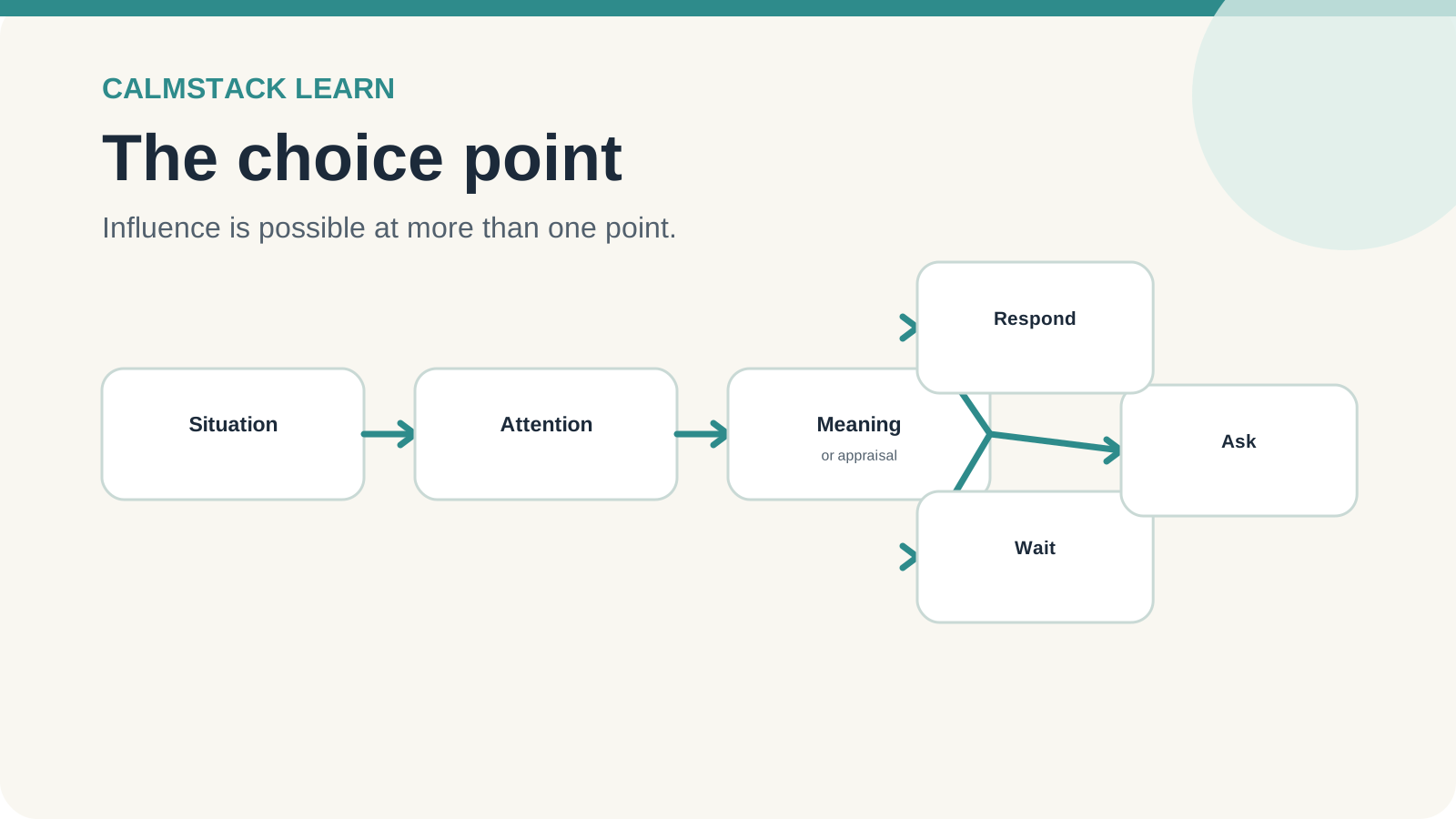
What CalmStack means by pause, process, respond
Most regrettable reactions have one feature in common.
They are very fast.
The reply is sent.
The comment leaves your mouth.
The decision is made while the feeling is still doing most of the talking.
Later, with more information and less urgency, a different response becomes obvious.
CalmStack was built around that gap.
Not the gap between having emotions and not having them.
The gap between a signal arriving and the next action becoming inevitable.
That is what CalmStack means by pause, process, respond.
Pause does not mean become calm
The first word is easy to misunderstand.
Pause can sound like a command to stop feeling, breathe perfectly and achieve serenity before continuing.
That is not the CalmStack idea.
Course 01 treats strong activation as information: signal received.
When the system is in RED, the first job is not to explain everything.
It is to reduce immediate demand where possible and create enough space for awareness to return.
The pause might be a slower exhale.
It might be putting both feet on the floor.
Looking around the room.
Putting the phone down.
Lowering stimulation.
Stepping away from a conversation for a moment.
Or simply not pressing Send yet.
Breathing is one option, not a compulsory ritual.
The purpose is the same: interrupt automatic continuation.
CalmStack Foundations describes this as contain before content.
You do not have to solve the whole story while the story is still shouting.
Process means work out what is actually happening
Once a little more awareness is available, the job changes.
This is AMBER in the Foundations model.
AMBER does not mean everything is fine.
It means the moment has become workable enough for one deliberate choice.
Processing starts with observation.
What am I noticing?
What emotion, body cue, urge or thought is strongest?
What happened?
What am I assuming?
What might this moment mean to me?
What actually needs attention?
This is where the rest of the CalmStack article library lives.
Tiredness can change the conditions in which a problem is met.
Several small demands can pile up.
An unclear message can invite interpretations that the message itself does not contain.
An awkward conversation can continue as rumination long after it ends.
A criticism can expand from information about a behaviour into a judgement about identity.
Waiting can turn missing information into repeated speculation.
Processing does not require a diagnosis for any of those things.
It requires a more accurate description of the moment.
Naming can help, but it does not have to solve the feeling
One part of the Foundations sequence is labeling.
The instruction is deliberately small: use one word or short phrase to describe what is strongest.
Anger.
Embarrassment.
Tight chest.
Urge to leave.
Too much input.
Research on affect labeling suggests that putting emotional experience into words can alter aspects of emotional processing, although it does not reliably make every feeling weaker.
That distinction matters.
The purpose of the label is not to make an emotion disappear.
It is to make the present moment a little more understandable.
Course 01 uses another important phrase here: this is a signal, not an instruction.
Anger can be real without requiring an angry email.
Anxiety can be real without proving the feared outcome.
Embarrassment can be real without requiring you to spend the next two hours reconstructing the conversation.
Processing also means checking the story
The next part of the sequence is a reframe.
That word can sound suspiciously like positive thinking.
CalmStack means something narrower.
A useful reframe is not the nicest sentence available.
It is a more workable sentence that you can actually believe.
This is difficult and temporary.
I do not have enough information yet.
I can delay the decision.
One mistake is not the whole situation.
I only need the next step.
The Foundations rule is simple: believable beats positive.
That fits the broader evidence on cognitive change and reappraisal. A major meta-analysis of 306 experimental comparisons found that cognitive-change strategies had, on average, small-to-moderate effects on emotional outcomes, while also showing that different regulation strategies do not have identical effects.
Modern emotion-regulation research goes further: context matters. A strategy that is useful in one situation may be less useful in another.
So CalmStack does not ask you to replace every unpleasant thought with a cheerful one.
It asks whether the first interpretation is the only workable interpretation available.
Respond means choose one next move
This is the point at which regulation becomes behaviour.
If the pause creates space and processing improves the information, the response is what you do with that extra choice.
Course 01 calls this a Tiny Action.
The action is deliberately modest.
Ask one question.
Delay one reply.
Write one sentence.
Contact one person.
Reduce one demand.
Do nothing for five minutes.
The phrase Tiny Action is important because emotional regulation can easily become another performance standard.
We imagine the correct response should be impressive.
CalmStack takes the opposite view.
Small enough to do is better than perfect enough to avoid.
Respond does not mean comply
There is another distinction worth protecting.
Regulation is sometimes presented as becoming calm enough to accept whatever is happening.
That is not what respond means.
A deliberate response can be saying no.
Leaving a situation.
Challenging something unfair.
Asking for clarification.
Setting a boundary.
Making a complaint.
Or deciding that the original anger was telling you something important.
The pause is not there to make you more agreeable.
It is there to reduce the chance that the first automatic action becomes the only available action.
RED, AMBER and GREEN describe movement, not personality
The Red–Amber–Green (RAG) model in Foundations gives CalmStack an optional map for this process.
RED is activation or shutdown that needs attention.
AMBER is the bridge where enough awareness exists to assess and choose.
GREEN is a steadier state in which there is more flexibility and capacity to continue.
None of these states is a personality type.
GREEN is not morally better.
RED is not failure.
And nobody stays in one state permanently.
The model can be useful because it describes movement without requiring a person to fit every moment into a colour.
You do not need to jump from RED to GREEN, move through the colours in order, or use a RAG label at all when it does not fit.
Sometimes success is simply reaching AMBER.
One slightly slower breath.
One less demand.
One clearer sentence.
One safer choice.
That is enough movement for the next decision to be different.
This is why CalmStack asks about now
The model is deliberately concerned with what is happening in the current moment.
Ecological momentary assessment research was developed partly to study experiences closer to when and where they occur, rather than relying entirely on later retrospective summaries.
CalmStack's own feasibility study used the same general logic: repeated check-ins during ordinary daily life, with a brief intervention offered when reported distress crossed a predefined threshold.
The study produced encouraging within-event patterns, but it was small and uncontrolled, so it cannot establish that CalmStack caused the changes observed.
That evidence boundary matters.
Pause, process, respond is a psychoeducational framework informed by established emotion-regulation research and early CalmStack feasibility work.
It is not a proven clinical treatment protocol.
The whole system in three words
Across the CalmStack library, the situations change.
An angry email.
A difficult meeting.
A delayed reply.
A tired evening.
A criticism at work.
A pile-up of small demands.
The mechanism changes too.
Sometimes the issue is appraisal.
Sometimes uncertainty.
Sometimes rumination.
Sometimes cognitive load.
Sometimes the environment is simply asking too much.
Pause, process, respond does not pretend those problems are identical.
It provides a common route through them.
Pause interrupts automatic continuation. Process improves the information. Respond turns that information into one deliberate next move.
That is the CalmStack idea in its shortest form.
The useful click
Emotional regulation is often described as controlling what you feel.
CalmStack starts somewhere else.
You do not always need to control the emotion. You need enough space to stop the emotion deciding the next action by itself.
Sometimes that space is tiny.
Tiny can be enough.
One small question
The next time you notice a reaction gathering speed, try the whole framework without making it complicated.
Pause:
Can I create a little space before I act?
Process:
What is actually happening here?
Respond:
What is one useful next move?
Not the whole solution.
Not a perfect emotional state.
One move.
Then return to your life.
References
- Gross, J. J. (2015). Emotion regulation: Current status and future prospects. Psychological Inquiry, 26(1), 1–26. https://doi.org/10.1080/1047840X.2014.940781
- Webb, T. L., Miles, E., & Sheeran, P. (2012). Dealing with feeling: A meta-analysis of the effectiveness of strategies derived from the process model of emotion regulation. Psychological Bulletin, 138(4), 775–808. https://doi.org/10.1037/a0027600
- Nahum-Shani, I., Smith, S. N., Spring, B. J., Collins, L. M., Witkiewitz, K., Tewari, A., & Murphy, S. A. (2018). Just-in-time adaptive interventions (JITAIs) in mobile health: Key components and design principles for ongoing health behavior support. Annals of Behavioral Medicine, 52(6), 446–462. https://doi.org/10.1007/s12160-016-9830-8
- Thompson, C. (2026). Evaluating a digital micro-intervention for real-time emotion regulation: A within-person EMA study. Undergraduate dissertation, Nottingham Trent University. CalmStack Research Archive.