Why CalmStack keeps interventions short
Support delivered in a difficult moment competes with the same limited attention it is trying to help. This article explains why CalmStack keeps in-the-moment interventions short without claiming that shorter is always better.
Published 5 September 2026 · Last evidence review 5 September 2026 · OASYS Editorial
A difficult moment is a surprisingly bad time to be handed a twelve-step programme.
You are already irritated, anxious, overwhelmed or trying not to send the message you will regret.
Then a wellbeing tool arrives with an introduction, three menus, a six-minute video and a suggestion that you begin by setting some long-term goals.
Technically, help has arrived.
Practically, it has brought paperwork.
CalmStack keeps its in-the-moment interventions short for a simple reason: the moment in which support is most useful may also be the moment in which there is least capacity for something complicated.
That is a design decision, not a claim that shorter interventions are always better.
Knowing what might help is not the same as being able to start it
Course 01, CalmStack Foundations, is built around a gap that appears repeatedly in real life: people can know a useful strategy and still struggle to use it when activation is high.
The course therefore treats regulation as a transition rather than a demand for instant calm.
RED means a signal has been noticed.
AMBER is the working zone in which enough awareness has returned for a deliberate choice.
GREEN is a steadier state to recognise and protect rather than a prize to achieve.
The important move is often not from distress to perfect calm.
It is from automatic reaction towards a little more usable awareness.
That is why the Foundations course repeatedly reduces the task to something small: label what is happening, pause briefly, create one believable reframe, then choose one Tiny Action.
Timing matters when support is supposed to work in real life
This principle has a close relative in the research literature on just-in-time adaptive interventions, or JITAIs.
JITAIs are designed around the idea that a person's state and context can change rapidly, and that support may therefore be more useful when it is delivered near a moment of need rather than only in a separate teaching session.
In their influential framework, Inbal Nahum-Shani and colleagues describe just-in-time support as providing the right type or amount of support at an appropriate moment while avoiding support that is unnecessarily disruptive.
That last part is important.
An intervention can become another demand.
If it requires too much attention, too many decisions or too much time, the person may reasonably decide not to use it.
So brevity is not only about convenience.
It is about fit.
Short does not mean simplistic
A short intervention can still contain several psychological processes.
CalmStack Foundations uses a low-burden sequence built around labeling, a brief pause, a believable reframe and one modest action.
Each element has a broader research literature behind it.
Emotion-labeling research suggests that putting feelings into words can alter aspects of emotional processing, although subjective effects are not uniform.
Cognitive-change strategies such as reappraisal have a substantial experimental evidence base, although their effects vary by strategy and situation.
Contemporary emotion-regulation research increasingly emphasises that the usefulness of a strategy depends on context rather than there being one universally correct response.
Keeping the sequence brief does not make those ideas shallow.
It means reducing how much of them a person is asked to retrieve and organise at once.
The aim is not to squeeze a course into thirty seconds
This distinction matters because the short intervention and the longer course do different jobs.
The course teaches.
It gives you time to understand RED, AMBER and GREEN, notice triggers and body cues, practise different pauses, build realistic reframes, identify supports and review patterns.
The micro-intervention is not trying to reproduce all of that teaching in the middle of a difficult moment.
It is trying to make a small part of that learning retrievable when it is useful.
That is why CalmStack's shortest version is deliberately modest.
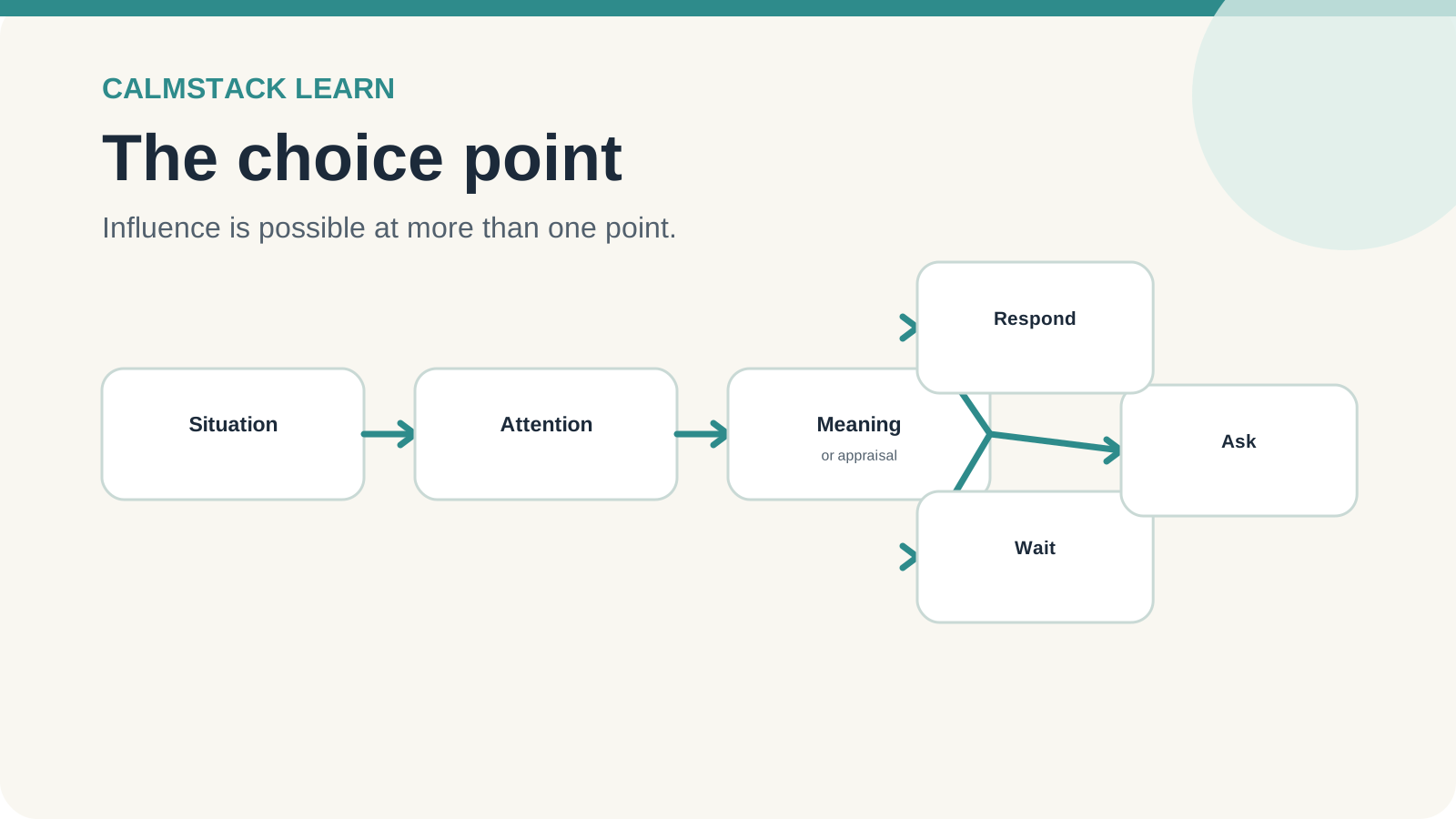
Notice the signal.
Create a little space.
Choose one next move.
If more reflection is needed, it can happen later.
Course 01 puts this neatly: contain before content.
What CalmStack's first study can and cannot tell us
The original CalmStack study tested a brief digital micro-intervention in a 14-day within-person ecological momentary assessment design.
Eleven adults were tracked. The study included a four-day baseline period followed by a ten-day intervention period, with repeated real-time check-ins during daily life.
When reported distress reached the study threshold, participants were offered a combined intervention lasting roughly 15 to 30 seconds. It included emotion labeling, paced breathing and a one-line cognitive reframe.
Across the study there were 625 paired distress observations. On average, the post-intervention rating was lower than the pre-intervention rating, and participants also rated the intervention positively for perceived helpfulness.
That is encouraging.
It is not proof that the intervention caused the reductions.
The study was small and feasibility-focused. It did not include a randomised control condition, the intervention components were combined rather than isolated, and ordinary fluctuation, self-monitoring effects and regression towards the mean could have contributed to the observed changes.
So the study supports feasibility, sustained engagement and preliminary within-event signals.
Controlled research is still needed before stronger causal or clinical effectiveness claims can be made.
More is not automatically better
Digital interventions sometimes inherit an assumption from traditional programmes: if something useful can be delivered in five minutes, ten minutes must be better.
The evidence does not justify such a simple rule.
Research on ecological momentary interventions shows wide variation in duration, adherence, delivery and outcomes. Systematic reviews have repeatedly noted that engagement and reporting are inconsistent across studies.
That means CalmStack should not claim that fifteen seconds is a scientifically proven ideal dose.
It is not.
The design question is more practical.
What is the smallest useful intervention that a person can realistically start in the moment for which it was designed?
Tiny Action is a design constraint
Foundations repeatedly asks learners to shrink the next action.
Write the action you think you should take.
Cut it in half.
Cut it in half again.
Then choose the smallest version that still helps.
That captures the logic of the whole micro-intervention.
The best next action is not the most impressive one.
It is the one you can actually do.
A short pause may lead to putting the phone down.
Sending one clarifying sentence.
Getting a glass of water.
Leaving a decision until tomorrow.
Moving somewhere quieter.
Or deciding that nothing needs doing right now.
The intervention is successful if it creates enough room for a more deliberate next move, not if it produces a dramatic transformation.
The useful click
CalmStack keeps interventions short because the intervention has to compete with the moment in which it is being used.
The goal is not to fit as much psychology as possible into the moment. It is to make enough psychology usable in the moment.
The deeper learning can happen before and afterwards.
The live intervention only needs to help create the next bit of choice.
One small question
When a strategy feels too complicated to use under pressure, ask:
What is the smallest version of this that would still help?
Not the perfect version.
Not the version you think you ought to be capable of.
The version you can actually start.
Sometimes thirty seconds is not a compromise.
It is the reason the tool gets used at all.
References
- Nahum-Shani, I., Smith, S. N., Spring, B. J., Collins, L. M., Witkiewitz, K., Tewari, A., & Murphy, S. A. (2018). Just-in-time adaptive interventions (JITAIs) in mobile health: Key components and design principles for ongoing health behavior support. Annals of Behavioral Medicine, 52(6), 446–462. https://doi.org/10.1007/s12160-016-9830-8
- Bettis, A. H., Burke, T. A., Nesi, J., & Liu, R. T. (2022). Digital technologies for emotion-regulation assessment and intervention: A conceptual review. Clinical Psychological Science, 10(1), 3–26. https://doi.org/10.1177/21677026211011982
- Webb, T. L., Miles, E., & Sheeran, P. (2012). Dealing with feeling: A meta-analysis of the effectiveness of strategies derived from the process model of emotion regulation. Psychological Bulletin, 138(4), 775–808. https://doi.org/10.1037/a0027600
- Thompson, C. (2026). Evaluating a digital micro-intervention for real-time emotion regulation: A within-person EMA study. Undergraduate dissertation, Nottingham Trent University. CalmStack Research Archive.