What emotional regulation means in everyday life
Emotion regulation is often mistaken for staying calm, thinking positively or keeping difficult feelings under control. Psychology describes something broader: the ways we influence how emotions unfold, what we do with them and how we respond to what is happening around us.
Published 2 September 2026 · Last evidence review 2 September 2026 · OASYS Editorial
You read a message and immediately feel irritated.
You start typing a reply.
Then you delete it.
Maybe you put your phone down.
Maybe you reread the message and realise it could mean something different from what you first assumed.
Maybe you are still annoyed — but decide this is not the moment to answer.
Nothing dramatic has happened.
But psychologically, quite a lot has.
The interesting part is not that you managed to “calm down”.
You might not have calmed down at all.
You may still be irritated.
What changed was something else.
Somewhere between feeling something and doing something, you influenced what happened next.
That is much closer to what psychologists mean by emotion regulation than the familiar idea of simply controlling your feelings.
And that distinction matters.
Because emotional regulation is not really about becoming less emotional.
It is about creating more flexibility in what happens next.
Regulation does not mean getting rid of emotion
Emotion regulation is often discussed as though emotions are problems waiting to be reduced.
Angry?
Reduce it.
Anxious?
Calm down.
Sad?
Feel better.
But the psychological meaning is much broader.
Kateri McRae and James Gross describe emotion regulation as attempts to influence emotions in ourselves or other people.
The important word is influence.
Sometimes regulation may involve reducing an emotion.
But not always.
You may want to hold on to excitement before something important.
Anger may tell you that a boundary feels crossed.
Sadness may fit perfectly well with what has happened.
And sometimes the useful change is not in the emotion itself.
It is in what you choose to do while feeling it.
So emotional regulation is not emotional elimination.
You do not have to win an argument against your own emotional state.
The question is:
What happens next?
An emotion is not an on/off switch
Imagine you are waiting for someone and they are late.
The external situation seems simple.
They have not arrived.
But then something begins to unfold.
You notice the time.
Your attention stays on it.
You start interpreting what their lateness means.
“They don't respect my time.”
“They've forgotten.”
“Maybe something happened.”
Same event.
Potentially very different emotional experience.
And potentially very different response.
This is one reason James Gross's Process Model of Emotion Regulation became so influential.
Instead of treating emotion as something that suddenly appears fully formed, the model describes several points where people may influence an emotional episode while it is unfolding.
Where regulation can happen
- Situation selection — choosing whether to approach, enter or avoid a situation.
- Situation modification — changing something about the situation itself.
- Attentional deployment — changing where you direct your attention.
- Cognitive change — changing how you understand or interpret what is happening.
- Response modulation — influencing your response once the emotion is already underway.
These are not five compulsory stages that everybody follows in order.
They are different points where regulation can happen.
And once you know what you are looking for, you can see examples everywhere.
Turning off notifications because you need to concentrate.
Leaving a noisy room.
Looking away from something upsetting for a moment.
Asking for clarification instead of assuming somebody's intention.
Waiting before sending a message.
Talking through what happened with somebody you trust.
Each action is different.
But each can influence how an emotional situation develops.
So which strategy is the “good” one?
This is where the story becomes more interesting.
Wellbeing advice often divides regulation strategies into neat categories.
Reappraisal is good.
Suppression is bad.
Distraction means avoidance.
Acceptance is healthy.
Real psychological research is considerably messier.
A major meta-analysis by Thomas Webb, Eleanor Miles and Paschal Sheeran examined 306 experimental comparisons of emotion-regulation strategies.
Different approaches produced different effects.
But there were also important differences within the same broad type of strategy.
Different forms of attentional deployment did not produce identical results.
Different forms of reappraisal did not produce identical results.
Even “suppression” was not one simple thing.
Suppressing outward emotional expression differs psychologically from attempting to suppress the feeling itself or trying not to think about the event.
That leaves us with a surprisingly difficult question:
Is this a good regulation strategy?
The research suggests that question may be too simple.
A better one is:
Useful for what, for this person, in this situation, at this moment?
Context changes the answer
Psychologists George Bonanno and Charles Burton describe the assumption that a strategy should always be helpful or harmful as the fallacy of uniform efficacy.
Their alternative is regulatory flexibility.
In simple terms, regulation is not only about knowing techniques.
It is also about recognising what the situation requires, having more than one possible response available and noticing whether the response you chose is actually helping.
Imagine you are angry during an important conversation.
Not saying the first thing that enters your head might be very useful.
Doing that every time you are upset, never discussing the problem and never returning to it is something different.
The outward behaviour may look similar.
Its purpose and consequences are not.
That is why emotional regulation and emotional suppression are not synonyms.
Suppression is one possible form of regulation.
Whether it is useful depends partly on what is being suppressed, why, for how long and in what context.
Culture complicates things further
There is another reason universal rules become difficult.
A lot of psychological research has historically been conducted within particular populations and then discussed as though the findings automatically apply everywhere.
A large 2025 systematic review and meta-analysis led by Mark Chen examined 249 articles, 861 effect sizes and 150,474 participants across 37 countries and regions.
It looked at associations involving two heavily researched strategies:
- cognitive reappraisal;
- expressive suppression.
The relationships between those strategies and mental-health outcomes were not identical across all populations.
Cultural characteristics and sample demographics mattered.
That does not mean psychology cannot tell us anything useful.
It means we should be cautious about turning findings from one context into universal rules about how everyone ought to manage emotion.
Human emotion does not fit neatly into one wellbeing rulebook.
The intensity of the moment matters too
There is another complication.
Something that feels easy to do in one situation may feel much harder in another.
The emotional conditions have changed.
Researchers increasingly study emotion regulation closer to where it actually happens — through diaries, smartphones and ecological methods rather than relying entirely on laboratory tasks or people's memories of what happened several days earlier.
One useful example comes from a 2023 study by Magdalena Kozubal and colleagues.
For seven days, 88 participants completed an online diary describing the situation that produced their strongest negative emotion that day.
Across the study, this produced 538 observations.
Participants recorded the emotion, its intensity and strategies including acceptance, reappraisal, rumination, distraction and suppression.
Higher emotional intensity was associated with more reported rumination and less reported cognitive reappraisal.
That does not prove that intense emotion causes people to ruminate or makes reappraisal impossible.
But it highlights something important:
the conditions in which regulation happens matter.
This is easy to miss when regulation is presented as a list of techniques.
In a laboratory, a researcher might tell you exactly when to use reappraisal.
Real life does not.
Nobody appears beside you after a difficult email and announces:
Please commence cognitive reappraisal now.
First you have to notice that something is happening.
Then decide whether anything needs changing.
Then choose a response.
Then actually use it.
Then notice what happened afterwards.
Knowing a technique exists is not the same thing as being able to use it when the moment arrives.
You probably regulate more than you realise
Emotion regulation can also be deliberate or relatively automatic.
Sometimes you consciously decide to rethink a situation or delay a response.
Other regulatory behaviours may become habitual enough that very little conscious planning is involved.
Researchers therefore distinguish between more explicit and more implicit forms of emotion regulation.
Which means regulation is not some specialist psychological process that suddenly begins when you open a wellbeing app.
You have probably been doing versions of it for years.
Changing the subject.
Making a joke.
Seeking reassurance.
Taking some space.
Thinking something through.
Distracting yourself.
Talking.
Not talking yet.
Changing how you interpret something.
Changing the situation itself.
Some responses may help.
Some may not.
Some may solve an immediate problem while creating another one later.
A strategy that works in one situation may not work particularly well in the next.
The point is not that every response becomes healthy simply because it can be called regulation.
The point is that regulation describes the process of influencing what happens next.
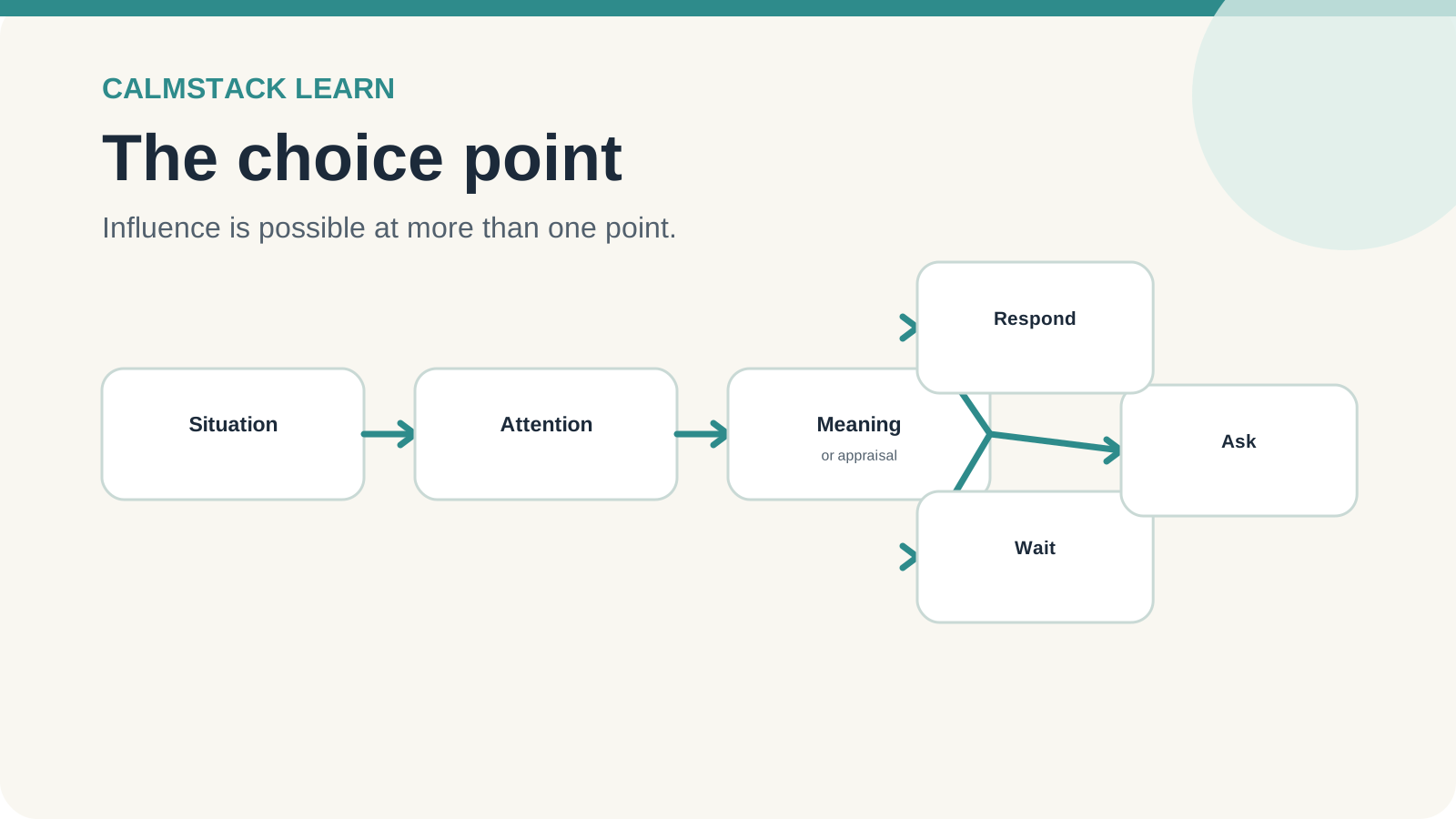
The interesting part is the choice point
This is where the idea becomes useful.
Suppose you feel angry.
The emotion itself is information.
But it is not necessarily an instruction.
You can feel angry and send the message.
Feel angry and wait.
Feel angry and ask a question.
Feel angry and leave the room.
Feel angry and decide the situation is not worth pursuing.
Same emotion.
Different next move.
That small distinction — between an emotional state and an automatic response — is one of the most useful ways to think about emotion regulation in everyday life.
Not:
How do I stop feeling this?
But:
What am I trying to do here?
Do I need enough space to think?
Do I need to understand what I am feeling?
Do I need to express something?
Do I need to postpone responding?
Do I need to change the situation?
Or is this an emotion that makes sense and does not need fixing at all?
There may not be one perfect answer.
Research into regulatory flexibility is still developing, and simply knowing more strategies does not automatically mean somebody regulates emotion more effectively.
What matters is the relationship between:
the person;
the situation;
their goal;
the strategy they choose;
and
what happens afterwards.
That is a more realistic way of thinking about emotional regulation.
Not permanent control.
Not suppression.
Not staying calm at all costs.
A little more awareness and a little more choice about what happens next.
One small thing to try
The next time you notice a strong emotion, instead of immediately asking:
“How do I get rid of this?”
try asking:
“What would be useful for me to do with this feeling right now?”
You do not need to identify the perfect psychological technique.
You do not even need to change the emotion.
Just notice that sometimes there is a space between the feeling arriving and the response that follows.
That space is where regulation can begin.