The difference between emotional regulation and suppressing emotions
Holding back an emotional reaction is not automatically the same as avoiding or denying an emotion. Suppression is one possible form of emotion regulation, and what it does depends on what you are suppressing, why and what the situation requires.
Published 2 September 2026 · Last evidence review 2 September 2026 · OASYS Editorial
You are sitting in a meeting and somebody says something that makes you furious.
You feel the reaction almost immediately.
But you do not say the first thing that enters your head.
You keep your face relatively neutral.
You wait.
Have you just regulated your emotion?
Or suppressed it?
The slightly awkward answer is:
potentially both.
Suppression is often talked about as though it is the opposite of emotional regulation.
One means dealing with your feelings properly.
The other means bottling them up.
Psychology is less tidy than that, which is useful here.
Suppression is actually one possible form of emotion regulation.
The important questions are what exactly you are suppressing, what you are trying to achieve and what happens next.
Feeling something and showing something are not the same thing
Imagine the meeting again.
You are angry.
Several things may be happening at once.
You might:
- feel angry;
- think angry thoughts;
- show anger through your face, voice or posture;
- feel an urge to respond;
- actually say or do something.
These things are related.
They are not identical.
In emotion-regulation research, expressive suppression usually refers to deliberately reducing the outward signs of an emotion that is already underway.
You might stop yourself raising your voice.
Keep your facial expression neutral.
Or decide not to say what you are thinking yet.
That changes what other people can see.
It does not necessarily make the emotion disappear internally.
James Gross demonstrated this distinction in classic experiments on emotion regulation. Participants instructed to suppress emotional expression showed less visible emotional behaviour, but suppression did not simply eliminate their subjective emotional experience.
A later meta-analysis by Thomas Webb, Eleanor Miles and Paschal Sheeran brought together 306 experimental comparisons of emotion-regulation strategies.
Suppressing emotional expression affected outward responding, while the meta-analysis found little evidence that attempts to suppress the emotional experience itself reduced emotional outcomes.
So the first distinction is straightforward:
Not showing an emotion is not the same thing as not feeling it.
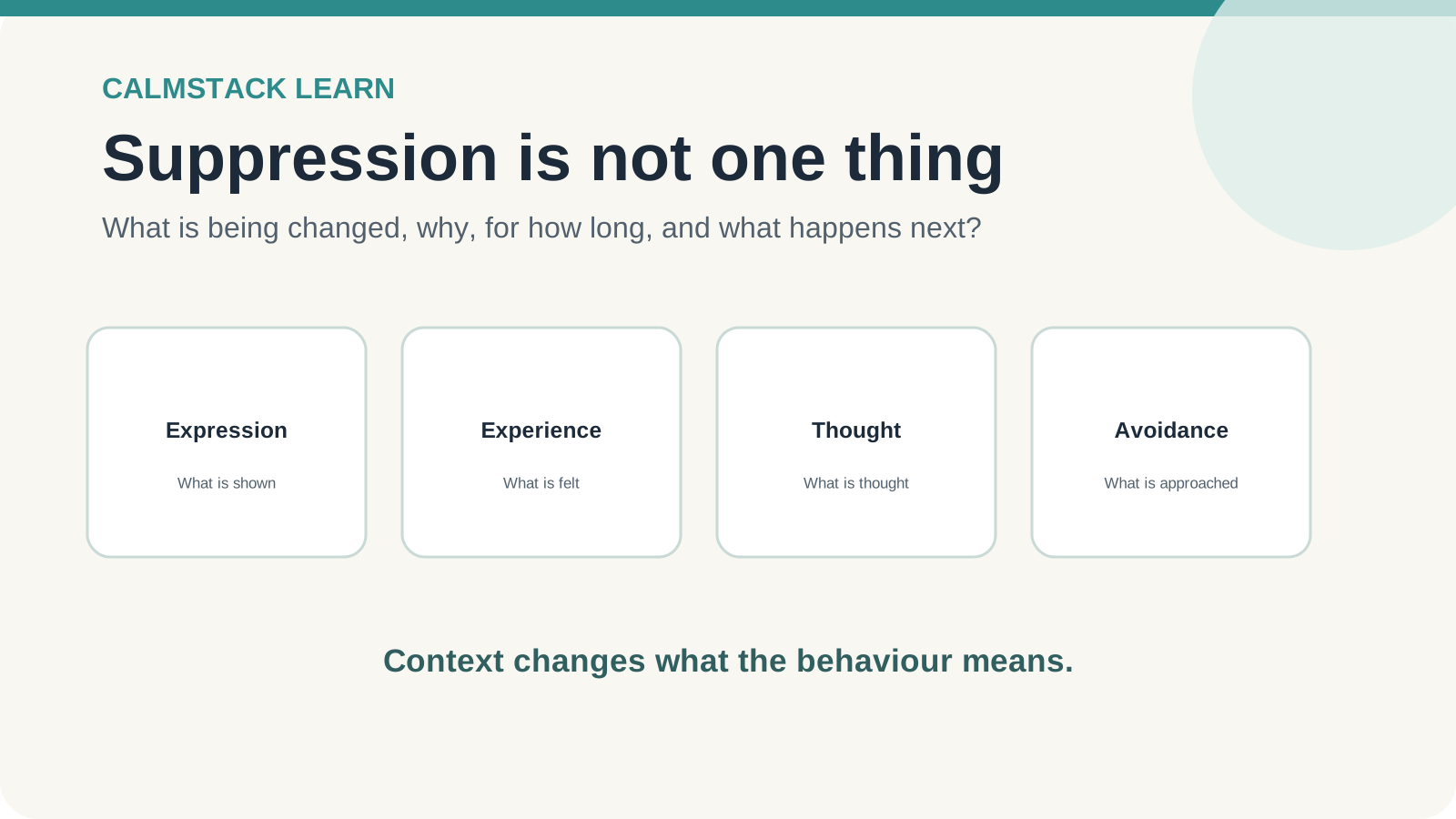
“Suppression” is not one single psychological process
Everyday language makes this unnecessarily confusing.
We often use the phrase “suppressing your feelings” to describe several different things.
Psychologically, they are not interchangeable.
Expressive suppression
Holding back the visible or audible expression of an emotion.
For example:
You feel angry but deliberately keep your voice steady.
Suppressing emotional experience
Trying to stop yourself experiencing the feeling internally.
For example:
“I shouldn't feel angry. Stop feeling this.”
Thought suppression
Trying to prevent a particular thought, image or memory from entering awareness.
For example:
“Do not think about that conversation.”
Avoidance
Trying to stay away from situations, experiences or internal states because they may produce uncomfortable emotion.
These processes can overlap.
But evidence about one cannot automatically be used to make claims about all the others.
Popular wellbeing advice often ignores that distinction and turns research about one type of suppression into a warning about “bottling everything up”.
The research is more precise than that.
Sometimes holding something back may be useful
Return to the meeting.
You are angry.
Would immediately expressing every part of that anger automatically be healthier?
Probably not.
There are situations where choosing not to express an emotion immediately may serve a useful social or practical goal.
You might want to avoid escalating an argument.
Wait until you understand what actually happened.
Keep an important conversation functioning.
Give yourself time before responding.
Or simply recognise that this is not the right place for the conversation you need to have.
George Bonanno and Charles Burton's work on regulatory flexibility helps explain why this matters.
Their argument is not that every emotional strategy is equally useful.
It is that strategies should not automatically be labelled universally good or universally bad without considering context, goals and what happens after the strategy is used.
Restraint can therefore look exactly like unhealthy suppression from the outside.
But compare:
“I'm not saying this now because I need time to think.”
with:
“I must never acknowledge that I feel this.”
The behaviour may initially look similar.
The purpose is very different.
This is one reason the alternative to suppression is not simply “express everything”.
Sometimes deciding not yet is itself a decision.
But hiding emotional expression can have costs
None of this means expressive suppression is consequence-free.
Laboratory studies suggest that deliberately suppressing outward emotional behaviour can alter physiological responding while the emotional situation continues.
The pattern is not simple enough to say that suppression always increases heart rate, always raises blood pressure or reliably “spikes cortisol”.
Different experiments and physiological measures produce different results.
But Gross's early experimental work found increased sympathetic activation on some measures during expressive suppression.
And emotional suppression can affect more than the person doing it.
In research by Emily Butler and colleagues, pairs of women discussed emotionally difficult topics while one participant was instructed either to suppress her emotional expression, reappraise the situation or respond naturally.
Suppression disrupted aspects of communication, reduced rapport and altered blood-pressure responses during the interaction.
That is interesting because suppression is usually imagined as something private:
I hide the emotion. Nobody sees it. End of story.
Social interactions are not that simple.
Other people respond not only to what we explicitly say, but to tone, responsiveness, engagement and the wider pattern of an interaction.
Habit and moment are not the same thing
There is another important distinction.
Using expressive suppression in one particular situation is not the same research question as habitually relying on suppression across your life.
A meta-analysis by Ekaterina Chervonsky and Caroline Hunt examined 43 papers and 105 effect sizes concerning emotional suppression and social outcomes.
Greater suppression was associated with poorer social wellbeing, including lower social support and relationship quality and less favourable first impressions.
Other individual-difference studies have also linked habitual expressive suppression with less favourable affective and wellbeing outcomes.
But we need to be careful with the language.
Those associations do not mean:
“Suppress one angry reaction today and your relationships will deteriorate.”
They concern patterns across people and situations.
The difference between what happens within a particular emotional episode and what tends to characterise somebody who regularly relies on a strategy matters throughout emotion-regulation research.
It is also why CalmStack Learn avoids statements such as:
“Suppression causes poor mental health.”
Association is not the same as causation.
Culture complicates the picture again
There is another problem with declaring one emotional strategy universally healthy or unhealthy:
people do not regulate emotion outside culture.
Different social environments attach different meanings to emotional expression and restraint.
A large 2025 systematic review and meta-analysis led by Mark Chen examined 249 articles, 861 effect sizes and 150,474 participants across 37 countries and regions.
It examined associations between cognitive reappraisal, expressive suppression and mental-health outcomes.
Those relationships varied with cultural characteristics and sample demographics.
That does not mean suppression is “good in one culture and bad in another”.
Cultures contain enormous individual variation, and crude East-versus-West stereotypes are not useful explanations.
What it does mean is that the meaning and consequences of emotional restraint cannot automatically be separated from the social environment in which it occurs.
The same outward behaviour may carry different interpersonal meanings in different settings.
Context changes the answer again.
Trying not to think about something is different again
Now we arrive at another thing casually called suppression:
thought suppression.
Try not to think about a white bear.
Easy instruction.
Surprisingly awkward cognitive task.
Research on thought suppression suggests that deliberately trying to keep a particular thought out of awareness can make that thought more accessible afterwards.
This is known as a rebound effect.
A 2020 meta-analysis by Deming Wang, Martin Hagger and Nikos Chatzisarantis examined 31 studies using the classic thought-suppression paradigm.
The researchers found rebound effects after suppression whether or not people were under additional cognitive load.
But the more dramatic immediate enhancement effect, where the unwanted thought becomes more prominent while somebody is actively trying to suppress it, appeared particularly when people were also under cognitive load.
That is subtler than the familiar internet claim:
> “The second you try not to think about something, you'll think about it more.”
Sometimes the effect emerges later.
Sometimes additional mental demands matter.
And most importantly for this article:
trying not to think something
is psychologically different from
choosing not to show something on your face.
Same everyday word.
Different mechanisms.
“Bottling things up” is a metaphor, not a mechanism
Popular emotion advice sometimes goes badly off-road here.
You may have heard phrases such as:
“Your emotions are trapped in your body.”
or:
“If you bottle anger up, eventually it has to explode.”
“Bottling things up” can be a useful everyday metaphor.
It is not, however, a precise biological mechanism.
Emotions are not literally stored under pressure somewhere in the body waiting to be released.
That does not mean emotional experiences have no physiological consequences.
Of course they can involve changes in arousal, cardiovascular activity, muscle tension, attention and other biological processes.
The problem is turning that complexity into the claim that an emotion behaves like compressed liquid.
There is another part of the metaphor worth challenging too:
the assumption that expression automatically releases emotion.
A 2024 meta-analysis by Sophie Kjærvik and Brad Bushman examined 154 studies, 184 independent samples and 10,189 participants involving activities intended to manage anger.
Activities that reduced physiological arousal were associated with reductions in anger and aggression.
Activities that increased arousal were ineffective overall.
The findings did not support the idea that “venting” anger is a generally effective way of managing it.
So the choice is not:
bottle it up
or
let it all out.
Psychology offers rather more options than a shaken bottle of Coke.
So what is the difference?
Emotion regulation is the larger process.
Suppression is one possible strategy within it.
Sometimes suppression refers specifically to controlling what other people can see.
Sometimes people use the word to describe trying not to feel something.
Sometimes they mean trying not to think about something.
Those processes should not be collapsed together.
And whether holding back emotional expression is useful cannot be decided from the behaviour alone.
It depends on things such as:
what you are trying to achieve;
what the situation requires;
how often you rely on the strategy;
what other responses are available;
and
what happens after the immediate moment has passed.
That leads us somewhere more useful than:
expression = healthy
and
suppression = unhealthy.
Not expressing an emotion and not acknowledging an emotion are not the same psychological act.
And the opposite of suppression is not uncontrolled expression.
The better question is:
Are you choosing what to do with this emotion, or has trying to make it disappear become your only available response?
One small thing to try
The next time you decide not to express an emotion immediately, notice the decision.
Ask:
“What am I trying to achieve by holding this back right now?”
Perhaps the answer is:
“I need ten minutes before I reply.”
Perhaps it is:
“This isn't the right place for this conversation.”
Or perhaps you notice:
“I keep pretending this doesn't bother me, but it does.”
No diagnosis required.
Just information.
Sometimes not reacting is part of regulation.
Sometimes hiding becomes a habit.
The useful part is beginning to notice the difference.