Why difficult meetings can stay with you afterwards
Some meetings end on the calendar before they end in your attention. This article explores cognitive and emotional carry-over from demanding meetings, and why recovery time can matter before the next task begins.
Published 5 September 2026 · Last evidence review 5 September 2026 · OASYS Editorial
The meeting ends at 2:58.
Your next task begins at 3:00.
According to the calendar, this is perfectly efficient.
According to the person who has just spent fifty-eight minutes disagreeing politely with three colleagues while trying to understand a spreadsheet, it may be less impressive.
Some meetings disappear as soon as we leave them.
Others seem to follow us back to the desk.
The interesting question is why.
A meeting can create more than one kind of demand
Meetings are not a single psychological activity.
They can require sustained attention, rapid switching between speakers, social judgement, decision-making, conflict management, impression management and remembering what happens next.
A difficult meeting may contain several of those demands at once.
That helps explain why the end of the meeting does not necessarily equal immediate recovery.
In a 2022 study of working adults, Joseph Allen and colleagues examined what they called meeting-to-work transition time. Their results linked meeting quality with the need for recovery after virtual meetings, especially when the meeting was relevant to the person.
The study was survey-based, so it does not prove that a particular kind of meeting causes a fixed recovery period.
But it captures something ordinary calendars tend to ignore: a meeting can end before the cognitive and emotional consequences of the meeting have finished.
Social evaluation can lengthen the afterlife
Some meetings matter because of what was decided.
Others matter because of what seemed to happen socially.
Did my idea land badly?
Why did they challenge that point?
Was my manager agreeing with them or just moving the conversation along?
Social evaluation is a well-established feature of stress research.
A major meta-analysis by Sally Dickerson and Margaret Kemeny examined 208 laboratory studies of acute psychological stressors. Tasks involving social-evaluative threat, especially when combined with low control, were associated with stronger cortisol responses and slower recovery.
A workplace meeting is not a laboratory stress test, and a disagreement with a colleague should not be treated as equivalent to the experimental tasks in that literature.
The useful principle is narrower: situations in which we believe our performance, competence or social standing is being judged can be especially salient.
Unfinished meaning travels well
A meeting that produces a clear decision may be easier to leave than one that produces ambiguity.
If you know what happened and what happens next, attention has somewhere to go.
If the meeting ends with unresolved disagreement, unclear responsibility or uncertainty about what someone meant, the event has material for continued processing.
That connects difficult meetings with the research on rumination and perseverative cognition.
Mentally revisiting a stressful event can keep the event represented after the external event has stopped.
Again, that does not mean thinking afterwards is inherently bad.
A brief review may identify a useful action.
The difficulty begins when the meeting keeps being replayed without producing new information.
Back-to-back scheduling assumes transitions are free
A calendar treats time as blocks.
Ten o'clock meeting.
Eleven o'clock report.
Eleven-thirty call.
The psychological transitions between those blocks are invisible.
But task-switching and recovery research both suggest that transitions can carry costs.
You may need to reconstruct the task you were doing before the meeting.
You may need to lower your level of activation after conflict.
You may need to make a note of an action so your mind does not keep rehearsing it.
A two-minute gap can therefore do more than the calendar suggests.
Not every difficult meeting is a personal regulation problem
There is a workplace-design issue here too.
If meetings are routinely hostile, badly chaired, unnecessarily long or scheduled without transition time, the solution is not to teach employees to breathe more efficiently between them.
Some problems belong to the meeting.
Some belong to the organisation.
And some belong to how we continue processing the meeting afterwards.
Those levels should not be collapsed into one.
The useful click
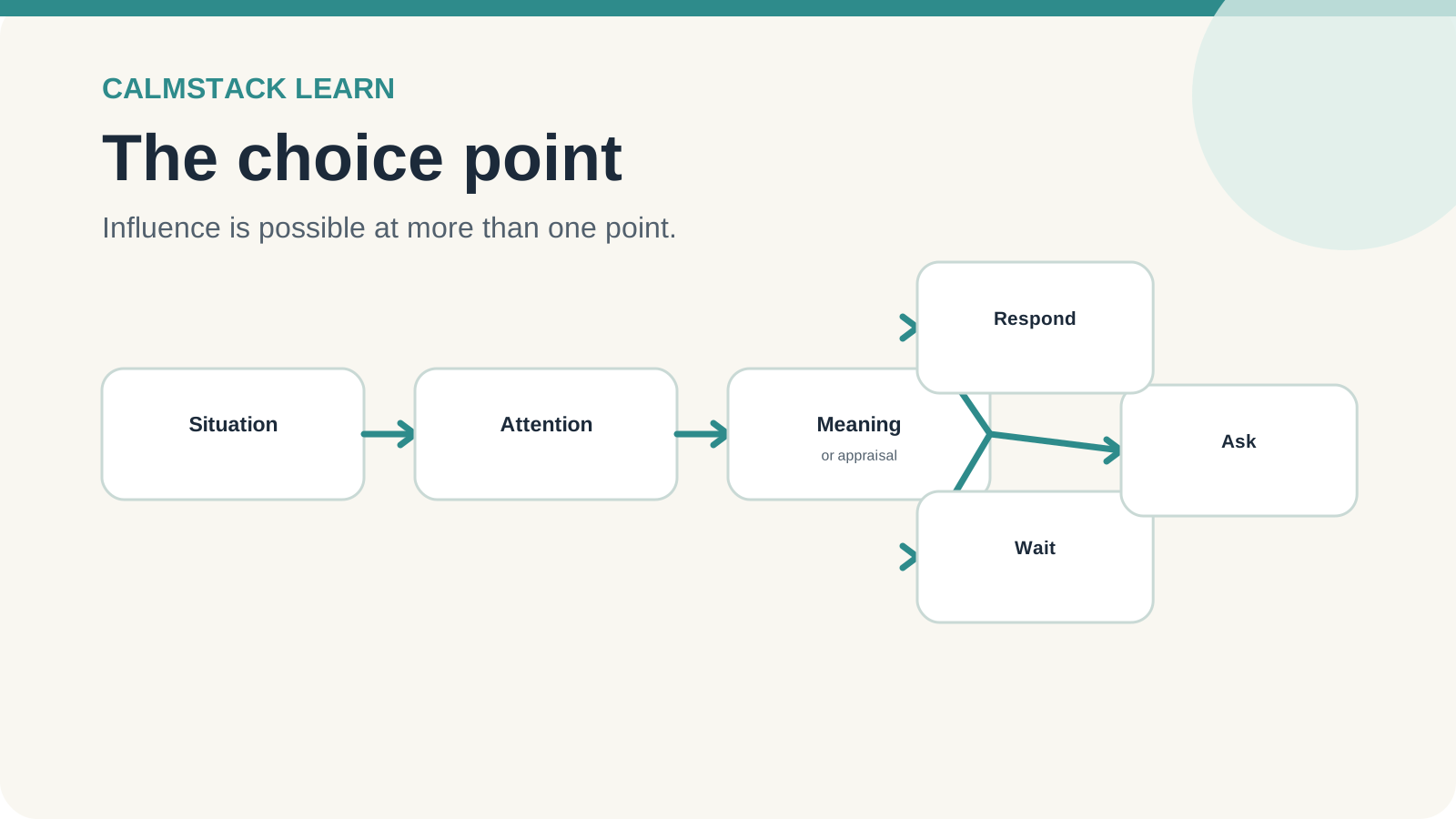
A difficult meeting can be over in the calendar while remaining active in attention.
The end of the meeting is an administrative boundary. It is not necessarily a psychological one.
Recognising that can stop you interpreting the need for a few minutes of recovery as evidence that you handled the meeting badly.
One small question
Before carrying a difficult meeting into the next task, ask:
What, specifically, is still unfinished?
Perhaps there is an action.
Perhaps there is a conversation you need later.
Perhaps there is only irritation that needs a minute to settle.
And sometimes the honest answer is nothing.
The meeting was unpleasant.
It is also finished.
That can be useful information before the next calendar block starts.
References
- Allen, J. A., Thiese, M. S., Eden, E., & Knowles, S. E. (2022). Why am I so exhausted? Exploring meeting-to-work transition time and recovery from virtual meeting fatigue. Journal of Occupational and Environmental Medicine, 64(12), 1053–1058. https://doi.org/10.1097/JOM.0000000000002641
- Dickerson, S. S., & Kemeny, M. E. (2004). Acute stressors and cortisol responses: A theoretical integration and synthesis of laboratory research. Psychological Bulletin, 130(3), 355–391. https://doi.org/10.1037/0033-2909.130.3.355
- Brosschot, J. F., Gerin, W., & Thayer, J. F. (2006). The perseverative cognition hypothesis: A review of worry, prolonged stress-related physiological activation, and health. Journal of Psychosomatic Research, 60(2), 113–124. https://doi.org/10.1016/j.jpsychores.2005.06.074