What happens when you feel criticised at work
Feedback can trigger a reaction before the feedback itself has even arrived. This article explores appraisal, threat, status and interpretation to explain why criticism at work can quickly become about more than the words being said.
Published 5 September 2026 · Last evidence review 5 September 2026 · OASYS Editorial
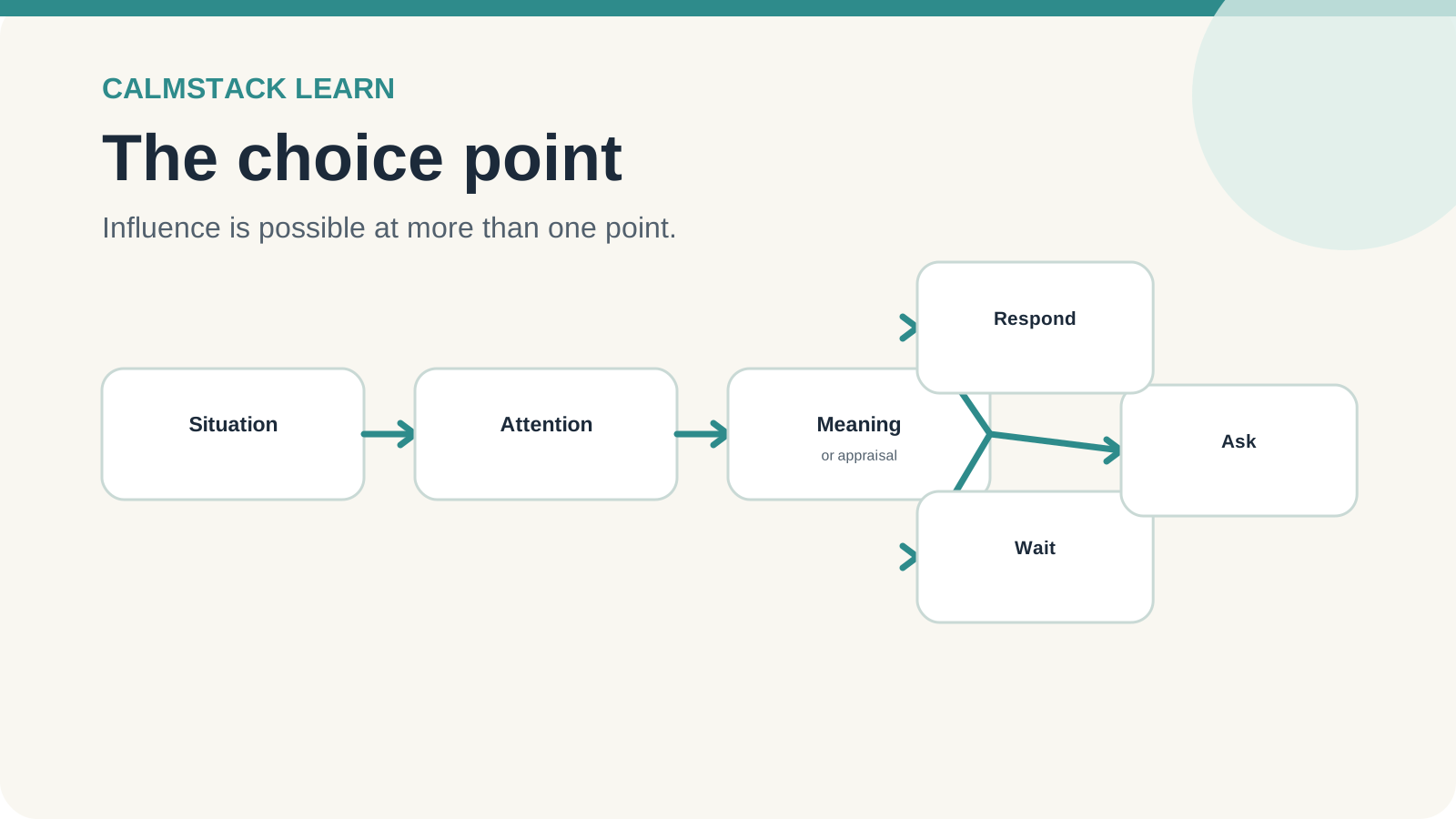
“Can I give you some feedback?”
A perfectly ordinary sentence.
Yet it can produce an impressively fast internal response.
What have I done?
Is this serious?
Who else knows?
You have not heard the feedback yet.
Your mind has already begun preparing the appeal.
Criticism at work can feel unusually potent because feedback is rarely only information about a task. Depending on the context, it can also appear to say something about competence, status, belonging or how somebody else sees us.
Evaluation changes the meaning of the moment
Stress research has repeatedly found that social evaluation matters.
In their meta-analysis of 208 laboratory stress studies, Sally Dickerson and Margaret Kemeny found that situations involving social-evaluative threat, particularly when people also had little control, produced some of the largest and longest-lasting hormonal stress responses.
That does not mean a manager correcting a spreadsheet is biologically equivalent to a laboratory stress test.
It means being negatively judged by others is a psychologically meaningful feature of some stressful situations.
At work, where competence and reputation can have real consequences, criticism can carry more than the literal content of the sentence.
Feedback and identity can collide
Suppose your manager says:
“You need to be clearer when you explain this to clients.”
One interpretation is narrow.
A communication behaviour needs improving.
Another interpretation is much broader.
I am bad at my job.
The first appraisal gives you a task.
The second gives you an identity problem.
Recent organisational research has examined exactly this distinction. In a mixed-methods experience-sampling study of women leaders in engineering firms, Logan Steele and Emily Hill found that feedback conflicting with a person's self-view was associated with different emotional outcomes depending on whether it was appraised as an identity threat or as an opportunity.
That study has a specific population and cannot be treated as a universal model of workplace criticism.
But the central idea fits broader appraisal research: the meaning assigned to feedback helps shape the emotional response.
Feeling defensive does not prove the feedback is wrong
This is the uncomfortable bit.
A criticism can feel unfair and still contain useful information.
It can feel threatening and be inaccurate.
It can be delivered badly and still identify a genuine problem.
Or it can be delivered confidently and be completely wrong.
The emotional response therefore cannot settle the factual question by itself.
Feeling defensive tells you that something about the feedback matters.
It does not tell you whether the person giving it is correct.
Negative feedback can also be useful
Workplace research does not support the idea that all negative feedback damages people.
In a field study of managerial assessment centres, Nikolaos Dimotakis and colleagues examined how positive and negative developmental feedback related to later self-efficacy, feedback seeking and promotion.
The broader feedback literature treats negative information as potentially developmental when it is credible, specific and usable.
That is important because a regulation article should not teach people to neutralise criticism before dismissing it.
Sometimes the best outcome of feeling uncomfortable is learning something.
Delivery still matters
Useful feedback and well-delivered feedback are not the same thing.
Vague criticism creates interpretive work.
Personal criticism broadens the target from behaviour to identity.
Public criticism adds an audience.
Feedback from somebody with power over your job adds consequence.
And criticism that arrives when you cannot respond can add low control.
Those contextual features can change the appraisal before we have even reached the factual content.
This is why “do not take feedback personally” is often poor advice.
Work is personal enough that evaluation can matter.
The more useful task is separating what was actually said from everything the mind concludes it means.
A pause can protect accuracy, not pride
When criticism arrives, the first regulation task is not to become calm enough to agree.
It is to become accurate enough to evaluate.
What exactly is the claim?
Is there an example?
Is this about one behaviour, a repeated pattern or somebody's interpretation?
What would improvement actually look like?
Those questions convert a broad feeling of being judged into information that can be examined.
Sometimes the answer will reveal useful feedback.
Sometimes it will reveal feedback so vague that the sensible response is to ask for clarification.
Sometimes it will reveal a genuinely unfair judgement.
The useful click
Criticism often feels bigger when the mind expands a comment about something you did into a conclusion about who you are.
Feedback can contain information about your work without being a complete description of you.
That distinction does not make criticism pleasant.
It makes it easier to decide what deserves attention.
One small question
When criticism lands hard, ask:
What exactly is being evaluated here?
A behaviour?
A result?
A decision?
A skill?
Or have you already expanded the feedback into a judgement about your entire competence?
You do not have to agree with the criticism.
You are simply reducing it back to its actual size before deciding what to do with it.
References
- Dickerson, S. S., & Kemeny, M. E. (2004). Acute stressors and cortisol responses: A theoretical integration and synthesis of laboratory research. Psychological Bulletin, 130(3), 355–391. https://doi.org/10.1037/0033-2909.130.3.355
- Steele, L. M., & Hill, E. (2026). I am not who you think I am: The role of appraisal in responses to non-verifying feedback. Journal of Organizational Behavior, 47(1), 100–121. https://doi.org/10.1002/job.70028
- Dimotakis, N., Mitchell, D., & Maurer, T. (2017). Positive and negative assessment center feedback in relation to development self-efficacy, feedback seeking, and promotion. Journal of Applied Psychology, 102(11), 1514–1527. https://doi.org/10.1037/apl0000228