A brief pause in a busy day
A very short break will not magically restore your concentration or “reset your nervous system”. But research suggests brief pauses can still make a difference, particularly to how fatigued or energised we feel.
Published 2 September 2026 · Last evidence review 2 September 2026 · OASYS Editorial
You have been staring at the same paragraph for five minutes.
You've reread the same sentence three times.
Technically, you're still working.
It's becoming less clear what the word working means.
So you stand up.
Look away from the screen.
Get some water.
Two minutes later, you sit down again.
Has that tiny break actually achieved anything?
Or have you simply delayed the work for two minutes?
Research gives a less dramatic answer:
A short pause may help, but not necessarily in the way productivity advice often promises.
What counts as a micro-break?
Researchers sometimes use the term micro-break for brief interruptions taken during periods of work.
There is no universally agreed perfect duration.
One major 2022 systematic review and meta-analysis by Patricia Albulescu and colleagues examined experimental and quasi-experimental studies in which micro-breaks lasted ten minutes or less.
Across 19 records, the researchers identified 22 independent study samples involving 2,335 participants.
They looked at three broad outcomes:
vigour: roughly, how energetic or lively people felt;
fatigue: how depleted or tired people felt;
and
performance: how well people actually completed the task.
Separating those outcomes produced the most interesting result.
The evidence is stronger for how people feel than how they perform
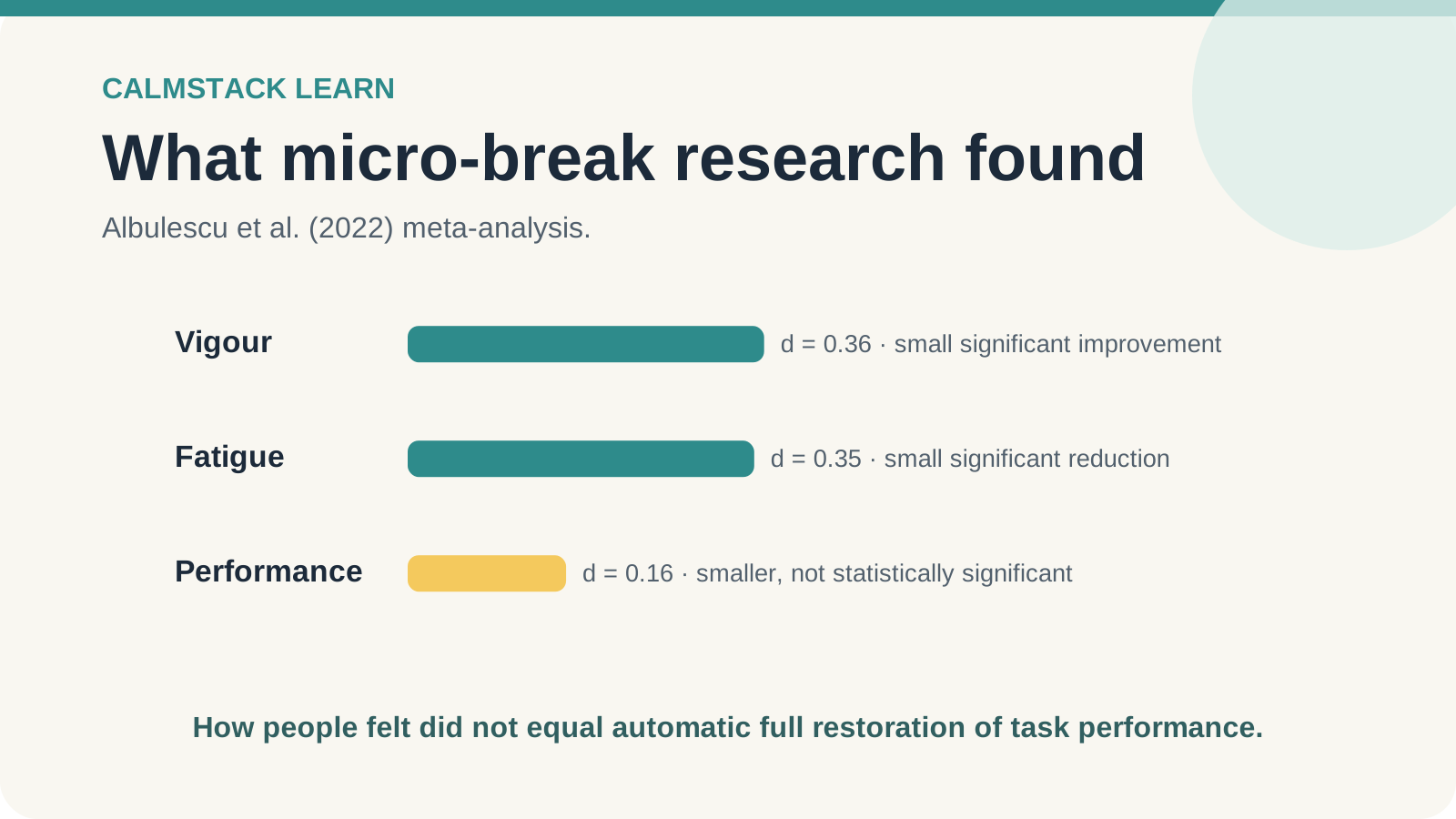
Across the studies, micro-breaks produced small but statistically significant improvements in vigour and reductions in fatigue.
The estimated effects were:
d = .36 for vigour
and
d = .35 for fatigue.
When the researchers looked at overall task performance, however, the effect was smaller and not statistically significant:
d = .16, p = .116.
Performance benefits were clearer for tasks involving lower cognitive demands.
The researchers also found that longer breaks within the studies tended to be associated with greater improvements in performance.
So the distinction matters.
A short pause might leave you feeling somewhat less depleted.
That does not mean it has magically restored every aspect of your cognitive performance.
And those are not the same outcome.
A pause does not need to make you more productive to matter
There is a strange assumption hidden inside a lot of advice about breaks.
A break has to justify itself.
If you stop working for three minutes, those three minutes apparently need to return as:
more concentration;
faster thinking;
better output;
or some impressive percentage increase in productivity.
Otherwise the break has failed.
But researchers measure fatigue and vigour separately from task performance for a reason.
Feeling less fatigued is an outcome too.
That does not mean a micro-break treats exhaustion.
It does not mean it prevents burnout.
And it certainly does not mean that a few minutes away from a task reverses the effects of prolonged stress or inadequate recovery.
Those would be much larger claims.
The evidence is more modest.
A brief interruption in effort may provide a small opportunity for recovery, even when somebody does not immediately become better at the task they were doing.
A pause does not have to turn you into a more productive person to have done something useful.
What you do during the pause may matter
Not every break is the same.
A separate 2022 systematic review led by Zhanna Lyubykh examined 83 studies of work breaks and wellbeing and performance among knowledge workers.
The researchers described breaks using several different features, including:
- who initiates the break;
- how long it lasts;
- how frequently it happens;
- what somebody does during it;
- and how the break is experienced.
There was no single perfect break prescription.
That makes intuitive sense.
Standing outside for two minutes is different from technically leaving your spreadsheet while continuing to rehearse the same problem in your head.
And both are different again from replacing one screen full of demands with another stream of notifications.
One concept studied in this area is psychological detachment, which means temporarily disengaging mentally from the demand you were working on.
That does not necessarily require leaving the building or completely forgetting that the work exists.
It simply means the break involves some degree of mental separation from the task.
Can forty seconds make a difference?
One experiment took the idea particularly literally.
Amanda Conlin and colleagues randomly assigned participants completing a monotonous task to:
- a brief relaxation activity;
- a brief mastery activity;
- or no break.
The micro-breaks lasted just 40 seconds.
The researchers found evidence of improved within-task recovery and performance in the micro-break conditions.
Psychological detachment appeared relevant to the recovery effect, whereas positive affect did not show the same relationship.
The mastery activity also produced more psychological detachment than the relaxation activity, although that difference did not explain differences in performance between the two break types.
That is interesting.
It is also one experiment.
It does not establish a scientifically optimal forty-second break.
What it does suggest is something more modest:
a break is not only an amount of time. What happens to your attention during that time may matter too.
There is no perfect two-minute “reset”
Sensible research findings can become strange internet claims very quickly.
A short pause is not a scientifically established method for:
“resetting your nervous system”;
restoring executive function in exactly 90 seconds;
erasing accumulated stress;
preventing burnout;
or returning your brain to factory settings.
The micro-break literature does not support those promises.
Even the 2022 meta-analysis found that improvement in performance overall was uncertain, particularly after more cognitively demanding tasks.
The authors suggested that recovery following highly depleting work may require breaks longer than ten minutes.
That is not the same thing as discovering a universal ten-minute rule.
How much recovery somebody needs is likely to depend on factors such as:
what they have been doing;
how demanding it has been;
how long they have been doing it;
what state they were already in;
and what outcome we are interested in.
There is a considerable difference between:
“I feel slightly fresher.”
and
“My cognitive performance has fully recovered.”
Research should not make us pretend those are the same thing.
What about moving, breathing or going outside?
All of these are things somebody might choose to do during a pause.
But this article is about the pause itself.
You might:
stand up;
stretch;
look away from the screen;
walk into another room;
get some water;
step outside;
talk briefly to somebody;
or simply stop doing the task for a moment.
Research into specific break activities is still developing, and the evidence does not give us one universally superior micro-break for every person and every task.
There is also no requirement that every pause has to become a wellbeing exercise.
You do not have to turn two minutes away from your laptop into a personal-development programme.
Sometimes the useful change may simply be that, for a moment, you are not doing the thing that was demanding your attention.
The interesting part may be what happens when you return
This connects back to something we introduced in the first CalmStack Learn article.
Regulation is not only about trying something.
It also involves noticing what happens afterwards.
The same principle can be useful with breaks.
A pause might help.
It might not.
The question is probably not:
“Did my two-minute break scientifically optimise my productivity?”
It is much simpler:
“Do I feel any different now?”
Perhaps your concentration feels exactly the same.
Perhaps the problem you were stuck on looks slightly less irritating.
Perhaps you notice that you were more tired than you realised.
Perhaps you return with a little more energy.
Or perhaps two minutes was nowhere near enough.
That is information too.
Why stopping can be difficult
There is another small irony here.
The moment when a pause might be useful is often the moment when stopping feels least sensible.
You are behind.
The task is unfinished.
There is another message waiting.
You think:
“I'll stop when I've finished this.”
Then this becomes something else.
And then something else.
A brief pause interrupts that momentum.
It does not solve the workload.
It does not remove the deadline.
It does not make the next demand disappear.
But it creates a moment in which you can notice whether continuing exactly as you were is still useful.
That is a much smaller claim than “a two-minute break makes you more productive”.
It may also be a more useful one.
One small thing to try
The next time you notice yourself pushing through without really getting anywhere, try taking a short pause that is genuinely different from what you were just doing.
Stand up.
Look somewhere else.
Move around a little.
Get some water.
Or simply stop for a moment.
Then return.
Do not ask whether the pause transformed your productivity.
Just notice:
“Do I feel any different?”
Maybe yes.
Maybe no.
A brief pause does not have to reset anything.
It does not have to fix the day.
Sometimes it is simply a small interruption in a process that was becoming tiring.
And sometimes that is enough to be useful.