What happens in the few seconds before we react
A reaction can feel instantaneous, but that does not mean nothing happened in between. Attention, interpretation, bodily changes and learned responses can all contribute to what happens next, often before we have deliberately thought it through.
Published 2 September 2026 · Last evidence review 2 September 2026 · OASYS Editorial
A message appears on your phone.
You read one sentence.
Your jaw tightens.
Your attention locks onto a particular phrase.
A meaning seems to arrive almost immediately:
“They're blaming me.”
And before you have really thought it through, you already know what you want to type back.
It can feel as though the reaction simply appeared.
Event.
Emotion.
Response.
Bang.
But a reaction can feel instantaneous without being simple.
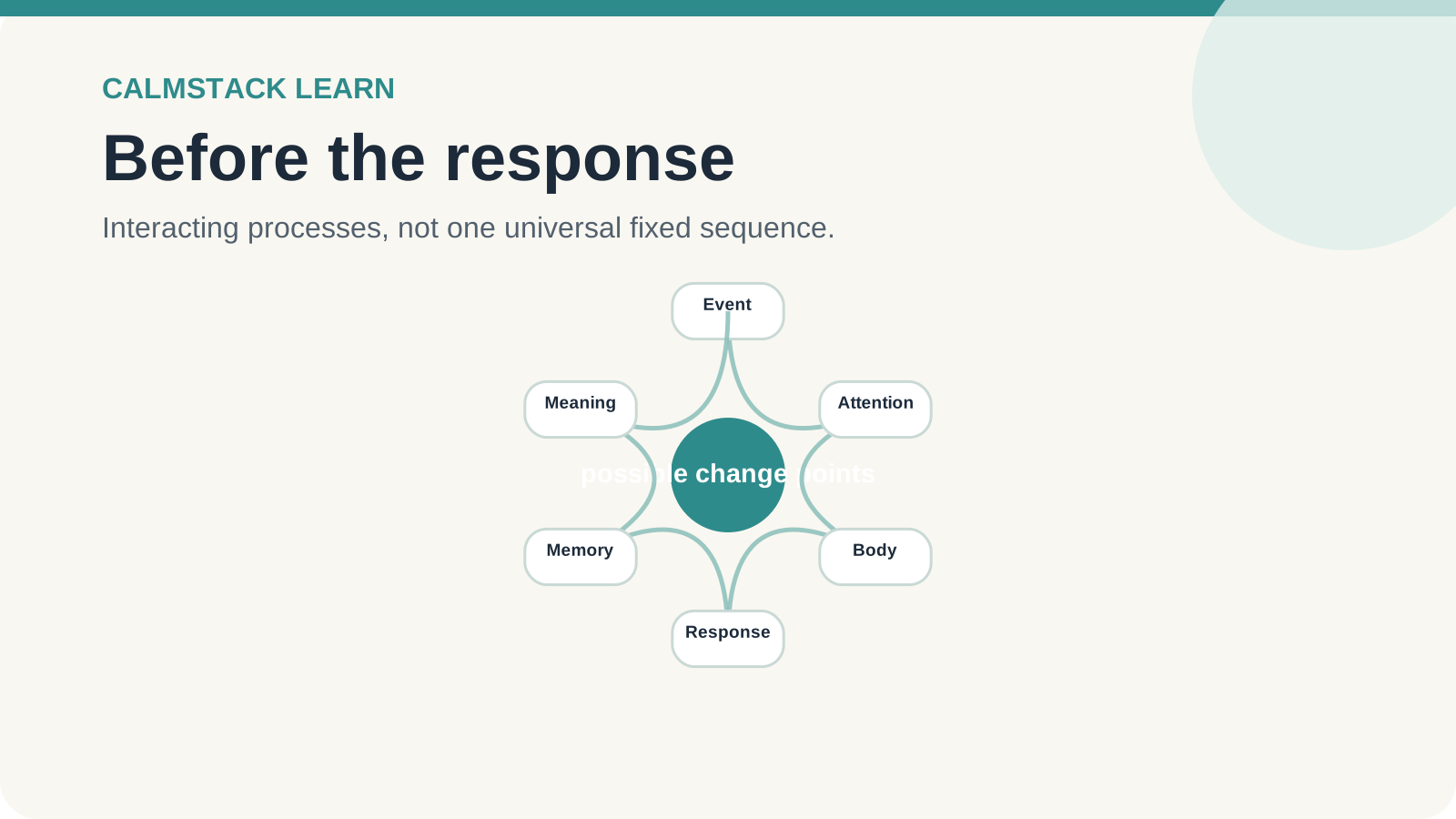
In between something happening and what you eventually do, several processes may already be interacting: what you notice, what the situation means to you, changes in your body, what you expected to happen and what previous experience has taught you to do next.
Some of this can happen quickly.
Some of it may involve little deliberate awareness.
And that is where emotion regulation starts becoming interesting.
A reaction is not one single event
In Article 1, we looked at James Gross's Process Model of Emotion Regulation.
One of its useful ideas is that emotions unfold.
Something happens.
Attention is directed somewhere.
The situation is interpreted.
Emotional responses develop.
Those responses can involve changes in experience, behaviour and physiology.
The model helps explain why regulation can happen at several different points rather than only after an emotion is fully underway.
But it is important not to turn this into a rigid psychological conveyor belt.
Real emotional episodes involve interacting processes.
Attention can influence interpretation.
Interpretation can change what attracts attention.
Bodily sensations may themselves become part of what you are interpreting.
And all of this can continue changing as the situation develops.
So when we talk about the “few seconds before we react”, we are not describing a universal countdown.
There is no scientifically established three-second, six-second or ten-second window that everybody moves through.
We are describing an unfolding process.
What something means matters
Consider the message again.
The words on the screen matter.
But they are not the entire emotional event.
Imagine the message says:
“Can we talk about what happened yesterday?”
One person reads it and thinks:
“I've done something wrong.”
Another thinks:
“Good. We need to clear this up.”
Another thinks:
“I wonder what they mean.”
Same words.
Potentially very different emotional responses.
Appraisal is the useful concept here.
Appraisal theories of emotion examine how people evaluate the significance of events.
That can include questions such as:
Is this relevant to something I care about?
Is it threatening?
Unfair?
Embarrassing?
Helpful?
Expected?
Can I do anything about it?
These do not necessarily appear in the mind as a neat spoken checklist.
Appraisal does not necessarily mean consciously thinking through a situation.
Klaus Scherer's work describes evaluation operating at different levels, from relatively automatic responses to familiar patterns through to more deliberate judgments about goals, consequences and what we can do next.
That helps explain why the “meaning” of an event can seem to arrive almost instantly.
Sometimes there is no obvious internal sentence such as:
“I have evaluated this situation and decided it is threatening.”
The significance can already feel apparent before we deliberately reflect on why.
People respond not only to what happened, but also to what that event appears to mean in relation to their goals, expectations and circumstances.
That helps explain something everybody has experienced:
Two people can react very differently to the same event.
And the same person can react differently to something on Monday than they do on Friday.
Your attention is already part of the reaction
Emotion also influences what gets your attention.
Imagine receiving a long email containing ten fairly neutral sentences and one sentence that feels critical.
Which sentence do you keep rereading?
Probably not number four about next week's timetable.
Information that seems emotionally important can gain priority.
Research on emotion and attention suggests that emotionally significant information can influence what receives further processing, while attention is also shaped by our current goals and expectations.
Again, this is not simply:
“Emotion takes over attention.”
Attention works in both directions.
Something emotionally significant can capture attention.
But what you are already looking for, worrying about or trying to accomplish can also affect what becomes emotionally significant.
That creates a useful feedback loop.
You notice the critical sentence.
You interpret it negatively.
That interpretation makes the sentence feel even more important.
So you look at it again.
Before long, one sentence has become the whole email.
Not because the other sentences vanished.
Because attention is selective.
Emotion is not just something happening in your thoughts
There may also be changes in the body.
Heart rate.
Breathing.
Muscle tension.
Facial expression.
Posture.
Sweating.
Readiness to move, speak, approach or withdraw.
Different emotions and situations do not produce one universal bodily pattern, and people's physiological responses vary considerably.
Bodily responses also do not map neatly onto one emotion in a simple one-to-one way.
Similar physiological changes can occur across different emotional states, and the bodily pattern associated with the same named emotion can vary between people, situations and individual episodes.
But emotion involves more than conscious thought.
Sometimes the first thing you notice is physical.
You realise your shoulders have tightened.
Your voice has changed.
You're gripping the phone.
You feel restless.
Then you recognise:
“I'm actually quite angry.”
That does not mean:
“The body reacted and then the brain caught up.”
Your brain and body are continuously interacting.
The idea that one acts first while the other watches from the sidelines is too simple.
What about the “amygdala hijack”?
This is probably the most famous explanation of fast emotional reactions.
Something happens.
The amygdala detects danger.
The emotional brain takes over.
The rational prefrontal cortex goes offline.
Then, eventually, reason comes back.
It is memorable.
It is also a much cleaner story than modern neuroscience supports.
The amygdala is important in processes including learning about biologically and motivationally significant events.
Prefrontal regions contribute to many forms of planning, attention, decision-making and regulation.
But researchers increasingly caution against treating the brain as two competing machines:
an emotional brain
versus
a rational brain.
Neuroscientist Luiz Pessoa, for example, has argued that complex emotional and cognitive behaviour depends on interacting networks rather than isolated “emotion” and “reason” centres.
Brain regions commonly given simple labels often participate in multiple functions.
So strong emotion does not mean your “rational brain has switched off”.
The more accurate story is about changing patterns of processing across interacting systems.
Less catchy.
Much better neuroscience.
Strong stress can still change how we think
Rejecting the “brain switched off” story does not mean strong stress has no effect on thinking.
It can.
A major meta-analysis by Grant Shields, Matthew Sazma and Andrew Yonelinas examined research on acute stress and three core executive functions:
working memory;
cognitive flexibility;
and
inhibition.
Across the studies they reviewed, acute stress impaired working memory and cognitive flexibility overall.
The effects on inhibition were more complicated.
That distinction matters.
Stress does not simply destroy “rational thought”.
But under some conditions it may become harder to hold several pieces of information in mind or flexibly shift perspective.
That fits a familiar experience:
You can think of five sensible responses to an argument the following morning.
In the middle of it, you somehow had one.
This is also why advice such as:
“Just think rationally.”
can be less useful than it sounds when somebody is already highly activated.
Thinking differently may require cognitive resources that are under greater pressure in that moment.
Some responses become familiar
Previous experience matters too.
Suppose criticism has repeatedly led you to defend yourself immediately.
Over time, criticism and defence can become closely linked.
Someone questions your decision.
You explain.
They challenge the explanation.
You explain harder.
The process starts feeling automatic.
This does not mean there is literally a fixed pathway that forces the response every time.
But emotional regulation research distinguishes between processes that are relatively deliberate and those that can operate with much less conscious intention.
Repeated patterns, expectations and learned associations may make some responses feel increasingly familiar or automatic.
That is one reason noticing patterns can matter.
Not because awareness gives you perfect control.
But because something that previously felt like:
“That's just what happens.”
can gradually become:
“Ah. This is the bit where I usually do that.”
That is a different kind of information.
Can naming the feeling change anything?
Possibly.
But this is another area where a modest research finding has sometimes become an enormous internet claim.
In a well-known 2007 brain-imaging study, Matthew Lieberman and colleagues asked participants to label emotional facial expressions.
Compared with other conditions, affect labelling was associated with reduced amygdala responses to negative emotional images and increased activity in right ventrolateral prefrontal cortex.
That finding is interesting.
It does not mean:
“Naming your emotion shuts down your amygdala.”
An fMRI study measures changes in blood-oxygen-level-dependent signals under particular experimental conditions.
It does not show a brain region being switched off.
And laboratory affect labelling is not identical to noticing that you're annoyed during a real argument.
So CalmStack should not turn one neuroscience experiment into a guaranteed technique.
The more proportionate takeaway is simpler:
putting an emotional experience into words may sometimes change aspects of how that experience is processed.
That is worth investigating.
It is not magic.
So where is the “space” before we respond?
We often talk about there being a space between feeling something and responding to it.
That can be a useful idea.
But the space is easy to misunderstand.
It is not necessarily a peaceful little blank gap where nothing is happening and you simply decide whether to behave rationally.
Quite a lot may already be happening.
Attention.
Appraisal.
Bodily change.
Memory.
Expectation.
Action tendencies.
Habit.
And further interpretation.
The useful opportunity is not that emotion politely stops and waits for instructions.
It is that an emotional episode is still developing.
Different parts of that process may be influenced.
You might change where your attention goes.
Check an interpretation.
Notice what your body is doing.
Delay an action.
Ask for more information.
Leave the situation.
Or realise that your first interpretation may not be the only possible one.
The first three CalmStack Learn articles meet here.
Emotion regulation is not just calming down.
Suppression is not simply the opposite of regulation.
And reacting is not one single event.
A reaction can feel instantaneous while still unfolding through processes that may leave more than one opportunity for what happens next to change.
One small thing to try
The next time you notice yourself reacting quickly, you do not need to reconstruct your entire nervous system.
Just ask:
“What happened just before I wanted to respond?”
Maybe you noticed one particular sentence.
Maybe you made an assumption about somebody's intention.
Maybe your body changed before you noticed how strongly you felt.
Maybe the situation reminded you of something familiar.
You do not need to fix any of it immediately.
Start by noticing one link in the chain.
Because the more of the process you can see, the less the reaction has to feel like one mysterious event that simply happened to you.