Why small frustrations can feel bigger when the day is already full
A minor frustration can feel manageable in the morning and much harder later in the day. Research on daily stress suggests that the event itself is only part of the story. What has already happened, how demanding the day has been and the state you are in can all shape what happens next.
Published 3 September 2026 · Last evidence review 3 September 2026 · OASYS Editorial
At 9:15 in the morning, the printer jams.
You open the tray.
Pull out the paper.
Press a button.
Problem solved.
At 4:45 in the afternoon, the printer jams again.
This time it appears to have developed a personal vendetta.
Same printer.
Same paper jam.
Very different reaction.
Why?
It is tempting to explain this by saying the second problem was somehow more stressful.
But the printer has not changed.
The context in which you are meeting the problem has.
By 4:45, the paper jam may not be arriving on its own.
It may be arriving after a delayed train, three meetings, an awkward conversation, six things you have not finished, an inbox that keeps growing and the realisation that you have been meaning to get some water for the past two hours.
The frustration is happening now.
But your response to it may include more of the day than the printer.
Small stressors do not always arrive one at a time
Psychologists who study daily stress are interested in ordinary events as well as major life events.
Arguments.
Deadlines.
Interruptions.
Things going wrong.
Unexpected demands.
Minor problems that would look completely unremarkable written down on a list.
One useful finding from this research is that these events do not always occur in isolation.
Sometimes several happen within the same day.
Sometimes they happen close together.
Sometimes the emotional effects of one event have not fully faded before the next one arrives.
Oliver Schilling and Manfred Diehl explored this using a 30 day diary study involving 289 adults aged from 18 to 89.
They examined what they called stressor pile up.
The important finding was not that several stressors somehow merged into one giant hidden stressor.
Accumulated stressors were associated with higher daily negative affect, even after the researchers accounted for stressors occurring on the current day.
In other words, what had already been happening still mattered.
That does not give us a formula for predicting how someone will react to the fifth inconvenience of the day.
It does give us a good reason to stop treating every reaction as though it began at the exact moment the latest problem appeared.
What happened earlier can still matter
Later research looked more closely at stressors occurring within the same day.
Participants reported their feelings and stressful experiences several times as the day unfolded.
The study involved older adults, so we should not assume the findings apply in exactly the same way to everyone.
But the pattern is useful.
When several stressors had already occurred, people's emotional reactions to a current stressor tended to be stronger.
That gives us a more useful explanation than the familiar idea of a stress bucket filling until it spills over.
There is no literal container.
Earlier events can simply remain relevant to the state in which the next event is encountered.
The argument earlier in the day.
The deadline you are still thinking about.
The task you have not finished.
The constant interruptions.
None of these needs to be physically stored somewhere to influence what happens next.
Daily hassles can leave a trace
Researchers can study this much closer to everyday life now using smartphones and repeated assessments.
In one four week study, 70 young adults reported daily hassles and negative emotion five times each day.
Greater cumulative strain from hassles was associated with higher negative affect at the same assessment and later assessments.
Again, that does not mean every inconvenience adds a predictable amount of irritation.
Human emotion is not a loyalty card where the tenth inconvenience earns you a free argument.
It tells us something simpler.
Earlier demands can remain relevant to later emotional experience.
That changes the question.
Instead of only asking:
"Why am I reacting so strongly to this tiny thing?"
we can also ask:
"What state was I already in when this tiny thing happened?"
Those are different questions.
Fatigue may change what feels possible
There is another part of the picture.
Some forms of emotion regulation involve deliberate mental effort.
Reconsidering what somebody meant.
Holding several explanations in mind.
Stopping yourself from settling immediately on the first interpretation.
Switching perspective.
Those things can become more difficult under some forms of stress and fatigue.
A major meta analysis by Grant Shields and colleagues found that acute stress impaired working memory and cognitive flexibility overall, although effects on inhibition were more complicated.
That does not mean stress switches off rational thought.
It means that under some conditions, mental processes involved in holding information in mind and changing perspective can become harder.
There is also experimental evidence that mental fatigue can interfere with deliberate emotion regulation.
In one study, participants first completed either a more demanding or less demanding cognitive task.
They were then asked to regulate their reactions to negative images.
Participants who had completed the more demanding task were less successful at deliberately reducing their later emotional response.
That is interesting.
It is not evidence that we have a fixed mental battery that simply empties throughout the day.
Research on effort, fatigue and self control is much more complicated than that.
The more cautious conclusion is enough:
the state you are in can affect how easy or difficult some responses are to use.
That does not mean the reaction is irrational
This distinction matters.
If a minor problem feels much more irritating after a difficult day, it is easy to start judging the reaction itself.
"This is ridiculous."
"Why am I getting annoyed about this?"
"I shouldn't be this bothered."
But recognising context does not mean deciding that the emotion is wrong.
The printer can still be annoying.
The interrupted journey can still be frustrating.
The person who sent the message may genuinely have been rude.
Context does not make the current event imaginary.
It helps explain why the emotional response may be different today from the response you would have had yesterday.
That is a much more useful way of looking at it.
The last thing is rarely only the last thing
Think about a familiar evening.
You are trying to cook.
Someone asks you a question.
Your phone goes off.
You remember something you forgot.
Then you drop a spoon.
And for some reason the spoon becomes the final insult.
It would be strange to explain the entire reaction by studying the spoon.
The spoon is simply the event that arrived while several other things were already competing for attention.
That does not mean every strong reaction is caused by accumulated stress.
Sometimes the immediate event really is significant.
Sometimes a small event matters because of what it represents.
Sometimes somebody is simply more irritated by a printer than seems reasonable to the rest of civilisation.
People differ.
Days differ.
Contexts differ.
That variability is part of the point.
The same problem can arrive in a different context
This connects back to what we explored in Article 3.
An emotional reaction is not one event followed by one automatic output.
Attention, appraisal, bodily state, expectations and previous experience can all contribute to what happens next.
So a frustration late in a demanding day is not necessarily being processed under the same conditions as the identical frustration earlier.
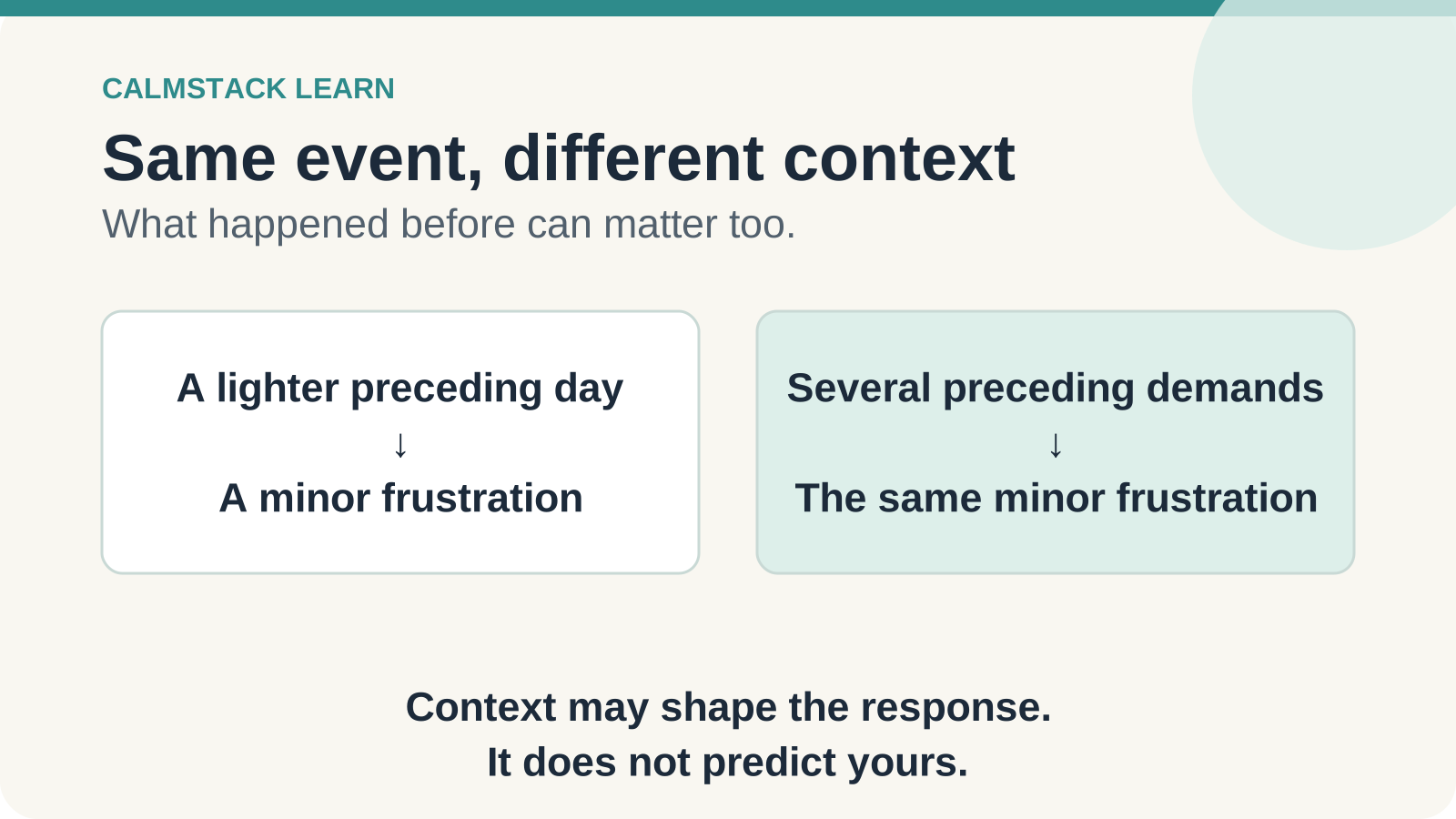
The event may be the same.
The surrounding conditions are not.
That gives us the useful click:
The frustration has not necessarily become bigger. The context in which you are meeting it has changed.
That does not make the feeling disappear.
It gives you more information about it.
One small thing to try
The next time something minor feels surprisingly big, do not immediately tell yourself you are overreacting.
Ask:
"Is this only about what just happened, or is some of the day arriving with it?"
Maybe it really is about what just happened.
Maybe it is partly about the six things before it.
Maybe you are tired.
Maybe you are still thinking about something earlier.
Maybe you simply need to deal with the problem in front of you.
You do not need to diagnose the whole day.
Just notice the context.
Sometimes understanding why this moment feels different is more useful than arguing with yourself about whether it should.
References
- Grillon, C., Quispe Escudero, D., Mathur, A., & Ernst, M. (2015). Mental fatigue impairs emotion regulation. Emotion, 15(3), 383-389. https://doi.org/10.1037/emo0000058
- Mey, L. K., Chmitorz, A., Kurth, K., Wenzel, M., Kalisch, R., Tüscher, O., & Kubiak, T. (2020). Increases of negative affect following daily hassles are not moderated by neuroticism: An ecological momentary assessment study. Stress and Health. https://doi.org/10.1002/smi.2964
- Schilling, O. K., & Diehl, M. (2014). Reactivity to stressor pile up in adulthood: Effects on daily negative and positive affect. Psychology and Aging, 29(1), 72-83. https://doi.org/10.1037/a0035500
- Schilling, O. K., Gerstorf, D., Lücke, A. J., Katzorreck, M., Wahl, H. W., Diehl, M., & Kunzmann, U. (2022). Emotional reactivity to daily stressors: Does stressor pile up within a day matter for young old and very old adults? Psychology and Aging, 37(2), 149-162. https://doi.org/10.1037/pag0000667
- Shields, G. S., Sazma, M. A., & Yonelinas, A. P. (2016). The effects of acute stress on core executive functions: A meta analysis and comparison with cortisol. Neuroscience & Biobehavioral Reviews, 68, 651-668. https://doi.org/10.1016/j.neubiorev.2016.06.038