How to respond when a colleague’s message feels abrupt
A short message can feel abrupt even when the sender’s intent is unknown. This article explores tone in digital communication, interpretation and practical ways to slow the jump from sparse wording to confident conclusions.
Published 5 September 2026 · Last evidence review 5 September 2026 · OASYS Editorial
Your colleague replies:
“Noted.”
That is it.
One word and a full stop.
Within seconds, you may be doing forensic linguistics.
Why the full stop?
Why not “Thanks”?
Are they annoyed?
Were they being deliberately cold?
Or did they type “Noted.” while walking between meetings and then forget the message existed?
Short digital messages create a peculiar problem. They are easy to send and sometimes surprisingly difficult to interpret.
Text carries fewer clues than conversation
When people speak face to face, meaning is carried by more than words.
Tone of voice, pace, expression, timing and immediate responses all help us interpret what is happening.
Many of those cues disappear in email and messaging.
Research by Justin Kruger and colleagues demonstrated that people can be overconfident about how successfully their intended tone travels through email. Writers have access to their own intention. Readers do not.
This creates an asymmetry.
The sender may think the message is obviously neutral.
The receiver may be trying to decide between neutral, irritated, sarcastic and “apparently we are enemies now”.
Ambiguity and incivility are not the same thing
There is an important line to draw here.
Some digital communication really is rude.
Workplace researchers use terms such as email incivility or cyber incivility for low-intensity disrespectful behaviour conducted through digital communication.
In a 2020 study, Zhenyu Yuan, YoungAh Park and Michael Sliter distinguished active email incivility from passive email incivility. Active forms included more direct disrespect, while passive forms involved behaviours such as ignoring requests.
The researchers found that active incivility was appraised as more emotionally charged, whereas passive incivility was experienced as more ambiguous.
A 2025 systematic review of 31 empirical studies likewise concluded that cyber incivility is associated with negative employee outcomes and that misinterpretation is one of the technology-related features relevant to the problem.
So CalmStack should not teach people to reinterpret every abrupt message as harmless.
Sometimes the communication is uncivil.
The difficulty is working out when the evidence supports that conclusion.
Abrupt is not a complete explanation
A message can feel abrupt for several reasons.
It may genuinely be dismissive.
It may be brief because the sender is busy.
It may reflect somebody’s normal writing style.
It may sound harsher because you were expecting warmth.
It may look unusually cold because a previous interaction has changed how you read it.
Or it may be ambiguous enough that there is no defensible answer yet.
Notice what this does to the regulation task.
The goal is not to choose the nicest interpretation.
The goal is to avoid choosing any interpretation more confidently than the evidence allows.
Do not make punctuation carry the whole case
Digital communication encourages us to treat tiny features as social evidence.
A full stop.
No greeting.
A reply two hours later.
“Okay” instead of “OK”.
Sometimes these differences matter within a relationship or workplace culture.
But one cue rarely provides enough information to support a large conclusion on its own.
This is particularly important when your emotional response is already strong, because the mind can begin gathering ambiguous details in support of the interpretation it reached first.
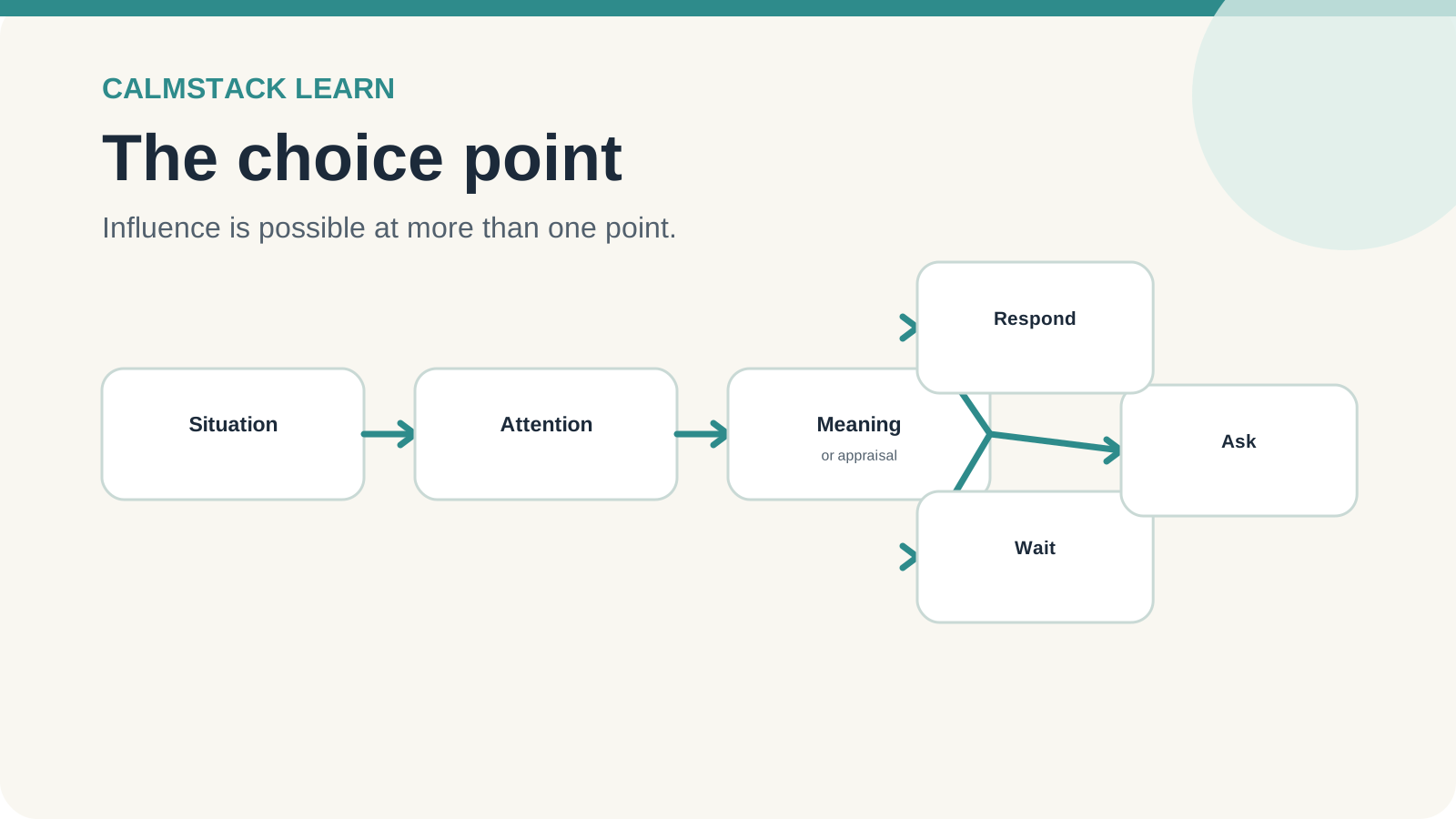
The response channel can be changed
One advantage of recognising ambiguity is that you are not trapped inside the same channel.
If a message matters and the tone is genuinely unclear, you can ask.
You can call.
You can speak in person.
Or you can reply to the content rather than the tone and see what happens next.
Not every “Noted.” requires a summit meeting.
But not every communication problem needs to be solved by staring harder at the punctuation either.
Do not confuse regulation with tolerating disrespect
There is another boundary worth keeping.
If abrupt or disrespectful communication becomes a repeated pattern, affects your work, or is part of wider workplace incivility, the issue may require an organisational response rather than a better private interpretation.
Emotional regulation can help you respond deliberately.
It should not be used to teach people to absorb poor treatment quietly.
The useful click
An abrupt message gives you the words the sender used.
It does not always give you reliable access to the state of mind that produced them.
You can respond to what was written before deciding that you know why it was written that way.
That preserves room for both possibilities: harmless brevity and genuine incivility.
One small question
When a colleague’s message feels sharp, ask:
What in the message is clear, and what am I inferring about the tone?
If the content itself is a problem, deal with the content.
If the tone is ambiguous, leave some uncertainty in the interpretation.
And if the pattern is consistently disrespectful, call the pattern what it is rather than endlessly explaining it away.
References
- Kruger, J., Epley, N., Parker, J., & Ng, Z.-W. (2005). Egocentrism over e-mail: Can we communicate as well as we think? Journal of Personality and Social Psychology, 89(6), 925–936. https://doi.org/10.1037/0022-3514.89.6.925
- Yuan, Z., Park, Y. A., & Sliter, M. T. (2020). Put you down versus tune you out: Further understanding active and passive e-mail incivility. Journal of Occupational Health Psychology, 25(5), 330–344. https://doi.org/10.1037/ocp0000215
- Ju, B. J., & Pak, S. (2025). Managing cyber incivility in digital workplaces: A systematic review and HR strategies. International Journal of Organizational Analysis, 33(8), 2799–2824. https://doi.org/10.1108/IJOA-09-2024-4789