What workplace stress can and cannot tell you about yourself
Feeling stressed at work does not automatically measure your resilience, competence or suitability for the job. This article uses Job Demands–Resources research to examine what workplace stress can reveal about conditions as well as the person experiencing them.
Published 5 September 2026 · Last evidence review 5 September 2026 · OASYS Editorial
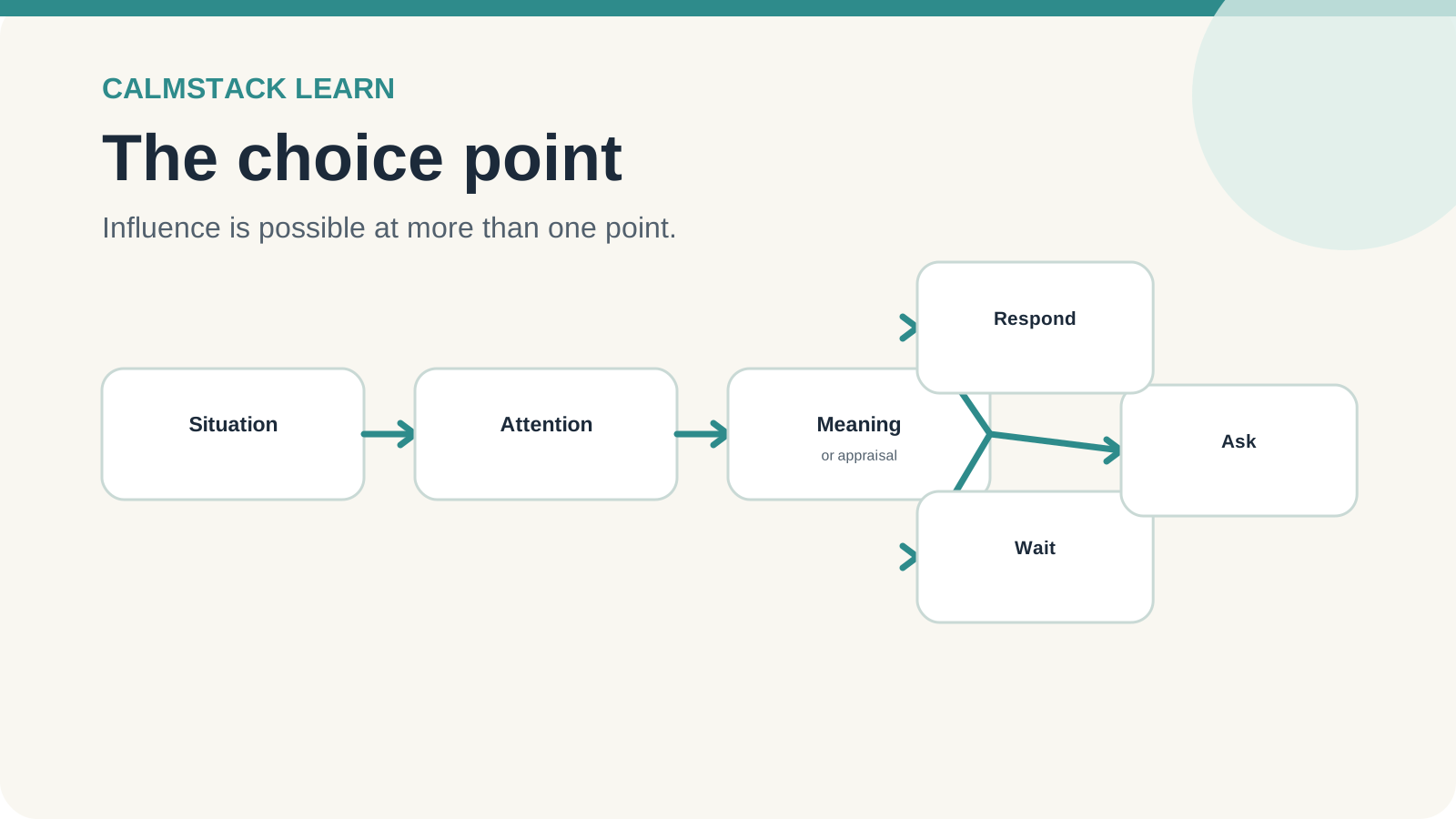
A difficult week at work can produce a very personal question.
Why am I finding this so hard?
It is an understandable question.
It is also an easy question to aim in the wrong direction.
If work is leaving you tired, irritable or unable to switch off, it can be tempting to treat the response as a measurement of your resilience, competence or suitability for the job.
Sometimes personal factors matter.
But workplace stress research gives us a much wider frame.
Stress at work is not produced by the worker alone.
Start with the conditions of the job
One of the most influential frameworks in occupational psychology is Job Demands–Resources theory.
The basic distinction is between job demands, which require sustained effort and can carry costs, and job resources, which help people meet demands, achieve work goals, learn and recover.
Demands can include workload, emotional demands, complexity, conflict or other aspects of work requiring effort.
Resources can include autonomy, support, useful feedback, knowledge and opportunities to influence how the work is done.
A 2023 Annual Review by Arnold Bakker, Evangelia Demerouti and Ana Sanz-Vergel summarised a large body of evidence showing that job demands and resources operate at individual, team and organisational levels.
That matters because it immediately rules out a purely character-based explanation of workplace strain.
Large meta-analyses find work conditions matter
This is not just a theory with an attractive diagram.
A meta-analysis of 203 independent samples involving 186,440 employees found that job demands were associated with burnout and that job resources such as autonomy, knowledge and supportive environments were associated with engagement and safety outcomes.
More recently, the 2026 meta-analysis of role stressors synthesised 515 studies and 787,959 participants. Role ambiguity, role conflict and role overload were all connected with important employee and organisational outcomes, with ambiguity emerging as particularly consequential overall.
These findings do not mean working conditions determine exactly how any individual will feel.
They do mean that a person’s response cannot sensibly be interpreted without looking at the environment producing the demands.
People still differ
Two people in the same job may not respond in the same way.
Experience matters.
Skills matter.
Health, sleep, life outside work and personal preferences can matter.
The meaning attached to a demand matters.
And some people have access to resources that others in the same organisation do not.
Job Demands–Resources theory has increasingly incorporated this person-by-situation interaction rather than pretending employees are interchangeable units.
So the opposite extreme is wrong too.
It would be misleading to say that workplace stress tells us nothing about the person.
It may tell you something about what you find demanding, what resources help you, where your boundaries are, or what kind of work context fits you better.
It just does not tell you those things in isolation from the job.
Strain is not a personality test
Suppose two people are carrying identical boxes.
One starts struggling after ten minutes.
You could ask what is different about the people.
You could also ask how heavy the boxes are, how far they have to walk, whether they were allowed a break, whether one person was already carrying something else, and why the boxes needed to be carried by hand in the first place.
Workplace stress deserves the same level of curiosity.
A reaction can contain information about the person and information about the system at the same time.
Stress can become reciprocal
The relationship between work and strain can also run in both directions.
A continuous-time meta-analysis of 48 longitudinal studies involving 26,319 people found reciprocal relationships between job stressors and burnout over time. Job stressors predicted later burnout to a small degree, while strain could also influence how later job stressors were experienced or reported.
That complexity is useful.
It prevents two bad conclusions.
The first is: “The job caused everything.”
The second is: “If I am struggling, the problem must be me.”
Real occupational stress processes are more interactive than either slogan.
Some demands belong to the organisation
This distinction has practical consequences.
If the recurring problem is unclear roles, impossible workload, poor staffing, low control, chronic interruptions or a culture of disrespect, an individual regulation technique cannot remove the source.
It may help you respond more deliberately in the moment.
It may help you notice the pattern more clearly.
But the organisation still owns organisational problems.
This is central to how CalmStack should talk about workplace wellbeing.
A personal tool can support a person without pretending every difficulty has a personal solution.
What stress can tell you
Workplace stress can tell you that something in the relationship between demands and available resources deserves attention.
It may tell you that a specific task is unusually demanding.
That uncertainty is costly.
That you need more control, clarity, support or recovery.
That a particular pattern repeats.
That a workplace condition needs changing.
Or that your current resources are stretched by things both inside and outside work.
Those are observations.
They are not verdicts on character.
The useful click
Feeling stressed at work is evidence that a person is responding to a set of demands.
It is not, by itself, evidence that the person is weak, unsuitable or failing.
To understand the response, you have to look at both sides of the relationship: the person and the conditions they are being asked to meet.
One small question
When work stress starts turning into self-judgement, ask:
What is this response telling me about the demands and resources around me, not just about me?
Perhaps there is a personal adjustment worth making.
Perhaps there is a work problem worth raising.
Perhaps both are true.
That is a more accurate starting point than converting a difficult week into a personality assessment.
References
- Bakker, A. B., Demerouti, E., & Sanz-Vergel, A. (2023). Job Demands–Resources Theory: Ten years later. Annual Review of Organizational Psychology and Organizational Behavior, 10, 25–53. https://doi.org/10.1146/annurev-orgpsych-120920-053933***
- Nahrgang, J. D., Morgeson, F. P., & Hofmann, D. A. (2011). Safety at work: A meta-analytic investigation of the link between job demands, job resources, burnout, engagement, and safety outcomes. Journal of Applied Psychology, 96(1), 71–94. https://doi.org/10.1037/a0021484***
- Sawhney, G., McCord, M. A., Cunningham, A., Cook, P., Adjei, K., & Flinn, T. (2026). A meta-analytic review of 60 years of role stressor research. Journal of Vocational Behavior, 167, 104234. https://doi.org/10.1016/j.jvb.2026.104234***
- Guthier, C., Dormann, C., & Voelkle, M. C. (2020). Reciprocal effects between job stressors and burnout: A continuous time meta-analysis of longitudinal studies. Psychological Bulletin, 146(12), 1146–1173. https://doi.org/10.1037/bul0000304***