Why an unclear message from your manager can occupy your attention
An unclear message from a manager can create far more uncertainty than its word count suggests. This article explores role ambiguity, hierarchy and missing communication cues, and why lack of clarity can itself become a meaningful work demand.
Published 5 September 2026 · Last evidence review 5 September 2026 · OASYS Editorial
Your manager sends: “Can you come and see me when you have a minute?”
There is no further information.
Which, of course, gives the mind plenty to work with.
Is something wrong?
Did I miss something?
Is this about yesterday?
By the time you walk across the office, you may have generated six possible conversations and prepared answers for four of them.
The message itself is short. The uncertainty it creates can occupy much more space.
Ambiguity creates work for the receiver
A message is ambiguous when it leaves important parts of its meaning unresolved.
At work, ambiguity can concern what is expected, what somebody means, what will happen next or how important a request is.
This is not merely an irritation invented by people who dislike vague emails.
Role ambiguity has been studied in organisational psychology for decades. A 2026 meta-analysis brought together 515 studies, 588 samples and 787,959 participants examining role ambiguity, role conflict and role overload. Of the three, role ambiguity emerged as the most detrimental overall across a range of employee and organisational outcomes.
That evidence concerns broader uncertainty about work roles, not one mysterious Teams message from a manager.
But it establishes an important principle: lack of clarity at work can itself function as a meaningful demand.
A manager’s message carries more than its words
The same sentence can feel different depending on who sends it.
“Can we talk?” from a colleague may be ordinary.
The same words from somebody who controls your workload, evaluates your performance or can change what happens next may carry more consequence.
The message therefore contains two things.
There are the literal words.
And there is everything you know about the relationship, hierarchy and possible consequences around them.
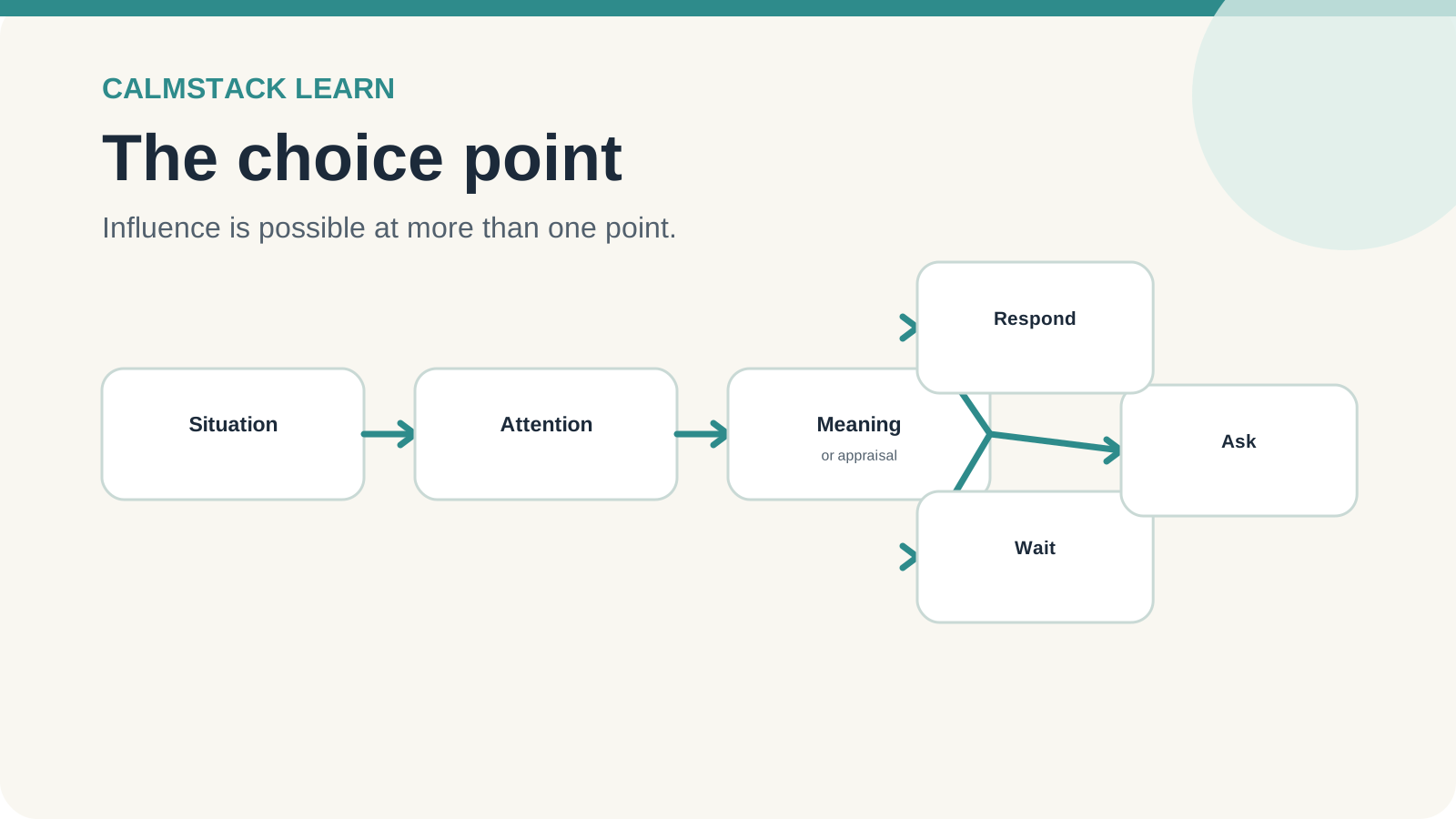
Appraisal research helps explain why this matters. Emotional responses are shaped partly by what an event appears to mean for goals, control, uncertainty and potential consequences.
An unclear message from a manager can score highly on uncertainty before it has said anything negative at all.
Written communication removes useful clues
Digital messages make this harder because many cues available in spoken conversation are missing.
There is no intonation.
No facial expression.
No immediate correction when you misunderstand the tone.
In a series of experiments, Justin Kruger and colleagues found that people were more confident in their ability to communicate tone by email than recipients were actually able to interpret it. The authors linked this partly to the difficulty of stepping outside our own perspective when writing.
The sender knows what they mean.
The receiver has the sentence.
That difference can be surprisingly expensive.
Uncertainty invites prediction
When information is missing, the mind does not simply leave a blank space.
It predicts.
Sometimes that prediction is neutral.
Sometimes it is optimistic.
Sometimes, especially when the stakes feel high, it starts preparing for a problem.
This is understandable. Prediction can be useful when action may soon be required.
The difficulty is that a prediction can begin to feel like evidence.
“I do not know why they want to see me” can quietly become “They want to see me because something is wrong.”
Those are not the same statement.
Ambiguity does not mean you are overreacting
It would be equally unhelpful to dismiss every uneasy response with “you are just reading into it”.
Managers can communicate poorly.
Workplaces can leave responsibilities unclear.
Important information can be withheld.
And sometimes an ominous-sounding message really is followed by a difficult conversation.
The point is not that your concern is irrational.
The point is that concern and evidence are different categories.
Clarity can be a practical intervention
If uncertainty is the problem, the most useful response may not be elaborate emotional regulation.
It may be information.
“Of course. Is there anything I need to bring?”
“Is this about the project?”
“Happy to. Is it urgent or can we catch up after lunch?”
A simple clarification question can reduce the number of possible situations your mind is trying to prepare for.
That is not reassurance seeking for its own sake.
It is sometimes just good communication.
The useful click
An unclear message can occupy attention not because it contains lots of information, but because it contains too little.
Ambiguity gives the mind several possible futures to prepare for at once.
That explains why seven words from a manager can compete successfully with the forty-page report sitting in front of you.
One small question
When an unclear message starts generating possibilities, ask:
What do I actually know from the message, and what am I predicting?
Then, if clarification is available and appropriate, get it.
You may discover there is a problem to deal with.
You may discover they want to ask where the stapler went.
Either is easier to work with than twelve imaginary conversations.
References
- Sawhney, G., McCord, M. A., Cunningham, A., Cook, P., Adjei, K., & Flinn, T. (2026). A meta-analytic review of 60 years of role stressor research. Journal of Vocational Behavior, 167, 104234. https://doi.org/10.1016/j.jvb.2026.104234***
- Kruger, J., Epley, N., Parker, J., & Ng, Z.-W. (2005). Egocentrism over e-mail: Can we communicate as well as we think? Journal of Personality and Social Psychology, 89(6), 925–936. https://doi.org/10.1037/0022-3514.89.6.925***
- O’Driscoll, M. P., & Beehr, T. A. (2000). Moderating effects of perceived control and need for clarity on the relationship between role stressors and employee affective reactions. The Journal of Social Psychology, 140(2), 151–159. https://doi.org/10.1080/00224540009600454***