How to pause before replying to an angry email
An email can feel rude, unfair or infuriating before we have finished deciding what it actually means. A short pause will not tell you whether the message is reasonable, but it can create room to separate what was written from what you have inferred and what you want to do next.
Published 3 September 2026 · Last evidence review 3 September 2026 · OASYS Editorial
An email arrives.
You read it once.
Then again.
By the third reading, you are no longer just reading the email.
You are preparing the prosecution.
You have identified the offending sentence.
Worked out what they obviously meant by it.
Remembered the last time they did something similar.
And drafted a reply beginning with:
"Just to be absolutely clear..."
Perhaps the email really is rude.
Perhaps the sender is wrong.
Perhaps something genuinely needs challenging.
But before any of that comes another question.
What was actually written, and what have I added to it?
That is where a pause can be useful.
Not because anger is automatically wrong.
Not because every difficult email is a misunderstanding.
And not because the correct workplace response is always to wait until tomorrow and write something pleasant.
A pause simply gives you another point at which to decide what happens next.
Email contains less information than a conversation
Face to face communication gives us more than words.
There is tone of voice.
Timing.
Facial expression.
Gesture.
Immediate clarification.
You can hear whether somebody sounds amused, irritated, uncertain or embarrassed.
Email gives us fewer of those cues.
That can create room for interpretation.
Classic research by Justin Kruger and colleagues found that people were often more confident about communicating tone by email than their actual accuracy justified.
Later experiments by Monica Riordan and Lauren Trichtinger reached a similar conclusion.
Writers and readers could both feel confident about the emotional meaning of an email while their accuracy was less reliable than that confidence suggested.
That is useful.
But it would be too easy to turn those studies into another universal rule:
"Nobody can understand tone in email."
More recent evidence complicates that story.
A 2025 study by Monique Pollmann and Carla Roos examined real text messages and emails rather than messages constructed only for laboratory experiments.
In their samples, the emotional valence intended by senders and perceived by receivers aligned well.
People can communicate tone successfully in text.
So the problem is not that email is emotionally unreadable.
The more useful point is:
we should not assume our interpretation is guaranteed simply because it feels obvious.
Context can change what one sentence means
Consider this email:
"I need this corrected today."
That might be rude.
It might be urgent.
It might be unusually blunt because the sender is rushing.
It might follow three previous conversations in which the work was not corrected.
It might come from somebody who writes every email like a telegram.
Or it might be exactly as irritated as it sounds.
The sentence alone does not always settle the question.
Research by Alan Sillars and Theodore Zorn looked at workplace emails that recipients had experienced as negative.
Recipients rated those messages more negatively than outside observers did.
Interestingly, the negativity was only weakly related to obvious features of the message itself.
Context mattered.
Power relationships mattered.
The wider communication climate mattered.
That does not mean the recipients were wrong.
The outside observers did not know everything the recipient knew.
A sentence that looks harmless to a stranger can carry a very different meaning after six months of working with the person who sent it.
That gives us a better way to think about email interpretation.
Sometimes we add something that is not there.
Sometimes we know something an outsider does not.
Often both text and context matter.
Your first interpretation can arrive very quickly
This connects directly to Article 3.
Something happens.
Your attention goes somewhere.
You interpret its meaning.
An emotional response begins to develop.
With an irritating email, attention can narrow around one phrase.
Perhaps there are twelve sentences and only one bothers you.
That becomes the sentence you reread.
Then the interpretation arrives.
"They're blaming me."
"They're questioning whether I did my job."
"They're being deliberately patronising."
Maybe that interpretation is right.
The point is not to replace it with a nicer one.
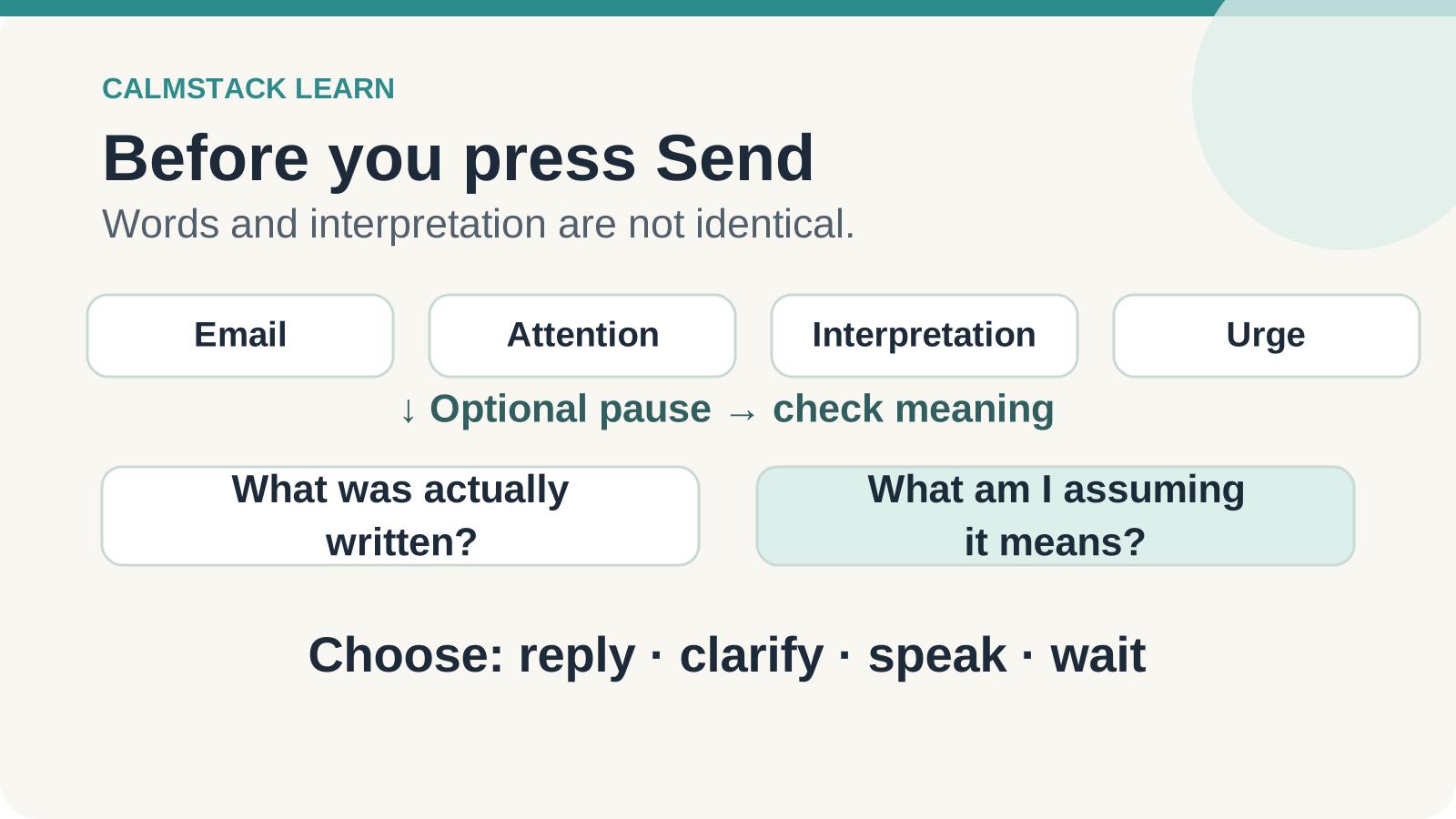
The point is to recognise that the words and your interpretation of the words are related, but they are not identical.
That small distinction gives you something to work with.
The state you are already in matters too
Article 5 looked at why a small frustration can feel different when the day has already been demanding.
Email does not arrive outside that context.
The same message can land differently at 9:30 in the morning than at 5:12 after three difficult meetings.
Again, that does not mean the email suddenly becomes acceptable because you are tired.
It means your current state is part of the situation.
If you notice yourself becoming unusually angry, it can be useful to ask whether some of the day has arrived with the message.
You might still decide the email deserves a firm response.
But you are making that decision with more information.
Sometimes the email really is uncivil
We should not turn every angry reaction into an interpretation error.
There is genuine workplace email incivility.
Rude, dismissive and disrespectful messages happen.
Research on cyber incivility has linked days involving uncivil work email with greater emotional and physical distress.
A daily study by YoungAh Park and colleagues found that workers reported more distress on days when they experienced cyber incivility, with some of that distress carrying into the following morning.
More recent research with Italian and British workers has also found associations between reported email incivility, emotional exhaustion and conflict between work and non work life.
These studies do not prove that one rude email causes exhaustion.
They show that digital communication can form part of a wider pattern of workplace strain.
So the aim of pausing is not:
"Convince yourself the other person probably meant well."
Sometimes they did not.
The aim is to decide what response best serves the situation.
Anger is information, not an email draft
Article 1 made an important distinction.
An emotion can tell you something without dictating what you do next.
Anger might tell you:
something feels unfair;
a boundary has been crossed;
you think you have been blamed wrongly;
you feel disrespected;
or something important needs correcting.
That information may be useful.
The first sentence your anger wants to send is a separate matter.
This is where Article 2 becomes relevant too.
Not immediately expressing something is not the same as pretending you do not feel it.
You can be angry and wait.
Angry and ask for clarification.
Angry and send a firm response.
Angry and decide this needs a conversation rather than another email.
Angry and respond immediately because the issue is genuinely urgent.
There is no universal rule saying:
"Never send an email when angry."
Sometimes a prompt response is necessary.
The useful part is having more than one possible response available.
What does the pause actually do?
A pause does not tell you whether your interpretation is correct.
It does not make rude behaviour acceptable.
And it does not guarantee that your eventual response will be wise.
What it can do is interrupt the movement from:
email arrives
to
meaning appears
to
reply sent
long enough to inspect part of the process.
That pause might last two minutes.
It might be the time it takes to get a drink.
It might simply mean writing the draft and not pressing Send immediately.
The research does not give us a magic number of minutes.
There is no scientifically established email cooling off period.
The point is not the timer.
The point is creating an opportunity to check what you are responding to.
Three questions are enough
Before sending the reply, try separating three things.
What was actually written?
Look at the words.
Not the history.
Not what you think they secretly believe.
The words.
What does the email definitely say?
What am I assuming it means?
Now look at your interpretation.
"They're blaming me."
"They think I'm incompetent."
"They're being deliberately rude."
Your interpretation may be correct.
You are not required to replace it with a positive one.
Just recognise that it is an interpretation.
Does this need a response now?
Sometimes yes.
Sometimes no.
Sometimes the right answer is not an email at all.
A short conversation may resolve ambiguity faster than six increasingly careful paragraphs.
The question is not:
"How long should I wait?"
It is:
"What response makes sense from here?"
The pause is not about becoming passive
This matters especially at work.
Advice to "pause" can easily sound like advice to tolerate poor behaviour.
That is not what we mean.
A pause can lead to a stronger response.
You may realise that the message contains a factual error.
That the request is unreasonable.
That you need to state a boundary clearly.
That somebody else needs to be involved.
Or that the issue should be documented rather than ignored.
Regulation is not the same as making every response softer.
Sometimes the most regulated response is direct.
The difference is that the response is chosen for a reason, rather than simply being the first available expression of the emotion.
What was written, and what did I add?
That is the click.
An email is partly text.
Your reaction also involves context, interpretation, previous experience and the state you were already in.
Sometimes the anger is telling you something important.
Sometimes an ambiguous sentence has acquired a meaning the sender did not intend.
Sometimes both are true.
You do not need to solve all of that before replying.
You only need enough space to notice that there may be more than one thing happening.
One small thing to try
The next time an email makes you angry, do not start with:
"How do I calm down?"
Start with three questions.
What was actually written?
What am I assuming it means?
Does this need a response now?
Then choose.
You may still send the firm email.
You may change two sentences.
You may ask a question instead.
You may decide to speak to the person.
Or you may realise that the draft beginning "Just to be absolutely clear..." can probably stay in Drafts for another five minutes.
That is not avoidance.
It is one more opportunity to decide what happens next.
References
- Bernuzzi, C., O'Shea, D., Setti, I., & Sommovigo, V. (2024). Mind your language! How and when victims of email incivility from colleagues experience work life conflict and emotional exhaustion. Current Psychology, 43, 17267 to 17281. https://doi.org/10.1007/s12144-024-05689-z
- Byron, K. (2008). Carrying too heavy a load? The communication and miscommunication of emotion by email. Academy of Management Review, 33(2), 309 to 327. https://doi.org/10.5465/AMR.2008.31193163
- Kruger, J., Epley, N., Parker, J., & Ng, Z. W. (2005). Egocentrism over e mail: Can we communicate as well as we think? Journal of Personality and Social Psychology, 89(6), 925 to 936. https://doi.org/10.1037/0022-3514.89.6.925
- Park, Y. A., Fritz, C., & Jex, S. M. (2018). Daily cyber incivility and distress: The moderating roles of resources at work and home. Journal of Management, 44(7), 2535 to 2557. https://doi.org/10.1177/0149206315576796
- Pollmann, M. M. H., & Roos, C. A. (2025). "I get u". People correctly interpret the tone of text messages and emails. Computers in Human Behavior Reports, 18, 100689. https://doi.org/10.1016/j.chbr.2025.100689
- Riordan, M. A., & Trichtinger, L. A. (2017). Overconfidence at the keyboard: Confidence and accuracy in interpreting affect in e mail exchanges. Human Communication Research, 43(1), 1 to 24. https://doi.org/10.1111/hcre.12093
- Sillars, A., & Zorn, T. E. (2021). Hypernegative interpretation of negatively perceived email at work. Management Communication Quarterly, 35(2), 171–200. https://doi.org/10.1177/0893318920979828