What do we mean by an emotional trigger?
What actually makes something a trigger? This article separates the cue itself from the meaning, prediction and learned associations that can make an ordinary message or situation feel immediately significant.
Published 5 September 2026 · Last evidence review 5 September 2026 · OASYS Editorial
The message says: “Can we talk later?”
That is all.
Three words and a question mark.
Yet your attention has already left whatever you were doing and begun assembling possibilities.
Did I do something wrong?
Is this bad news?
Why not just tell me now?
By the time “later” arrives, the message may have produced far more emotion than the conversation itself.
This is the sort of moment people often describe as being “triggered”.
The word is everywhere now. A comment can be a trigger. A smell can be a trigger. A certain tone of voice, an email subject line, a place, a memory, a look across a room.
But what does the term actually mean? And does calling something a trigger explain what happened?
A trigger is not an emotion button
In everyday language, an emotional trigger usually means something that reliably seems to precede a strong emotional response.
That can be a useful shorthand.
The problem starts when the shorthand becomes an explanation.
It can make it sound as though the outside event contains the emotional reaction inside it, like a button waiting to be pressed.
Psychological research gives us a more interesting picture.
Appraisal theories of emotion propose that emotional responses depend partly on how an event is interpreted: whether it matters to us, whether it helps or obstructs a goal, whether it seems threatening, controllable, unfair, uncertain or relevant to something we value.
A major meta-analysis published in 2024 brought together 2,634 effect sizes from 309 studies across 251 reports. It found substantial evidence linking particular patterns of appraisal with particular emotions, while also showing that the relationships are not perfectly simple or uniform.
So the same event does not necessarily produce the same emotion in everybody.
It does not necessarily produce the same emotion in you every time either.
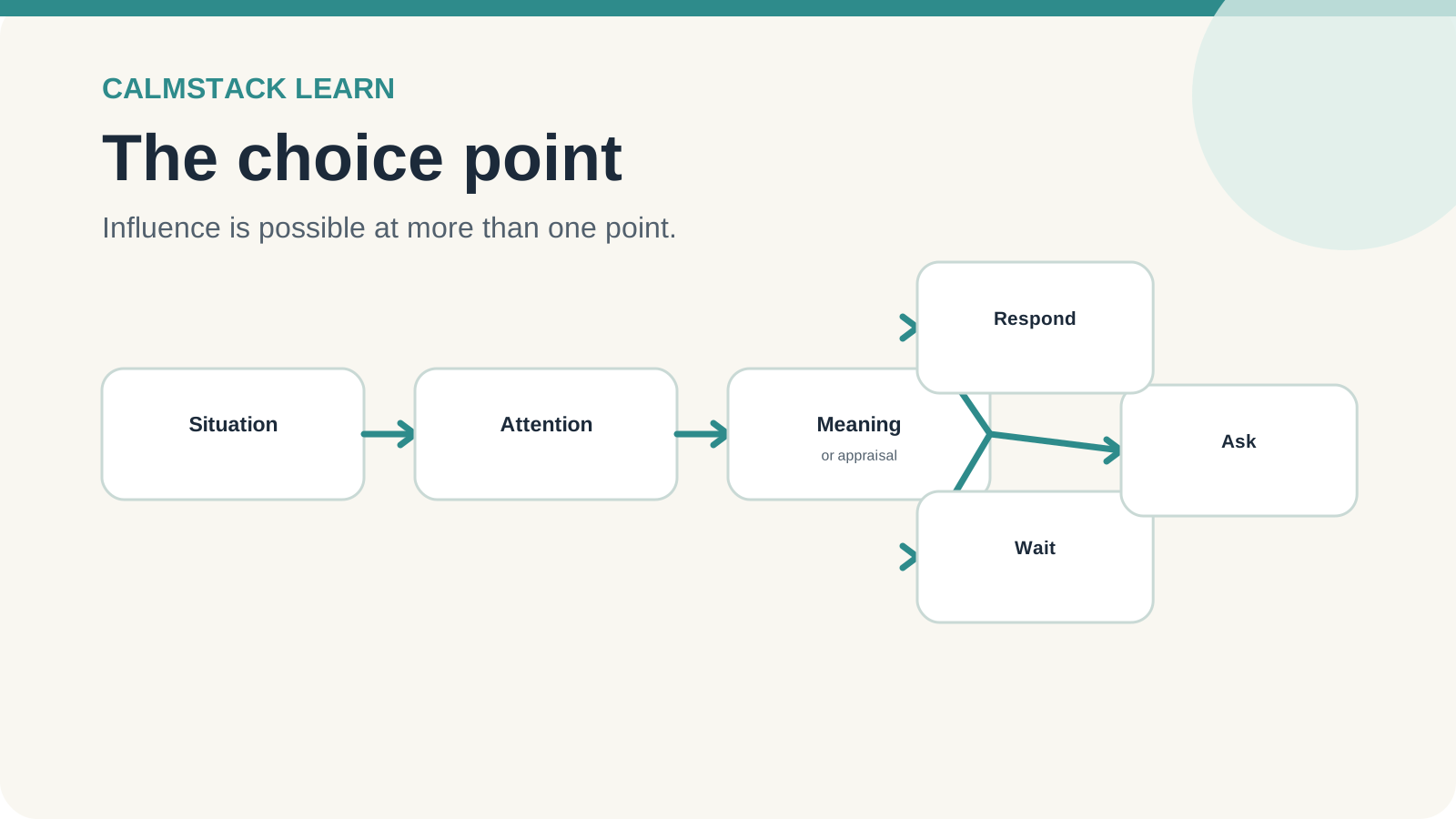
The event matters, but so does what it means
Imagine somebody walks past you at work without saying hello.
One interpretation is: they did not see me.
Another is: they are in a rush.
Another is: they are annoyed with me.
Another is: they always do this because they do not respect me.
The physical event is almost identical in each version.
The meaning is not.
Researchers Klaus Scherer and Agnes Moors describe emotion as a process in which events are evaluated for their significance before the experience is categorised and labelled as a particular emotion.
This does not mean we sit down and consciously complete an appraisal questionnaire every time someone fails to say hello. Much of this evaluation can happen rapidly.
It means the emotional response is shaped by the relationship between the event and what that event appears to mean for you in that moment.
That helps explain why a supposedly small event can sometimes carry a surprisingly large response.
The event may be small.
Its meaning may not be.
Why the same trigger does not always work
If a trigger were simply an emotional switch, we would expect a fairly reliable one-to-one relationship: event happens, emotion follows.
Real life is less tidy.
A remark that irritates you on Monday might barely register on Wednesday.
A delayed reply might feel threatening when a relationship already feels uncertain, but completely ordinary when everything feels secure.
A difficult task can look like a challenge when you feel prepared and like a threat when you do not.
Research on stress appraisal makes this point clearly. Responses depend not only on perceived demands but also on the resources people believe they have available to meet those demands.
This is one reason emotional patterns are useful without being destiny.
You can notice that certain situations often precede a particular reaction without concluding that the situation has permanent control over you.
A trigger can also be inside the person
Triggers are usually talked about as things in the outside world.
But the event that begins an emotional sequence does not always arrive from outside.
A memory can do it.
So can an image, an expectation, a physical sensation or a thought about what might happen next.
That is another reason the word needs care.
If we only hunt for external triggers, we can miss the interpretation that is actually giving the moment its significance.
The useful question is often not just: What triggered me?
It is: What did this moment seem to mean?
Not every strong reaction needs a label
There is also a cultural problem with the word.
“Triggered” has become so common that it can now mean anything from a clinically significant trauma-related cue to ordinary annoyance.
Those are not interchangeable.
CalmStack is not using the term diagnostically, and a strong response to something does not by itself tell you that you have a disorder, a trauma history or a hidden psychological wound.
Sometimes somebody is simply being irritating.
Sometimes a situation matters because the consequences are real.
Sometimes the reaction is being influenced by tiredness, uncertainty, previous experience, current pressure or what you believe is about to happen.
The job is not to pathologise the reaction.
It is to understand it more accurately.
The useful click
Calling something a trigger can identify where a sequence began.
It does not necessarily explain why the sequence took the shape it did.
The event may start the moment. The meaning you give the event helps shape what happens next.
That is a much more useful idea than imagining emotions as buttons other people press.
One small question
The next time you notice a familiar reaction arriving quickly, try asking:
What did this moment seem to mean to me?
You may notice threat.
Disrespect.
Uncertainty.
Loss of control.
Embarrassment.
Rejection.
Or you may decide the situation was simply unpleasant and your first interpretation was perfectly reasonable.
Either way, you have moved from naming the trigger to understanding the process.
References
- Scherer, K. R., & Moors, A. (2019). The emotion process: Event appraisal and component differentiation. Annual Review of Psychology, 70, 719–745. https://doi.org/10.1146/annurev-psych-122216-011854
- Siemer, M., Mauss, I., & Gross, J. J. (2007). Same situation, different emotions: How appraisals shape our emotions. Emotion, 7(3), 592–600. https://doi.org/10.1037/1528-3542.7.3.592
- Kiecolt-Glaser, J. K., Renna, M. E., Shrout, M. R., & Madison, A. A. (2020). Stress reactivity: What pushes us higher, faster, and longer—and why it matters. Current Directions in Psychological Science, 29(5), 492–498. https://doi.org/10.1177/0963721420949521