Why trying not to think about something can make it harder to ignore
Trying not to think about something can require repeatedly checking whether the thought is still there. This article explores why deliberate thought suppression can sometimes make the unwanted thought more noticeable rather than less.
Published 5 September 2026 · Last evidence review 5 September 2026 · OASYS Editorial
Do not think about a white bear.
Not its fur.
Not its paws.
Definitely not the fact that, having been told not to think about it, you are now checking whether you are thinking about it.
The white bear is an old psychology demonstration, but the everyday version is familiar.
Do not think about the argument.
Stop replaying the mistake.
Forget the embarrassing thing you said.
Do not worry about tomorrow.
The instruction sounds sensible. If a thought is unpleasant, why not simply remove it?
Because deliberately trying not to think something can create a peculiar problem: part of the job requires keeping track of the very thought you are trying to avoid.
Suppression can work for a while
There is a popular version of this research that says thought suppression always backfires immediately.
That is too simple.
A 2020 meta-analysis examined 31 studies using versions of the classic thought-suppression paradigm.
The researchers distinguished between two effects.
The first was immediate enhancement: the unwanted thought becoming more frequent while people were actively trying to suppress it.
The second was rebound: the thought becoming more accessible afterwards.
Rebound effects were found consistently across the studies.
Immediate enhancement was much less straightforward. It appeared particularly when people were also under cognitive load.
So people can sometimes push a thought away temporarily.
The problem is what that effort may leave behind.
To avoid a thought, you have to notice it
Daniel Wegner’s influential ironic-process account proposed that deliberate suppression involves two interacting processes.
One process tries to direct attention elsewhere.
Another monitors for signs that the unwanted thought has returned.
And there is the trap.
To check whether you are successfully not thinking about something, part of your mind has to keep the target available enough to recognise it.
It is a little like appointing somebody to stand at the office door all day looking for a person who absolutely must not be mentioned.
The surveillance keeps the person surprisingly relevant.
This does not mean the theory explains every unwanted thought or every failed attempt at suppression. Later reviews have pointed out important methodological problems and inconsistencies in the literature.
But the broader rebound finding has survived repeated quantitative review.
Busy minds make the task harder
The cognitive-load finding is particularly useful in ordinary life.
Imagine trying not to think about a difficult conversation while also finishing a report, answering messages, remembering to buy something on the way home and listening to somebody explain a problem you have already heard twice.
Suppression itself requires effort.
When other demands compete for the same limited attention, maintaining that suppression may become more difficult.
That gives us a useful connection with everyday regulation.
The thought may not be returning because it is secretly important, prophetic or revealing some hidden truth.
It may simply be difficult to keep deliberately excluded while everything else is demanding attention too.
Unwanted thoughts are not instructions
There is another reason to be careful here.
People often treat the return of a thought as evidence about the thought itself.
If I keep thinking about it, perhaps it must matter.
If the worry keeps returning, perhaps the danger is real.
If the memory keeps appearing, perhaps I have not dealt with it properly.
None of those conclusions follows automatically.
The frequency of a thought and the truth of a thought are different things.
A thought can become mentally accessible because you have been monitoring for it.
That does not make its content correct.
This is not an instruction to think about everything
There is an equally unhelpful reaction to suppression research: the claim that people should never distract themselves or deliberately move their attention.
That is not what the evidence says either.
Attention can be redirected deliberately and usefully.
There are moments when postponing a problem is sensible because you cannot do anything useful with it right now.
The distinction is between choosing where to place attention and repeatedly fighting with the existence of a thought.
“I am not dealing with this until tomorrow” is not quite the same mental task as “I must not think about this.”
The useful click
When an unwanted thought keeps returning, the obvious response is to push harder.
But pushing harder may keep the target mentally active.
Trying to remove a thought can accidentally give your mind another reason to keep checking for it.
That does not mean every thought should be explored.
It means recurrence is not proof that suppression needs more force.
A small alternative
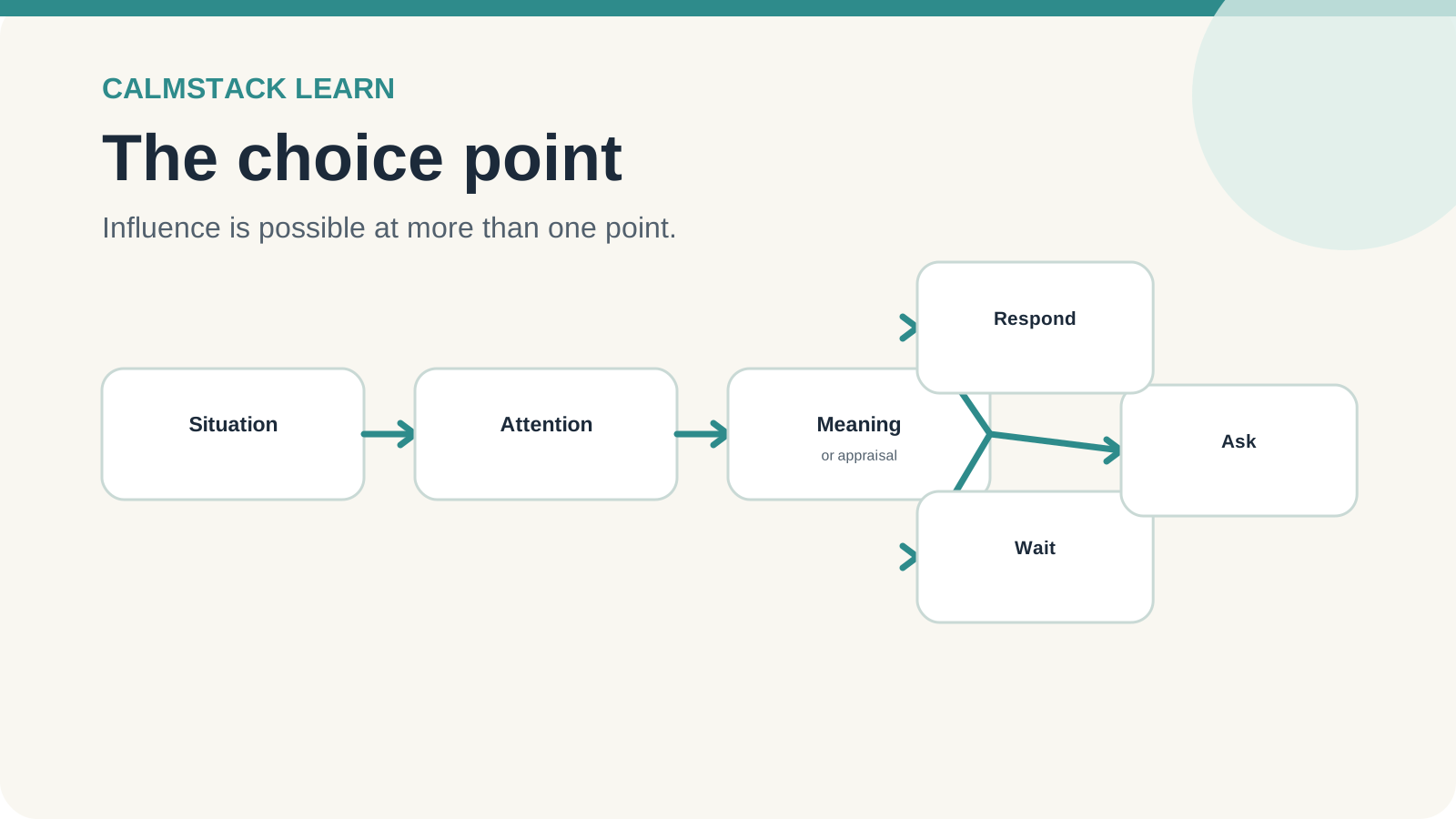
When you notice yourself repeatedly trying to eject the same thought, try changing the instruction.
Instead of:
I must stop thinking about this.
Try:
I have noticed the thought. Does anything need doing about it now?
If yes, decide what the next action is.
If no, you can return your attention to what you were doing without first requiring the thought to disappear.
That is a smaller ambition.
It may also be a more workable one.
References
- Wang, D. A., Hagger, M. S., & Chatzisarantis, N. L. D. (2020). Ironic effects of thought suppression: A meta-analysis. Perspectives on Psychological Science, 15(3), 778–793. https://doi.org/10.1177/1745691619898795
- Abramowitz, J. S., Tolin, D. F., & Street, G. P. (2001). Paradoxical effects of thought suppression: A meta-analysis of controlled studies. Clinical Psychology Review, 21(5), 683–703. https://doi.org/10.1016/S0272-7358(00)00057-X
- Purdon, C. (2020). Thought suppression. Oxford Research Encyclopedia of Psychology. https://doi.org/10.1093/acrefore/9780190236557.013.84