Why emotions can feel harder to manage when you’re tired
Why can a small frustration feel manageable one day and much harder when you are tired? This article looks at how sleep loss can affect mood, attention, emotional reactivity and the processes involved in regulation.
Published 5 September 2026 · Last evidence review 5 September 2026 · OASYS Editorial
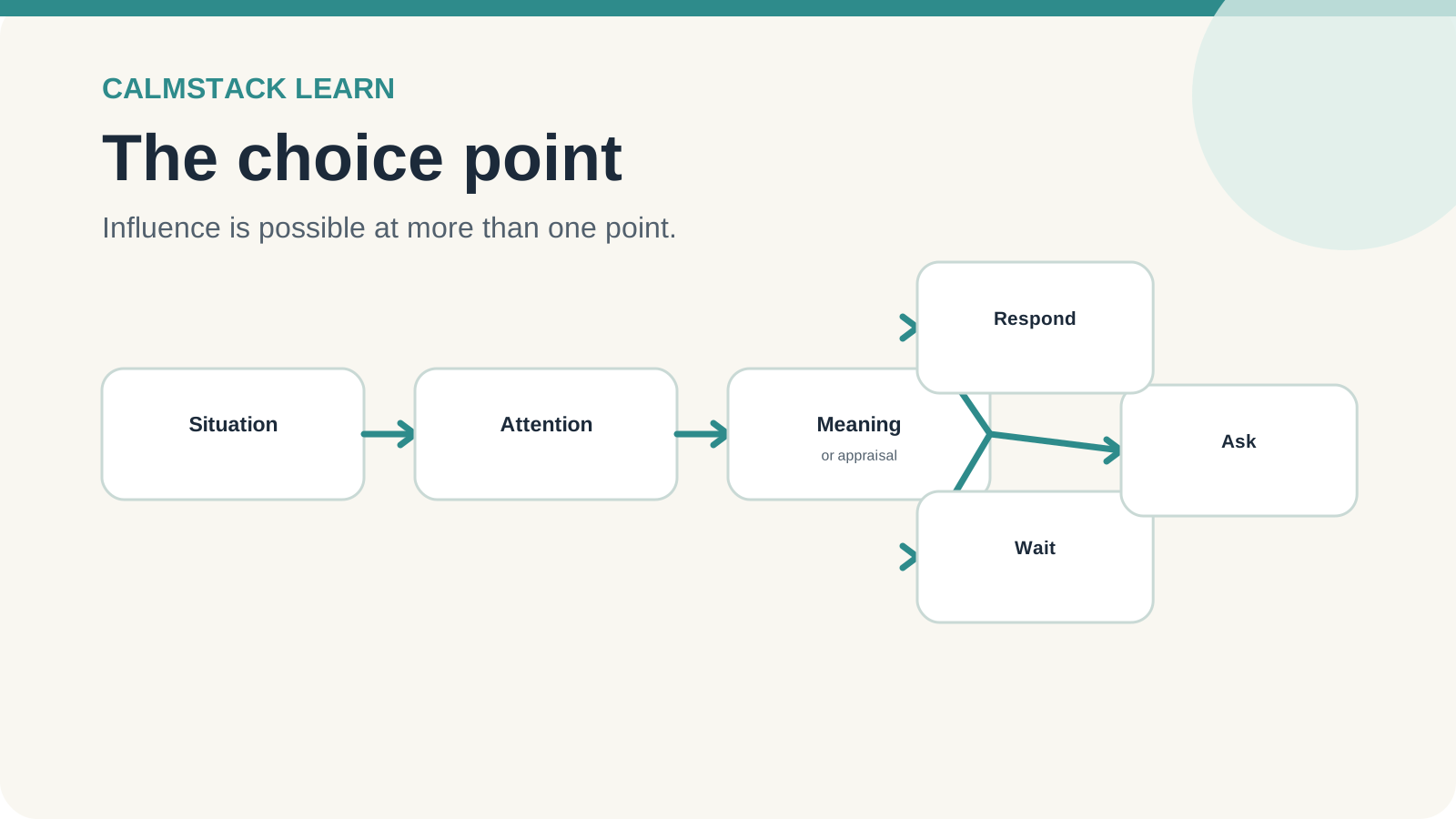
At ten in the morning, someone forgetting to attach a document to an email is mildly inconvenient.
At ten at night, after a long day and not enough sleep, the same missing attachment can somehow feel like evidence that civilisation has finally given up.
The document has not changed.
So what has?
Tiredness is often treated as if it simply turns up the volume on emotions. There is some truth in the idea that sleep affects how we feel, but the evidence is more interesting than “tired people get grumpy”.
Sleep loss appears to change several parts of our emotional experience at once. It can affect mood, attention, emotional reactivity and some of the processes involved in regulating what we feel.
That means the situation in front of you may be exactly the same.
The condition in which you are meeting it is not.
Sleep changes the emotional background
One of the clearest findings comes from a large systematic review and meta-analysis published in 2024.
Researchers brought together more than 50 years of experimental research on sleep loss, covering 154 studies, 1,338 effect sizes and 5,717 participants.
The studies included different ways of disrupting sleep, including staying awake for an extended period, restricting the amount of sleep people were allowed and repeatedly interrupting sleep.
Across these experiments, sleep loss reliably reduced positive feelings and increased anxiety symptoms.
It also altered people’s responses to emotional material.
The researchers did not find one neat effect in which every negative emotion simply became stronger. Some outcomes depended on the kind of sleep disruption being studied, and findings for negative affect were mixed.
That matters.
It would be tempting to say that tiredness makes everything feel worse.
The research does not justify something that simple.
What it does suggest is that inadequate sleep changes the emotional conditions in which the rest of the day takes place.
You may have less positive affect available in the background. You may feel more anxious. Your responses to emotionally meaningful events may be different.
Then the printer jams.
Or somebody replies with “Fine.”
Or your child asks the same question for the fourth time.
Or you discover that the thing you thought you had finished at work has somehow returned wearing another spreadsheet.
None of those events contains a fixed quantity of irritation.
Your response emerges from the interaction between what has happened and the state you are already in.
Feeling something and regulating it are not the same thing
There is another distinction worth making.
Researchers often separate emotional reactivity from emotion regulation.
Emotional reactivity concerns the response that arises when something happens.
Emotion regulation concerns what we do, deliberately or automatically, that influences that emotional response.
Those are connected, but they are not identical.
This becomes important when people hear claims such as:
“Lack of sleep switches off your ability to regulate emotions.”
That is too strong.
A 2024 comprehensive review of objective sleep and affect regulation found a clear relationship between sleep and emotional regulatory processes, but the picture differed depending on what kind of regulation researchers were measuring.
Evidence involving some more automatic forms of regulation was reasonably consistent.
Studies of deliberate strategies, such as consciously reinterpreting a situation, were less consistent.
In other words, poor sleep matters, but science has not demonstrated a simple on-off switch where a tired brain suddenly loses the capacity to regulate emotion.
You can still pause.
You can still interpret something differently.
You can still decide not to send the email you have just mentally titled An Exhaustive List of Your Failings.
It may simply be happening under different conditions.
Tiredness can change what the moment asks of you
Think about a familiar situation.
Someone says something slightly abrupt.
On one day, you notice it and carry on.
On another, you think:
What did they mean by that?
Then:
Actually, they have been like this with me all week.
Then:
I knew something was going on.
Five minutes later, an entire case has been assembled from a seven-word message.
The important question is not whether the emotional response is “real”.
It is.
The useful question is whether the response tells you only about the event that just happened.
Sometimes it does.
Sometimes it also tells you something about the condition in which you encountered it.
That condition can include what happened earlier in the day, how much pressure you are already carrying, whether you have eaten, what you expect to happen next and, importantly, how rested you are.
This is one reason identical situations do not always produce identical responses.
Humans do not arrive at each moment reset to zero.
We bring the rest of the day with us.
Sleep does not make the situation imaginary
There is a trap here.
Once we recognise that tiredness can influence emotional experience, it is easy to dismiss a reaction with:
“You’re only upset because you’re tired.”
That does not follow.
Being tired does not mean the problem is imaginary.
A rude comment can still be rude.
An unreasonable request can still be unreasonable.
A difficult conversation may still require another conversation tomorrow.
The fact that your current state may be influencing the intensity, speed or shape of your response does not tell you whether the underlying situation matters.
That is one reason emotional regulation is different from emotional suppression.
The aim is not to explain the emotion away.
It is to create enough room to understand what is happening before deciding what to do with it.
The useful distinction is not tired versus rational
We sometimes talk about tiredness as though there are two versions of us.
The sensible daytime version.
And the strange nocturnal creature who considers moving to another country because somebody left a mug beside the sink.
The distinction is not really rational versus irrational.
Your brain and body are continuously responding to changing conditions.
Sleep is one of those conditions.
Research suggests that sleep loss can alter emotional functioning, but it does not mean every tired response is exaggerated, nor that every well-rested response is correct.
What changes is the context in which the regulation task is happening.
And that produces a useful click:
The problem may not have become bigger. You may be meeting it with different resources.
That does not tell you to ignore the problem.
It tells you to include your current state when interpreting your response to it.
A small question before you react
You do not need to perform a sleep assessment every time somebody irritates you.
But when a reaction feels unusually strong, particularly late in a long day, one additional question can be useful:
Would this feel the same if I were rested?
You do not have to know the answer.
The question itself creates a little separation between the event and your first interpretation of it.
Perhaps the answer is yes.
Perhaps the conversation really does need dealing with.
Perhaps the answer is no.
Perhaps tomorrow morning the missing attachment will return to being a missing attachment rather than a declaration of war.
Either way, you have gained information.
And sometimes that is all a pause needs to do.
References
- Palmer, C. A., Bower, J. L., Cho, K. W., Clementi, M. A., Lau, S., Oosterhoff, B., & Alfano, C. A. (2024). Sleep loss and emotion: A systematic review and meta-analysis of over 50 years of experimental research. Psychological Bulletin, 150(4), 440–463. https://doi.org/10.1037/bul0000410
- Straus, L. D., ten Brink, M., Sikka, P., Srivastava, R., Gross, J. J., & Colvonen, P. J. (2024). The role of objective sleep in implicit and explicit affect regulation: A comprehensive review. Neurobiology of Stress, 31, 100655. https://doi.org/10.1016/j.ynstr.2024.100655