Why CalmStack asks what is happening now
Why does CalmStack focus on what is happening now instead of asking for a sweeping explanation of who you are? This article explores the value and limits of momentary information, context and present-focused observation.
Published 5 September 2026 · Last evidence review 5 September 2026 · OASYS Editorial
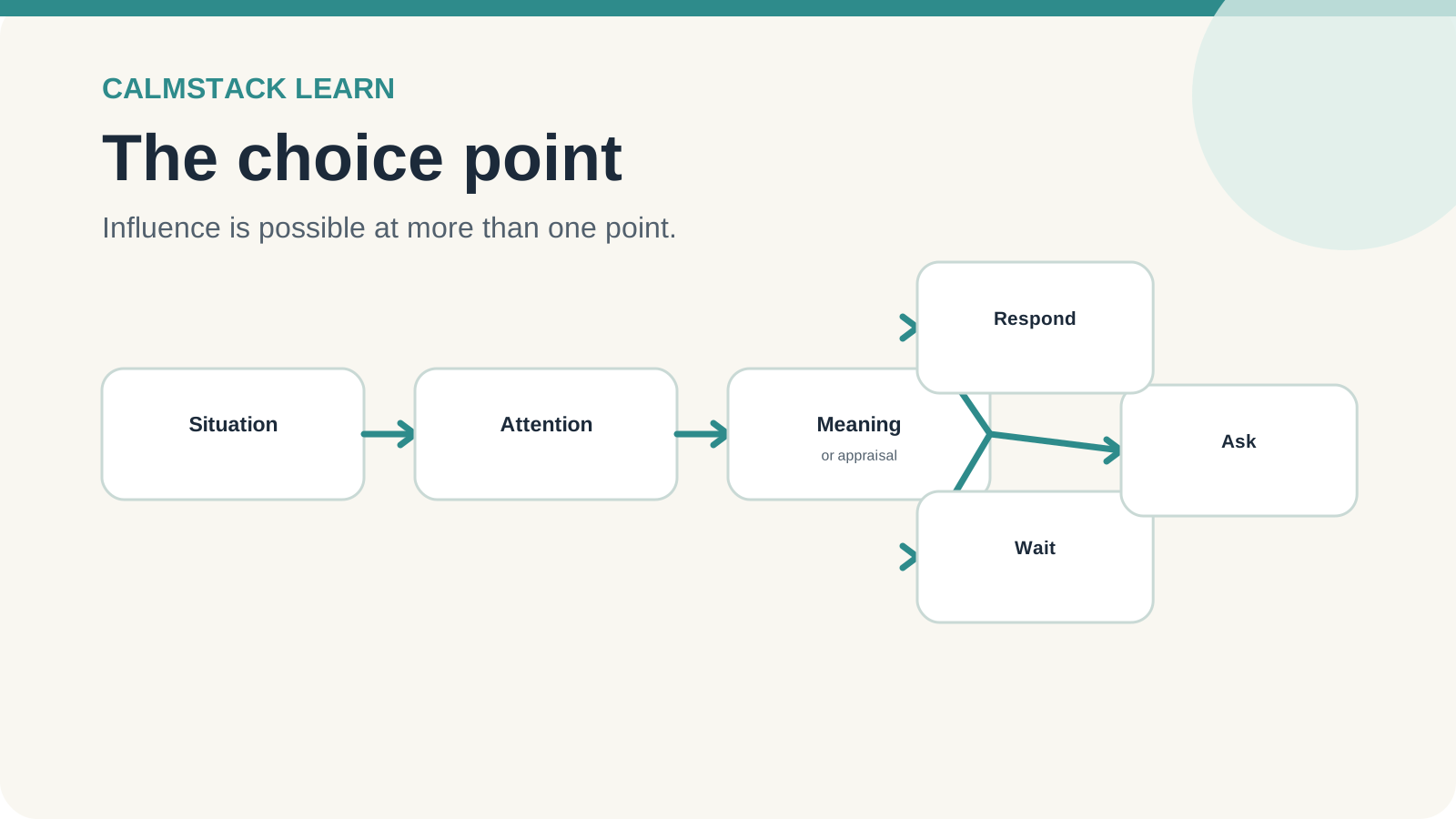
You can describe a difficult day perfectly well afterwards.
At least, it can feel that way.
By evening, the story has usually acquired a beginning, a middle and an explanation.
The meeting was stressful.
The email annoyed you.
The afternoon was a write-off.
That summary may be useful.
It is also different from asking what was happening at 2:17, while the meeting was still fresh and before the rest of the day had been added to it.
CalmStack asks about what is happening now because emotional experience changes across time and context. If you want to understand those changes, timing matters.
Memory gives us a summary, not a replay
Most ordinary reflection is retrospective.
How was your day?
How stressed were you this week?
How have you been feeling lately?
Those questions are useful, but they ask memory to compress many separate moments into one answer.
Ecological momentary assessment, usually shortened to EMA, was developed partly to study experience differently.
In their influential review, Saul Shiffman, Arthur Stone and Michael Hufford described EMA as repeated sampling of people's current behaviours and experiences in their natural environments.
The aim is not to declare memory useless.
It is to reduce the amount of reconstruction required and to observe how experience changes over time and across real-world situations.
That difference matters to CalmStack.
A weekly answer can tell you something about the week.
A check-in during a difficult afternoon can tell you something about that particular afternoon.
They are not competing forms of truth.
They answer different questions.
“Now” makes context visible
Suppose you tell somebody that work has been stressful recently.
That can be completely accurate.
But what is producing the stress?
Monday mornings?
One particular meeting?
Unclear messages from a manager?
Interruptions when you are trying to concentrate?
The final hour of the day when you are tired?
Or a mixture that changes from one day to another?
Repeated in-the-moment observations can help reveal that variation.
This is one reason EMA is useful in psychological research. Rather than treating a person as though they have one fixed level of stress, mood or emotional regulation, researchers can examine variation within the same person across different moments.
That idea sits underneath much of the CalmStack library.
The same problem can feel different on different days.
Tiredness can change the conditions in which you meet an irritation.
Several small demands can pile up.
An awkward interaction can continue afterwards as rumination.
Context matters.
Asking about now gives some of that context a chance to remain visible.
A Check-in is still self-report
There is an important boundary here.
Asking closer to the moment does not turn a subjective report into an objective measurement.
If you rate your distress as 7 out of 10, CalmStack has recorded that you reported 7 out of 10.
It has not measured a hidden biological quantity called “distress” and discovered that you contain exactly seven units of it.
EMA can reduce some problems associated with long retrospective recall and can capture repeated within-person change.
It does not remove interpretation, response bias, missing data or measurement error.
Nor does a Check-in tell CalmStack what caused the feeling.
That distinction is essential.
Patterns are clues, not verdicts
Imagine that several of your higher-pressure Check-ins happen late in the working day.
That pattern might be useful.
It does not prove that time of day causes the pressure.
Perhaps difficult meetings tend to be scheduled then.
Perhaps you are usually tired.
Perhaps that is when deadlines converge.
Perhaps you are simply more likely to use CalmStack when the afternoon is difficult.
The repeated observation can point towards a question.
It cannot settle the question by itself.
Course 01 describes tracking in exactly this spirit: track to learn, not to judge.
That is why CalmStack should resist turning Check-ins into personality categories, diagnoses or deterministic predictions.
A repeated pattern is information worth examining.
It is not a verdict about who you are.
Why the Foundations course starts with noticing
Course 01 introduces Red–Amber–Green (RAG) as an optional reflection map alongside personal cues and recurring patterns.
That is deliberate.
The first job is not to produce a sophisticated explanation.
It is to notice what is happening with enough accuracy to make the next move more deliberate.
RED means signal received.
AMBER is the working zone where some awareness and choice are available.
GREEN describes a steadier state to recognise and protect.
The labels are not objective physiological states, they are not diagnostic categories, and nobody has to choose one for every moment.
They are a simple psychoeducational map for organising experience when the map feels useful.
A Check-in supports the same job.
What seems closest to your experience right now — a RAG label, your own words, or no label at all?
What cue helped you choose that answer?
What happened around the moment?
What helped, even slightly?
The value is in observation close enough to the event that some of the surrounding detail has not yet been flattened into a general story.
CalmStack's own research used this logic
The first CalmStack study used a 14-day within-person EMA design.
Eleven adults were tracked across a four-day baseline period and a ten-day intervention period, with repeated prompts during ordinary daily life.
The study generated 941 observations, including 625 paired distress observations.
When reported distress reached the study threshold, participants were offered a brief combined intervention involving emotion labeling, paced breathing and a one-line cognitive reframe.
Average post-intervention distress ratings were lower than pre-intervention ratings across the paired observations, and participants rated the intervention positively for perceived helpfulness.
Those results are encouraging.
They do not establish that CalmStack caused the reductions.
The study was small, used self-report, had no randomised control condition, and could not rule out explanations such as natural fluctuation, regression towards the mean or effects of self-monitoring itself.
That is why CalmStack describes the study as feasibility-focused and preliminary.
The important point for this article is methodological.
The study was interested in what happened within events and across repeated moments, not only in a single summary at the end.
“Now” does not mean ignore the bigger picture
There is a risk in becoming too interested in moments.
A difficult workplace may still be a difficult workplace.
Repeated criticism may still be a pattern.
Poor sleep may still be a broader problem.
A thirty-second Check-in should not shrink structural issues into private emotional events.
The moment matters because it gives us detail.
The wider pattern matters because it gives that detail context.
CalmStack needs both.
This is also why Course 01 includes later pattern review rather than treating each Check-in as an isolated event.
Notice now.
Review later.
Learn from the relationship between the two.
The useful click
Retrospective reflection tells you the story you can see afterwards.
In-the-moment observation can preserve some of the information that existed before the story was finished.
CalmStack asks what is happening now because the moment contains context that a later summary may compress or lose.
That does not make the Check-in more “true”.
It makes it a different kind of information.
One small question
The next time you notice a shift in your state, ask:
What is happening around this feeling right now?
Not why am I always like this?
Not what does this say about me?
Right now.
The time.
The place.
The demand.
The thought.
The person.
The body cue.
You may find nothing important.
Or you may notice a pattern that would have disappeared by the time somebody asked how your week had been.
References
- Shiffman, S., Stone, A. A., & Hufford, M. R. (2008). Ecological momentary assessment. Annual Review of Clinical Psychology, 4, 1–32. https://doi.org/10.1146/annurev.clinpsy.3.022806.091415
- Trull, T. J., & Ebner-Priemer, U. W. (2020). Ambulatory assessment in psychopathology research: A review of recommended reporting guidelines and current practices. Journal of Abnormal Psychology, 129(1), 56–63. https://doi.org/10.1037/abn0000473
- Thompson, C. (2026). Evaluating a digital micro-intervention for real-time emotion regulation: A within-person EMA study. Undergraduate dissertation, Nottingham Trent University. CalmStack Research Archive.