Why naming an emotion can sometimes change what happens next
Putting a word to an emotion does not solve the situation, but it can change what becomes available next. This article explores what emotion labelling may do, what the evidence can and cannot establish, and why precision matters.
Published 5 September 2026 · Last evidence review 5 September 2026 · OASYS Editorial
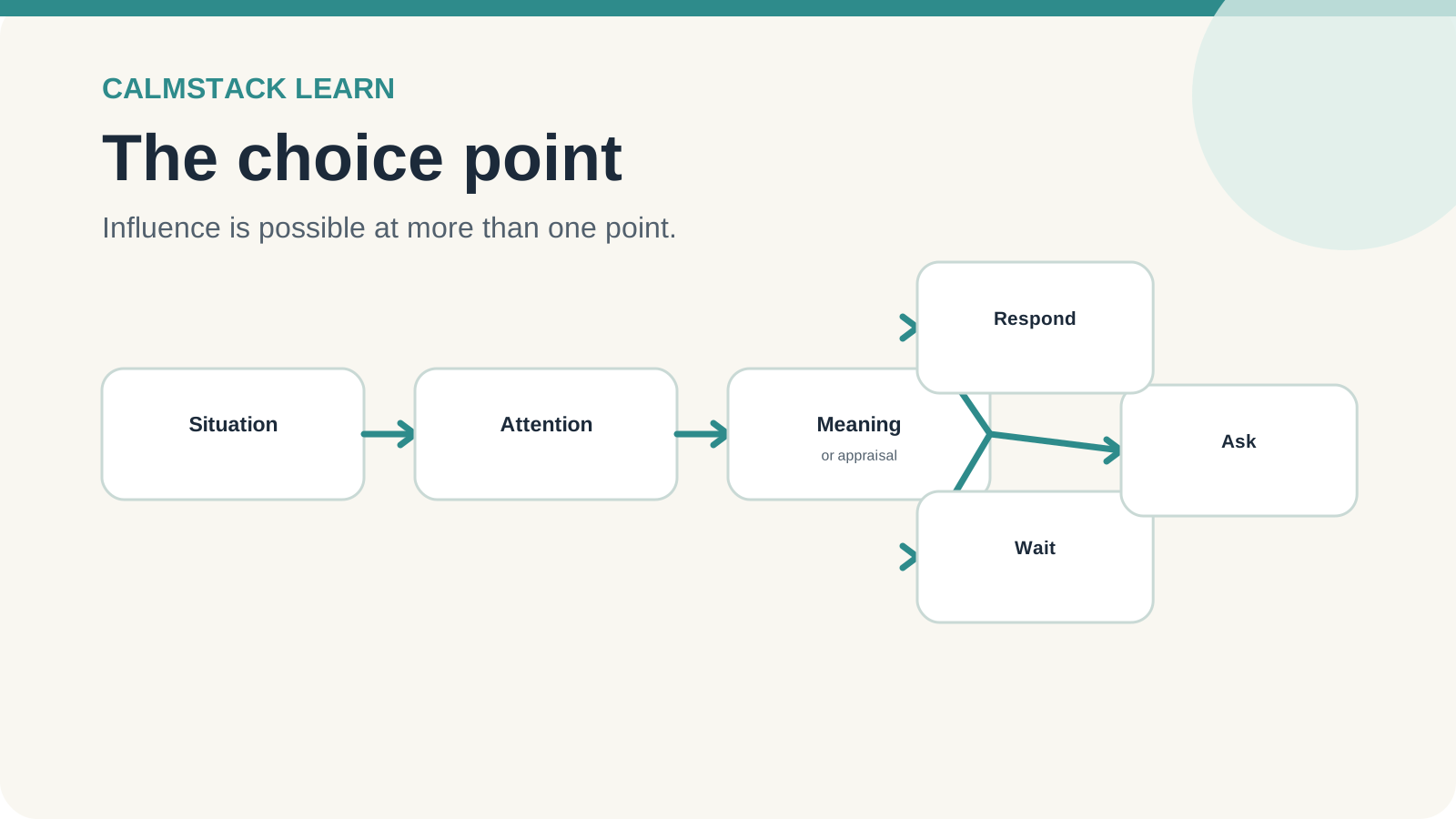
Sometimes the difficult part of an emotion is not only feeling it.
It is working out what it is.
You know something has changed.
Your attention narrows.
Your body feels different.
You want to do something, although what exactly is not yet clear.
Then a word arrives.
Annoyed.
Embarrassed.
Disappointed.
Nervous.
And occasionally the simple act of naming the feeling seems to alter the moment.
Psychologists call this affect labeling: putting an emotional state into words.
It sounds almost too small to matter.
The research suggests it can matter.
But not quite in the magical way it is sometimes advertised.
Naming is not the same as fixing
One of the best-known studies of affect labeling was published in 2007 by Matthew Lieberman and colleagues.
Participants viewed emotionally evocative images while researchers measured brain activity. When participants labelled the emotion they saw, activity in the amygdala and other limbic regions was reduced relative to comparison conditions, while activity increased in a region of right ventrolateral prefrontal cortex.
That finding helped create a popular idea: put feelings into words and the brain calms down.
The actual evidence base is more complicated.
A systematic review published in 2026 examined 43 studies of affect labeling conducted between 2005 and 2024.
Across psychophysiological and behavioural outcomes, labeling often reduced or stabilised emotional reactivity.
But self-reported emotional experience was mixed.
Some studies found reductions.
Some found no change.
Some found increases.
So naming an emotion does not guarantee that you will immediately feel less of it.
A label can make a vague state more specific
Why might a word change anything at all?
One possibility is that language helps organise an emotional experience.
Before the label, there may be a broad sense that something is wrong.
After the label, the experience has a little more structure.
“Bad” can become disappointed.
“Stressed” can become uncertain.
“Angry” can turn out to contain embarrassment as well.
Research on affect labeling suggests that translating an emotional state into language can change emotional processing even when people are not deliberately trying to regulate themselves.
That is why some researchers describe affect labeling as a form of implicit emotion regulation.
The important word is can.
The label is information, not an off switch.
Precision may change the options
Consider the difference between these two statements:
I feel awful.
I feel disappointed because I expected them to include me.
The second statement has not removed the feeling.
But it has changed the problem.
“Awful” gives you very little to work with.
Disappointment connected to an expectation gives you considerably more.
You might decide the expectation was reasonable.
You might realise it was never communicated.
You might decide nothing needs doing.
Or you might decide a conversation would help.
Naming can therefore matter even when it does not reduce emotional intensity.
It can help make the situation more interpretable.
More words are not always better
This is where the evidence becomes particularly useful for CalmStack.
If labeling were universally beneficial, the obvious advice would be to keep naming and analysing until the emotion disappears.
The research does not support that.
A 2026 experimental paper involving two studies and 226 participants found that affect labeling could interfere with subsequent cognitive reappraisal under the conditions tested. Participants who labelled negative emotional material before trying to reinterpret it showed less effective reappraisal than those who reappraised without first labeling.
That does not overturn the wider affect-labeling literature.
It tells us the sequence and context may matter.
The 2026 systematic review reached a similar broader conclusion: effects varied according to the person, the task, the kind of stimulus, the form of labeling and the outcome being measured.
So “name it to tame it” is memorable.
It is also too confident.
The label can be wrong
There is another ordinary limitation that laboratory studies cannot remove.
We can mislabel what we feel.
Irritation may turn out to be anxiety.
Anger may be covering disappointment.
A feeling described as being “stressed” may be mostly uncertainty about one particular decision.
This does not mean there is a hidden correct answer you must discover before you can respond.
Emotion words are tools for making sense of experience.
Sometimes the first tool fits.
Sometimes it does not.
That is why CalmStack treats a Check-in as an observation rather than a diagnosis.
The useful click
Naming an emotion is useful not because the correct word makes the emotion vanish.
It is useful because a word can turn an undifferentiated moment into something you can examine.
A label does not have to end the feeling to change what happens next.
Sometimes it reduces reactivity.
Sometimes it does not.
Sometimes its main value is simply that you now know a little more about what you are responding to.
One small question
When you notice that something has shifted, try moving one step beyond “good”, “bad” or “stressed”.
Ask:
If I had to give this feeling a more precise name, what would I call it?
Do not force an answer.
Do not keep analysing until the word feels perfect.
The point is not to win a vocabulary test.
The point is to see whether a little more precision gives you a little more choice.
References
- Lieberman, M. D., Eisenberger, N. I., Crockett, M. J., Tom, S. M., Pfeifer, J. H., & Way, B. M. (2007). Putting feelings into words: Affect labeling disrupts amygdala activity in response to affective stimuli. Psychological Science, 18(5), 421–428. https://doi.org/10.1111/j.1467-9280.2007.01916.x
- Torre, J. B., & Lieberman, M. D. (2018). Putting feelings into words: Affect labeling as implicit emotion regulation. Emotion Review, 10(2), 116–124. https://doi.org/10.1177/1754073917742706
- Jang, Y., Hwang, S., & Shin, J. (2026). A systematic review of the effectiveness of affect labeling: Is affect labeling effective for emotion regulation? Korean Journal of Health Psychology, 31(4), 1147–1174. https://doi.org/10.17315/kjhp.2026.31.4.009
- Ariely, Y., Mokady, A., Reggev, N., & Anholt, G. E. (2026). Affect labeling and reappraisal as an emotion regulation strategy. Affective Science, 7(2), 282–292. https://doi.org/10.1007/s42761-026-00362-z