Why the same problem can feel different on different days
The same problem can produce very different reactions on different days. This article explores how sleep, accumulated demands, context, attention and interpretation can change the conditions under which an event is experienced.
Published 5 September 2026 · Last evidence review 5 September 2026 · OASYS Editorial
On Tuesday, the supermarket queue is mildly annoying.
On Thursday, the same queue feels like a personal attack by the entire retail sector.
Nothing dramatic has happened.
Same shop. Same fluorescent lighting. Probably the same person deciding that now is the ideal moment to search for a loyalty card.
Yet your reaction is different.
This can be confusing because we often assume that emotions should be proportional to events. If the problem is the same size, surely the reaction should be roughly the same size too.
Psychology gives us a different picture.
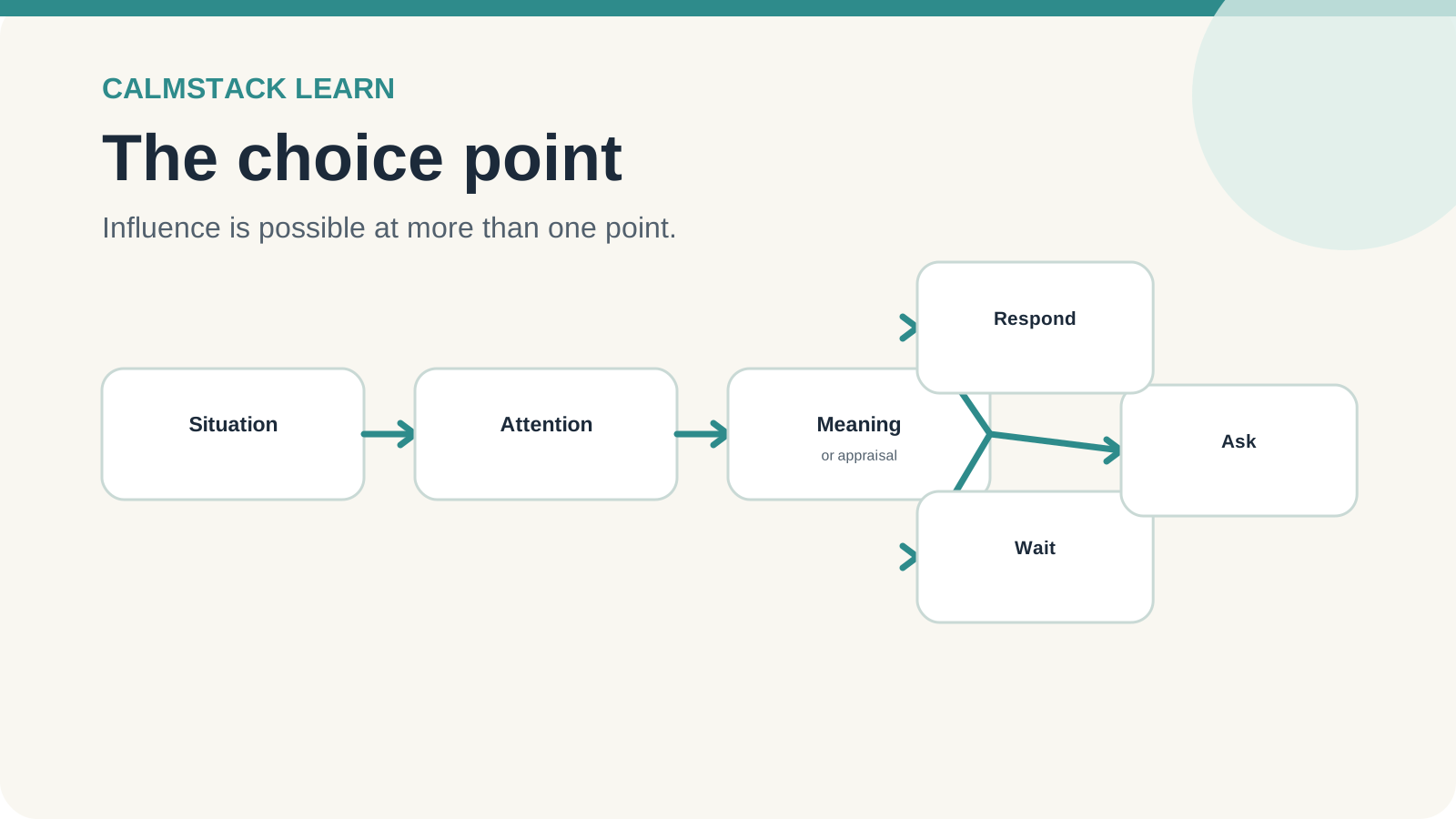
Emotional responses are not produced by events alone. They are shaped by how those events are interpreted, what else is happening, what resources seem available, and the state of the person meeting them.
The situation is only part of the equation
Appraisal theories of emotion start with a deceptively simple idea: what matters is not only what happened, but what the event appears to mean.
In a classic experiment, Matthias Siemer, Iris Mauss and James Gross exposed people to the same standardized situation. Participants nevertheless reported different emotions, and those differences tracked how they appraised the situation.
That does not mean events are irrelevant. It means an event is filtered through questions such as: Does this matter to me? Is it unfair? Is it controllable? Does it threaten something I value? Can I deal with it?
Those answers can change from one day to another.
A delayed train when you have nowhere urgent to be is one thing.
The same delay when you are already late for something important is another.
Your available resources matter too
Emotion regulation research has increasingly moved away from the idea that one strategy is always good and another always bad.
A systematic review and meta-analysis covering 219 studies found that choices about whether and how people regulate emotion are influenced by multiple factors, including the emotion itself, the person, the immediate situation and the broader social context.
That is useful because it explains why a response that seems easy on one day can require more effort on another.
If you are rested, unhurried and already feeling capable, a problem may look manageable.
If you are tired, carrying several unresolved demands and watching the clock, the same problem may arrive in a very different context.
The event has not necessarily changed.
Your relationship to the event has.
Daily stress research sees this variation in real life
Researchers who study daily stress often use repeated measures, asking the same people about events and emotions across many days.
This allows them to look at within-person reactivity: how much a person's affect changes on days when stressors occur compared with their own less stressful days.
These studies repeatedly find that people vary in how strongly they react to everyday stressors, and that stress responses can differ depending on person-level and situational factors.
A 2020 review by Janice Kiecolt-Glaser and colleagues makes the point clearly: brief everyday stressors can produce very different responses across people exposed to apparently similar events, and those responses are influenced by factors such as rumination, social evaluation and relationship context.
There is no single emotional value printed on the event.
This does not mean the feeling is random
If reactions change across days, it can be tempting to conclude that emotions are unreliable.
That would go too far.
Variation contains information.
Perhaps the problem really does matter more today because the consequences are different.
Perhaps you have fewer resources available.
Perhaps something earlier in the day has not fully settled.
Perhaps your first interpretation is harsher because you are expecting another problem to follow.
Or perhaps the event has touched something important that was not present last time.
The point is not that emotion is arbitrary.
The point is that context is part of the data.
The mistake is comparing yourself with an imaginary constant version of you
We often say things like:
I dealt with this fine last week. Why am I bothered now?
Hidden inside that question is an assumption that last week's version of you and today's version are operating under identical conditions.
They are not.
Humans are not laboratory instruments reset to a standard baseline every morning.
Sleep, workload, recent interactions, uncertainty, expectations and competing demands all change.
That does not excuse every reaction.
It simply makes the reaction easier to investigate without immediately turning it into a character judgement.
The useful click
When the same problem feels different on different days, the inconsistency is not necessarily evidence that one of the reactions is false.
The situation may be the same. The conditions in which you are meeting it may not be.
That gives you more to work with than asking why you cannot simply react the same way every time.
One small question
If something familiar feels unusually difficult today, ask:
What is different around this moment, even if the problem itself looks the same?
You might notice time pressure.
Fatigue.
An earlier argument.
A higher stake.
Less control.
Or nothing obvious at all.
You do not need to force an explanation.
You are simply widening the frame.
Sometimes the problem is not bigger.
The day around it is.
References
- Siemer, M., Mauss, I., & Gross, J. J. (2007). Same situation, different emotions: How appraisals shape our emotions. Emotion, 7(3), 592–600. https://doi.org/10.1037/1528-3542.7.3.592
- Matthews, M., Webb, T. L., Shafir, R., Snow, M., & Sheppes, G. (2021). Identifying the determinants of emotion regulation choice: A systematic review with meta-analysis. Cognition and Emotion, 35(6), 1056–1084. https://doi.org/10.1080/02699931.2021.1945538
- Kiecolt-Glaser, J. K., Renna, M. E., Shrout, M. R., & Madison, A. A. (2020). Stress reactivity: What pushes us higher, faster, and longer, and why it matters. Current Directions in Psychological Science, 29(5), 492–498. https://doi.org/10.1177/0963721420949521