Why we replay awkward conversations afterwards
Why can an awkward conversation continue long after everyone has left? This article explores post-event rumination, why replay can feel useful while becoming repetitive, and what distinguishes reflection from another lap around the same material.
Published 5 September 2026 · Last evidence review 5 September 2026 · OASYS Editorial
The conversation ended two hours ago.
Unfortunately, nobody told your brain.
So it has reopened the meeting.
This time there are transcripts.
You are replaying the sentence you used, the pause afterwards, the expression on the other person's face, and the much better reply you have now produced at a time when it is completely useless.
Most people recognise some version of this.
A conversation finishes in the outside world but continues internally.
Psychologists have studied a more specific form of this process under names such as post-event processing and post-event rumination, particularly after situations involving social evaluation.
The interesting question is not why we remember conversations.
It is why some conversations keep demanding another review.
Reflection and rumination are not the same thing
Thinking about an interaction afterwards can be useful.
You can notice that you interrupted someone.
Realise that an explanation was unclear.
Decide that an apology would help.
Or conclude that you handled a difficult moment better than you thought.
That is reflection doing a job.
Rumination is different. It tends to be repetitive, difficult to disengage from, and less successful at producing a useful next step.
A 2025 review in Nature Reviews Psychology describes repetitive negative thinking as a broader cognitive process that includes forms of rumination and worry. These processes share features such as repetition, negative content and difficulty disengaging.
So the important distinction is not simply thinking versus not thinking.
It is whether the thinking is moving somewhere.
Social moments are unusually rich material
Conversations leave gaps.
We know what we said.
We do not have direct access to what the other person thought about it.
That uncertainty gives the mind room to reconstruct.
Research on post-event processing has focused heavily on social anxiety, so we need to be careful not to generalise clinical findings to everyone.
But the mechanism itself is useful for understanding ordinary experience.
A 2024 systematic review and meta-analysis pooled 35 studies involving 10,082 participants and found a moderate association between post-event rumination and social anxiety symptoms.
A later scoping review found that post-event processing is linked with more negative memories of social events and more negative appraisals of performance. The authors also noted that important causal questions remain unresolved.
That last point matters.
Replaying an awkward conversation does not diagnose social anxiety.
It shows that social evaluation is one context in which repetitive thinking has been studied particularly closely.
Memory is not a recording
When we replay a conversation, it can feel as though we are inspecting evidence.
But memory is reconstructive.
The replay can therefore change as our interpretation changes.
If you start with the assumption that you embarrassed yourself, ambiguous details may begin to look like supporting evidence.
The pause becomes uncomfortable.
The other person's neutral face becomes disapproval.
A short reply becomes confirmation.
This is one reason repeated review does not necessarily produce greater certainty.
More thinking can mean more opportunities to elaborate the same interpretation.
The body may still be responding too
Rumination is not only a stream of words.
The perseverative cognition hypothesis proposes that worry and rumination can extend stress-related activation beyond the event itself.
In their influential 2006 review, Jos Brosschot, William Gerin and Julian Thayer argued that repeatedly representing a stressor mentally can prolong or reactivate parts of the stress response after the external event has ended.
That gives us a useful way to think about why a finished conversation can continue to feel current.
The event is over.
The representation of the event is not.
This does not mean every replay is harmful, or that thinking about a difficult interaction will damage your health.
It means the mind can keep an event functionally present after the room has gone quiet.
The search for certainty can keep the loop alive
An awkward interaction often contains an unsolved question.
Did they think I was rude?
Did I sound stupid?
Were they annoyed?
Should I have said something else?
Some of those questions have answers.
Many do not.
And if the purpose of the replay is to reach certainty about another person's private interpretation, the task may be impossible.
That is how a five-minute conversation can acquire a very long afterlife.
The useful click
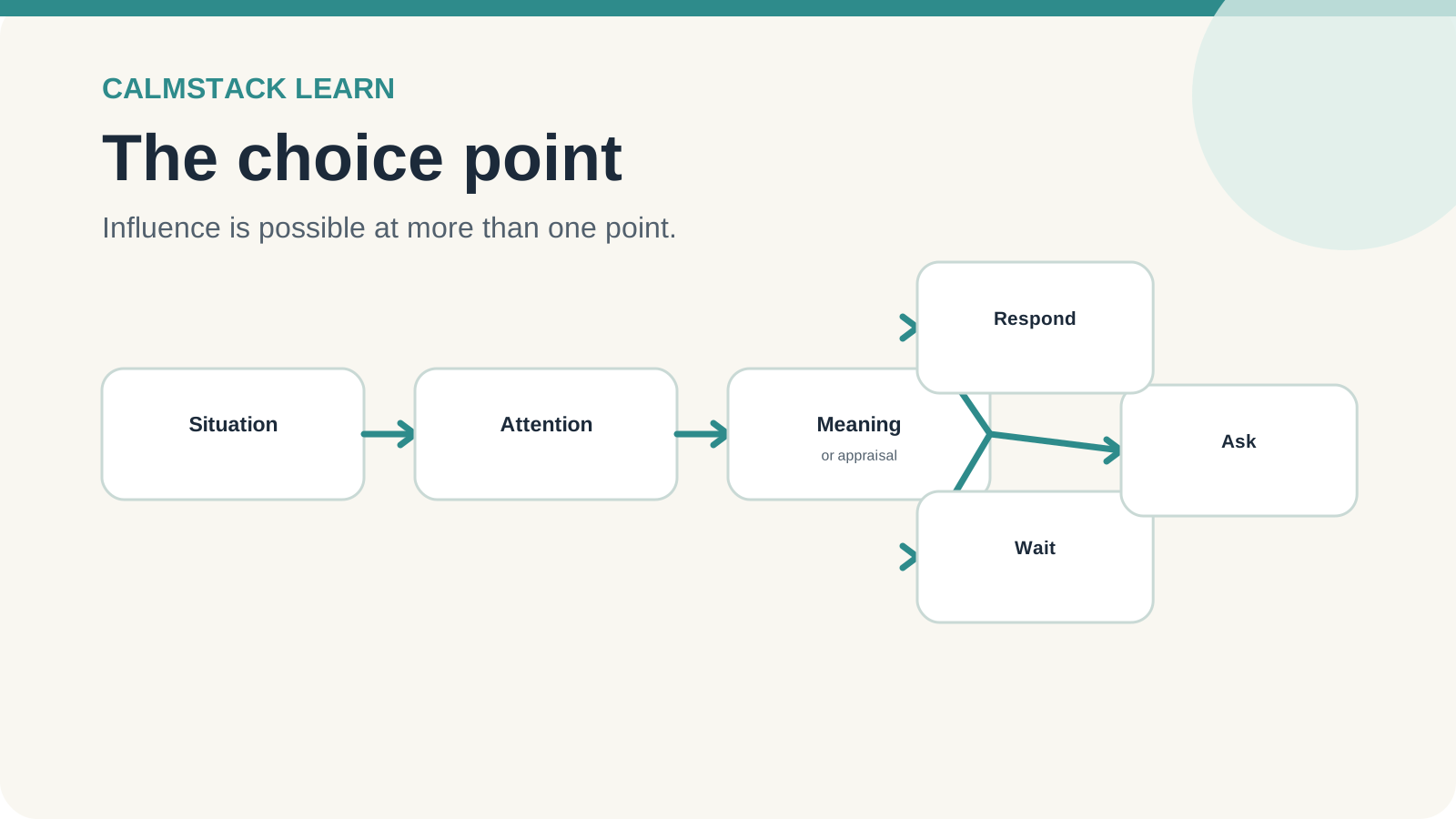
The fact that you are still thinking about a conversation does not necessarily mean there is still something to solve.
A conversation can be unfinished in your mind even when there is no unfinished action in the real world.
That distinction lets you separate useful reflection from repeated review.
One small question
When you notice the same interaction starting again, ask:
Is there anything new to do, or am I reviewing the same evidence again?
If there is something to do, make it concrete.
Send the clarification.
Apologise.
Make a note for tomorrow.
If there is nothing new to do, that is information too.
You do not have to win the argument with the replay.
You only need to notice that it has stopped producing new material.
References
- Edgar, E. V., Richards, A., Castagna, P. J., Bloch, M. H., & Crowley, M. J. (2024). Post-event rumination and social anxiety: A systematic review and meta-analysis. Journal of Psychiatric Research, 173, 87–97. https://doi.org/10.1016/j.jpsychires.2024.03.013
- Moulds, M. L., & McEvoy, P. M. (2025). Repetitive negative thinking as a transdiagnostic cognitive process. Nature Reviews Psychology, 4, 127–141. https://doi.org/10.1038/s44159-024-00399-6
- Brosschot, J. F., Gerin, W., & Thayer, J. F. (2006). The perseverative cognition hypothesis: A review of worry, prolonged stress-related physiological activation, and health. Journal of Psychosomatic Research, 60(2), 113–124. https://doi.org/10.1016/j.jpsychores.2005.06.074
- Flynn, A. J., & Yoon, K. L. (2025). Post-event processing in social anxiety: A scoping review. Journal of Anxiety Disorders, 109, 102947. https://doi.org/10.1016/j.janxdis.2024.102947