Why waiting for a reply can become surprisingly distracting
Waiting for a reply creates an unresolved information gap that attention can keep returning to. This article looks at uncertainty, checking and why an unanswered message can occupy more mental space than its size appears to justify.
Published 5 September 2026 · Last evidence review 5 September 2026 · OASYS Editorial
You send the message.
Then you do something else.
For approximately forty seconds.
After that, apparently, it becomes necessary to check whether the reply has arrived.
It has not.
You return to what you were doing.
Then, without consciously deciding to, you wonder whether the person has seen it.
Perhaps they are busy.
Perhaps they are thinking.
Perhaps the absence of a reply is itself a reply.
This is one of the strange properties of waiting: nothing new has happened, yet the situation keeps generating mental activity.
Uncertainty creates unfinished business
Psychologists have studied waiting most closely when people are awaiting important uncertain news, such as exam results, medical information or the outcome of an application.
A delayed text message is obviously not equivalent to waiting for a medical result.
But the research helps explain a shared feature: uncertainty leaves an outcome unresolved while preserving the expectation that more information is coming.
Kate Sweeny's work on uncertain waiting periods shows that these periods can involve anxiety, rumination and distraction.
In a longitudinal study of people awaiting consequential news, Sweeny and Sara Andrews found substantial individual variation in how people experienced the wait. The difficult part was not simply the eventual outcome. The waiting period had its own emotional pattern.
The mind does not like having a question with an answer that exists but is not yet available.
Waiting changes attention because the information could arrive at any time
There is a practical difference between a problem you cannot solve and a message that might arrive in thirty seconds.
The second one keeps offering the possibility of resolution.
That makes checking feel potentially useful.
Has it arrived now?
How about now?
One reason waiting can become distracting is that the target remains relevant. New information could change what you know, what you need to do or how you feel.
Research on waiting for uncertain news describes distraction as a central difficulty during these periods. A 2012 review by Sweeny specifically identified anxiety and disruptive rumination as characteristic problems while people wait.
Again, we should not turn a delayed WhatsApp message into a laboratory model of major life uncertainty.
The useful principle is smaller: unresolved, anticipated information can keep returning to attention.
Silence is unusually easy to interpret
If somebody replies, you have data.
If they do not reply, you have an empty space.
Humans are extremely capable of filling empty spaces.
They are annoyed.
I said too much.
They are deliberately ignoring me.
They have not seen it.
They are driving.
They are writing a thoughtful response.
Notice what has happened.
The evidence has not changed.
The interpretations have multiplied.
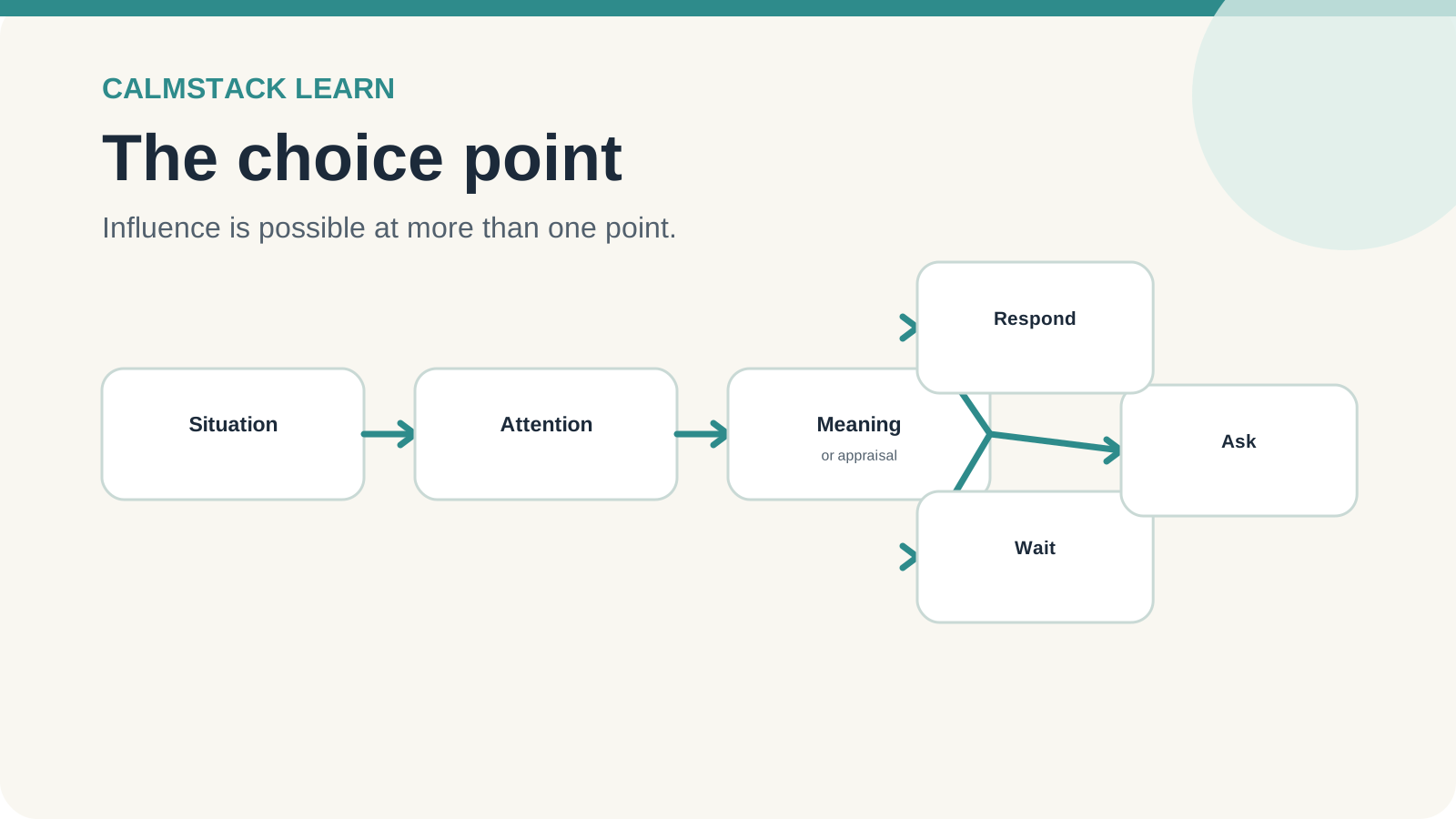
This is where waiting and appraisal meet.
Uncertainty does not tell you which explanation is correct, but it gives multiple explanations room to compete.
The closer the answer feels, the harder waiting can become
In 2015, Sweeny and Angelica Falkenstein compared the emotional experience of awaiting bad news with actually receiving it.
They found that anxiety could be particularly intense during anticipation, especially around the moment when the outcome was expected, while other negative emotions were stronger after bad news arrived.
The finding is useful because it shows that uncertainty has its own emotional burden.
Knowing something unpleasant and not knowing what is about to happen are different psychological states.
Sometimes certainty is easier to organise around, even when the certainty is disappointing.
A delayed reply does not explain itself
There is a trap in treating your emotional response to waiting as evidence about the other person.
Feeling increasingly uneasy does not make a negative interpretation increasingly accurate.
The extra anxiety may be coming from the wait itself.
This distinction becomes important with messages because response times are influenced by dozens of ordinary things that are invisible to the sender.
Meetings.
Work.
Driving.
Children.
A flat battery.
Seeing the message and intending to reply later.
Opening it while distracted and forgetting.
None of those explanations is guaranteed either.
The point is that silence contains less information than our interpretations often pretend.
The useful click
Waiting for a reply can feel active even though nothing is happening.
Uncertainty keeps the question open, and an open question can keep asking for attention.
That explains the distraction without telling you what the eventual answer will be.
One small question
When you catch yourself checking or interpreting the silence, ask:
Has new information arrived, or has my interpretation changed without new information?
If new information has arrived, respond to it.
If it has not, you can recognise that the mind has generated another possibility rather than another fact.
You may still want the reply.
You may still feel uncomfortable waiting.
But you have separated the absence of information from the story being built around it.
References
- Sweeny, K., & Andrews, S. E. (2014). Mapping individual differences in the experience of a waiting period. Journal of Personality and Social Psychology, 106(6), 1015–1030. https://doi.org/10.1037/a0036031
- Sweeny, K., & Falkenstein, A. (2015). Is waiting the hardest part? Comparing the emotional experiences of awaiting and receiving bad news. Personality and Social Psychology Bulletin, 41(11), 1551–1559. https://doi.org/10.1177/0146167215601407
- Sweeny, K. (2012). Waiting well: Tips for navigating painful uncertainty. Social and Personality Psychology Compass, 6(3), 258–269. https://doi.org/10.1111/j.1751-9004.2011.00423.x