After a difficult phone call: what next?
A difficult conversation can keep affecting us after the call itself has ended. Research on rumination, recovery and repetitive thought helps explain why the event ending and our response to it ending are not always the same moment.
Published 3 September 2026 · Last evidence review 3 September 2026 · OASYS Editorial
The call ended ten minutes ago.
The phone is back on the desk.
The other person is gone.
But the conversation is still happening in your head.
You remember one sentence.
Then another.
You think of something you should have said.
Then something they should not have said.
You replay your answer.
Rewrite theirs.
Run the conversation again with a much better ending.
Technically, the phone call is over.
Psychologically, things may still be moving.
That raises a useful question.
When an event ends, why doesn't our response always end with it?
The end of the event is not necessarily the end of the response
In Article 3, we looked at emotional reactions as unfolding processes.
The same idea applies after an event.
A conversation can stop while attention, interpretation and emotional responding continue.
You might still be thinking about what happened.
Trying to work out what somebody meant.
Planning what to do next.
Replaying part of the exchange.
Or noticing that your body still feels different from how it did before the phone rang.
None of this is unusual.
The important distinction is that the external event and your ongoing response to it are not the same thing.
A phone call has a clear end point.
Human attention does not always respect it.
Thinking about what happened is not automatically a problem
This matters because we often use the word rumination for almost any thinking that continues after an upsetting event.
That can make useful reflection sound unhealthy.
Thinking about a difficult conversation may serve a purpose.
You might realise that you misunderstood something.
Remember an action you need to take.
Work out what you want to say next time.
Notice that a boundary needs discussing.
Or simply make better sense of what happened.
Psychologist Edward Watkins reviewed a large body of research on repetitive thought and found that thinking repeatedly about an event can have both constructive and unconstructive consequences.
The outcome appears to depend on more than whether somebody thought about the event more than once.
Content matters.
Context matters.
And the way somebody is thinking about it matters.
That gives us an important starting point:
Reflection and repetitive replay are not automatically the same thing.
When thinking stops producing anything new
There is a familiar point where reflection can begin to change character.
You ask:
“Why did they say that?”
Then again:
“Why did they say that?”
Then:
“Why do people always do this?”
Twenty minutes later, the question is still open.
No new information has arrived.
Nothing has been decided.
But the mental conversation is still running.
Research on rumination has linked this kind of repetitive negative thinking with prolonged negative mood, poorer problem solving in some contexts and sustained stress responses.
A 2020 review by Edward Watkins and Henrietta Roberts describes rumination as a process that can magnify and prolong negative mood and interfere with effective action.
That does not mean every repeated thought is rumination.
It means repetition can become less useful when it stops helping us understand, decide or act.
There is a difference between:
“What happened, and what do I need to do?”
and
“Why did this happen, why did they do that, why am I still thinking about this?”
The second set of questions can feel like problem solving while producing very little that solves the problem.
The mind can keep an event active after it has finished
Researchers Jos Brosschot, William Gerin and Julian Thayer used the term perseverative cognition to describe processes such as worry and rumination that can extend the effects of stressful events beyond the event itself.
The basic idea is straightforward.
A stressor does not have to be physically present for us to keep representing it mentally.
Thinking ahead to a difficult meeting can affect us before the meeting begins.
Replaying an argument can affect us after the argument ends.
Their review found evidence linking worry and rumination with prolonged affective and physiological activation.
That is a much more precise claim than saying:
“Stress gets trapped in the body.”
Nothing needs to be trapped.
The event can continue to be represented, interpreted and revisited after the external situation has ended.
Recovery can take time
There is also experimental evidence that what we think about after a stressful event can influence recovery.
In research by Laura Glynn and colleagues, participants completed stressful tasks while researchers monitored cardiovascular responses.
The researchers also examined what happened afterwards.
Rumination following the stressor was associated with slower blood pressure recovery in their experiments.
That does not mean thinking about a phone call will keep everyone's blood pressure elevated.
The study used controlled stress tasks, not ordinary phone conversations.
But it does demonstrate an important principle:
recovery from a stressful event can be influenced by what happens after the event itself.
The end of the demand does not guarantee an instant return to baseline.
Again, no mysterious emotional residue is required.
The response itself can take time to settle.
But distraction is not automatically the answer either
At this point, it would be easy to turn the article into:
Stop thinking about it.
That would be just as crude.
Sometimes something genuinely needs attention.
Perhaps the call changed a decision.
Perhaps you need to send information.
Perhaps someone said something you need to address.
Perhaps you made a mistake.
Perhaps they did.
Immediately trying to force the whole event out of your mind might prevent useful reflection rather than help recovery.
We already looked at thought suppression in Article 2.
Trying not to think something is its own psychological process, and it does not provide a simple off switch for unwanted thoughts.
The aim is not:
“How do I stop thinking about the call?”
A more useful question is:
“Is this thinking still doing anything for me?”
Psychological detachment can help, but it is not a command
Work psychology provides another useful piece of the picture.
Researchers use the term psychological detachment to describe mentally disengaging from work during periods when somebody is no longer working.
A meta analysis by Andrew Bennett and colleagues combined 299 effect sizes from 54 independent samples involving 26,592 people.
Psychological detachment after work was associated with lower fatigue, while other forms of recovery experience such as relaxation, mastery and control showed different relationships with wellbeing outcomes.
A much larger later meta analysis also found psychological detachment was more strongly related to reductions in negative outcomes such as negative affect and exhaustion than to improved job performance.
That distinction matters.
Detachment does not need to make you better at your job to be relevant to recovery.
But most of this evidence concerns recovery from work, often across longer periods than the few minutes after one phone call.
We should not turn it into a universal instruction:
“You must detach immediately.”
Sometimes there is still something to do.
Sometimes there is not.
Reflection and replay can look very similar
This is probably the hardest part to notice in real life.
Useful reflection and unproductive replay can contain the same material.
Both might involve remembering what somebody said.
Both might involve thinking about your own response.
Both might involve imagining what should happen next.
The difference may become clearer when you ask what the thinking is producing.
Is it helping you:
understand something?
make a decision?
plan an action?
see the situation differently?
Or is it simply returning you to the same question?
Watkins's work on repetitive thought is helpful because it resists the idea that all repeated thinking is either good or bad.
The consequences depend partly on how the thinking is organised.
More concrete processing can sometimes help people focus on what actually happened and what can be done next.
More abstract repetitive thinking can become stuck around broad questions about causes, meanings and personal shortcomings.
So:
“What did they actually say?”
may take you somewhere different from:
“Why does this always happen to me?”
One is not guaranteed to be useful.
But they are not psychologically identical questions.
The conversation can be over while the task remains unfinished
There is another reason the mind sometimes keeps returning to an event.
Something may still genuinely be unresolved.
You need to reply.
Make a note.
Speak to someone.
Correct something.
Decide whether to continue the conversation later.
In that case, thinking about the event is not merely emotional carry over.
There is an unfinished task.
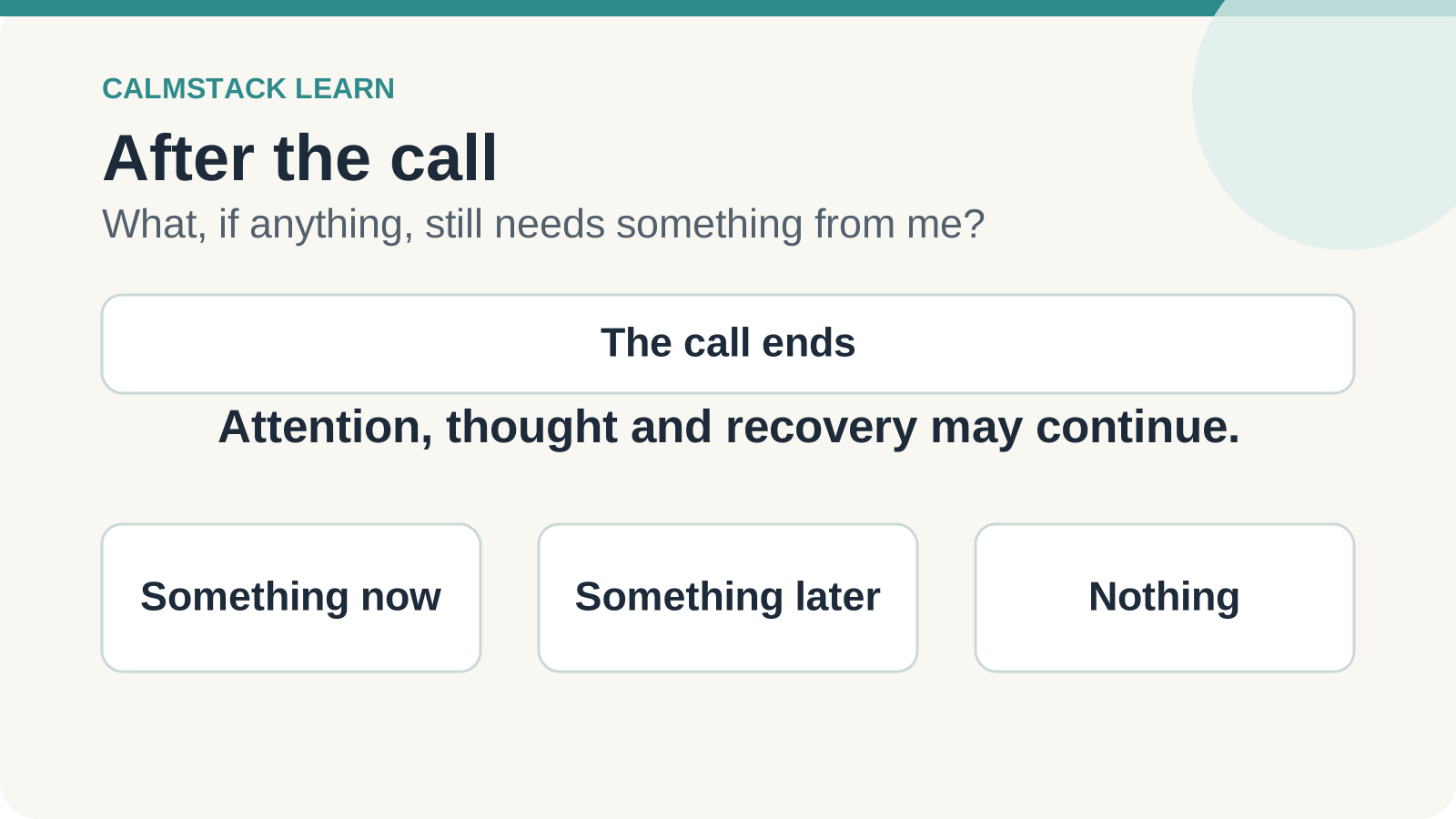
That suggests a useful distinction after a difficult call.
There may be:
something that needs attention now;
something that needs attention later;
or
nothing that needs action at all.
Those three possibilities can feel surprisingly similar while the conversation is still fresh.
Everything feels urgent because everything is still present in your attention.
It may not all be urgent.
What recovery does not require
There is a lot of language online about what you supposedly need to do after a stressful experience.
Complete the stress cycle.
Release the stored emotion.
Discharge the stress.
Reset the nervous system.
These phrases can sound convincing because they take a real phenomenon, ongoing emotional and physiological responding, and attach a much more specific mechanism to it.
The evidence does support the idea that recovery can continue after a stressor ends.
It supports the idea that repetitive negative thinking can prolong some aspects of that response.
It does not require us to imagine stress as a substance waiting to be physically released.
Sometimes you need to act.
Sometimes you need to think.
Sometimes you need some distance.
And sometimes you simply need time.
The useful question comes after the call
The satisfying bit is quite small.
A difficult event can finish externally before it finishes psychologically.
That does not mean something has gone wrong.
It means there may still be attention, appraisal, emotion, physiological recovery or an unresolved task carrying forward.
The useful question is not necessarily:
“How do I make this feeling stop?”
It is:
“What, if anything, still needs something from me?”
Maybe there is something.
Maybe not.
One small thing to try
After a difficult conversation, ask:
“What, if anything, still needs something from me?”
Then sort the answer into one of three places.
Something now
There is a clear action that genuinely needs doing.
Something later
It matters, but it does not need solving in the next five minutes.
Nothing
The event is finished. Your mind may still revisit it, but there is no action required.
You do not need to force yourself to stop thinking.
You are simply separating the conversation from what actually needs to happen next.
Sometimes that distinction is enough to make the end of the call feel a little more like the end of the call.
References
- Bennett, A. A., Bakker, A. B., & Field, J. G. (2018). Recovery from work related effort: A meta-analysis. Journal of Organizational Behavior, 39(3), 262 to 275. https://doi.org/10.1002/job.2217
- Brosschot, J. F., Gerin, W., & Thayer, J. F. (2006). The perseverative cognition hypothesis: A review of worry, prolonged stress related physiological activation, and health. Journal of Psychosomatic Research, 60(2), 113 to 124. https://doi.org/10.1016/j.jpsychores.2005.06.074
- Glynn, L. M., Christenfeld, N., & Gerin, W. (2002). The role of rumination in recovery from reactivity: Cardiovascular consequences of emotional states. Psychosomatic Medicine, 64(5), 714 to 726. https://doi.org/10.1097/01.PSY.0000031574.42041.23
- Headrick, L., Newman, D. A., Park, Y. A., & Liang, Y. (2023). Recovery experiences for work and health outcomes: A meta-analysis and recovery engagement exhaustion model. Journal of Business and Psychology, 38, 821 to 864. https://doi.org/10.1007/s10869-022-09821-3
- Watkins, E. R. (2008). Constructive and unconstructive repetitive thought. Psychological Bulletin, 134(2), 163 to 206. https://doi.org/10.1037/0033-2909.134.2.163
- Watkins, E. R., & Roberts, H. (2020). Reflecting on rumination: Consequences, causes, mechanisms and treatment of rumination. Behaviour Research and Therapy, 127, 103573. https://doi.org/10.1016/j.brat.2020.103573